
Cooling modules in high-temperature laboratory furnaces function as critical thermal barriers, utilizing mechanisms like water-jacketed flanges or gas cooling systems to rapidly dissipate intense heat from exhaust gases. By acting similarly to industrial quench chambers, these modules actively reduce the temperature of the gas stream before it exits the heating zone. This process is essential for preserving the structural integrity of the furnace and safeguarding sensitive downstream sensors from thermal damage.
Cooling modules serve a dual purpose: they are essential protective devices that prevent thermal damage to furnace infrastructure and sensors, while simultaneously acting as active research tools for analyzing heat exchange efficiency and waste heat recovery.
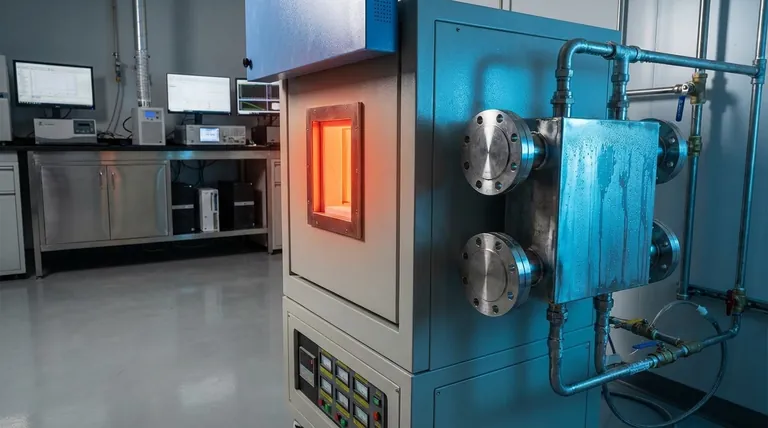
Mechanisms of Thermal Management
Rapid Temperature Reduction
The primary function of a cooling module is to simulate an industrial quench chamber on a laboratory scale. As high-temperature exhaust gases leave the furnace's reaction zone, the module forces a rapid drop in temperature. This immediate thermal reduction is critical for preventing heat from propagating to areas of the system designed for lower-temperature operation.
Active Cooling Technologies
To achieve this rapid cooling, systems like Tube furnaces and CVD (Chemical Vapor Deposition) setups employ active thermal transfer methods. Water-jacketed flanges circulate coolant around the piping to absorb heat through conduction. Alternatively, gas cooling systems introduce lower-temperature gas streams to dilute and cool the exhaust through convection.
Protecting Critical Infrastructure
Preserving Structural Integrity
High temperatures can compromise the physical structure of furnace components over time. Cooling modules mitigate this risk by ensuring that the connections, flanges, and external piping are not exposed to the full thermal load of the reaction zone. This thermal isolation helps maintain the mechanical stability of the system.
Safeguarding Downstream Components
Modern laboratory furnaces rely on precise instrumentation to monitor reactions. Downstream sensors, vacuum pumps, and sealing mechanisms often have lower thermal tolerances than the furnace core. The cooling module acts as a protective gatekeeper, ensuring exhaust gases are cooled to safe levels before interacting with these sensitive components.
Expanding Research Capabilities
Analyzing Heat Exchange Efficiency
Beyond protection, these modules turn the furnace into a tool for thermal dynamics research. By controlling and monitoring the cooling process, researchers can study heat exchange efficiency. This allows for precise data collection on how effectively energy is transferred from the gas stream to the cooling medium.
Waste Heat Recovery Studies
The energy removed from the exhaust gas represents potential resources. Cooling modules enable the study of waste heat recovery. Researchers can analyze the high-temperature gas streams to develop methods for capturing and repurposing thermal energy, contributing to more sustainable industrial designs.
Understanding the Constraints
System Complexity and Maintenance
Implementing active cooling, particularly water-jacketed systems, introduces additional complexity to the furnace setup. These systems require reliable plumbing and leak prevention measures. Failure in the cooling loop can lead to immediate overheating of protected components.
Managing Thermal Gradients
While rapid cooling is beneficial, it creates sharp thermal gradients between the hot zone and the cooled flange. If not designed correctly, this sharp contrast can induce thermal stress at the interface points. Users must ensure their specific module is rated for the thermal shock associated with their operating temperatures.
Making the Right Choice for Your Goal
To select the appropriate cooling strategy for your high-temperature application, consider your primary objective:
- If your primary focus is Equipment Longevity: Prioritize cooling modules with high heat capacity, such as water-jacketed flanges, to maximize the protection of seals and downstream sensors.
- If your primary focus is Energy Research: Select a system that offers precise control over the cooling medium, allowing you to accurately measure heat exchange efficiency and recovery potential.
By effectively integrating cooling modules, you transform your furnace from a simple heating element into a sophisticated, durable, and analytically capable thermal system.
Summary Table:
| Feature | Mechanism | Primary Benefit |
|---|---|---|
| Thermal Protection | Industrial Quench Simulation | Safeguards downstream sensors and structural integrity |
| Active Cooling | Water-jacketed Flanges | Rapid heat dissipation via conduction and coolant circulation |
| Gas Cooling | Convective Dilution | Lowers exhaust temperature using secondary gas streams |
| Research Utility | Data Monitoring | Analyzes heat exchange efficiency and waste heat recovery |
| System Safety | Thermal Isolation | Maintains mechanical stability of flanges and connections |
Elevate Your Thermal Management with KINTEK
Don’t let excessive heat compromise your research or damage your equipment. KINTEK provides expert-engineered high-temperature solutions—including Muffle, Tube, Rotary, Vacuum, and CVD systems—all designed with advanced cooling modules to ensure system longevity and precision.
Backed by our specialized R&D and manufacturing team, we offer fully customizable furnaces tailored to your unique laboratory needs. Whether you are focused on material synthesis or waste heat recovery studies, our systems provide the thermal stability you require.
Ready to optimize your lab's performance? Contact us today to find your custom solution!
Visual Guide

References
- Shiwei Yu, Mingjie Feng. Workflow Design and Operational Analysis of a Coal‐Based Multi‐Energy Combined Supply System for Electricity, Heating, Cooling, and Gas. DOI: 10.1002/ese3.70137
This article is also based on technical information from Kintek Furnace Knowledge Base .
Related Products
- 1700℃ High Temperature Laboratory Tube Furnace with Alumina Tube
- 1400℃ High Temperature Laboratory Tube Furnace with Alumina Tube
- 1700℃ High Temperature Muffle Oven Furnace for Laboratory
- 1800℃ High Temperature Muffle Oven Furnace for Laboratory
- 1200℃ Muffle Oven Furnace for Laboratory
People Also Ask
- How does zone-melting in tube furnaces synthesize bismuth micro-wires? Master Single-Crystal Thermoelectric Growth
- How are high-temperature laboratory tube furnaces applied in long-term vacuum homogenization heat treatments for intermetallic samples?
- How do high-temperature laboratory tube furnaces ensure environmental stability? Precision Thermal Reduction Tips
- How are high-temp tube furnaces used to measure diffusion coefficients per Fick's law? Master Precision Annealing
- How are high-temperature tube furnaces applied in testing ceramic-supported alloy membranes? Insights



















