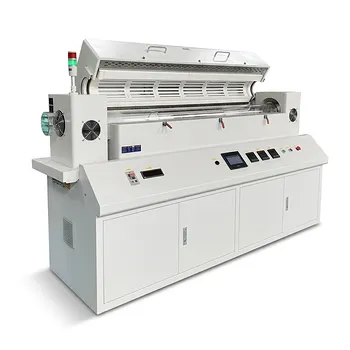
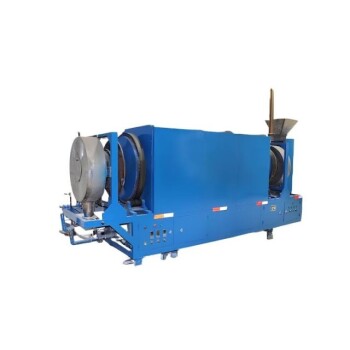
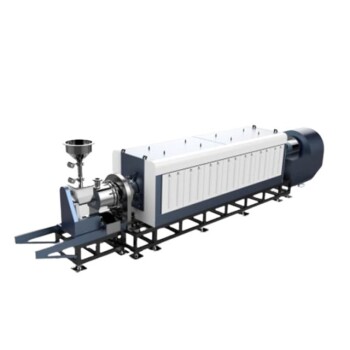
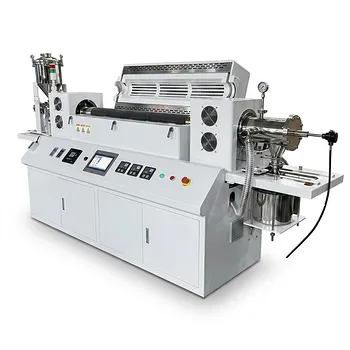
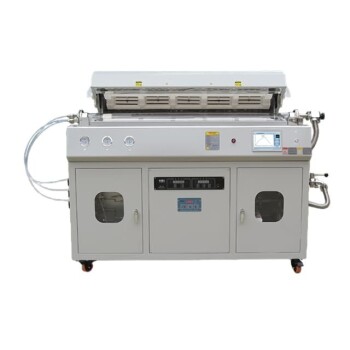
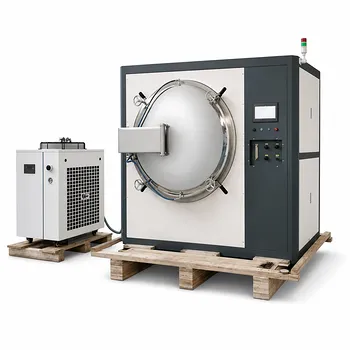
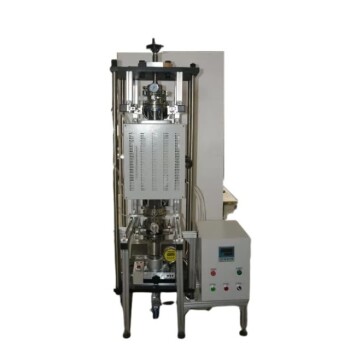
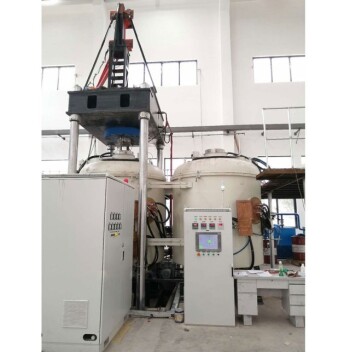
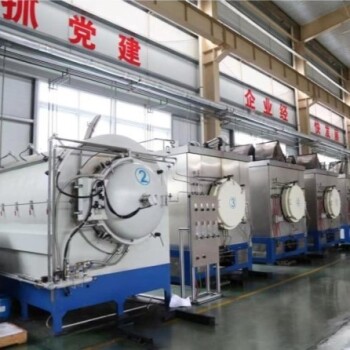
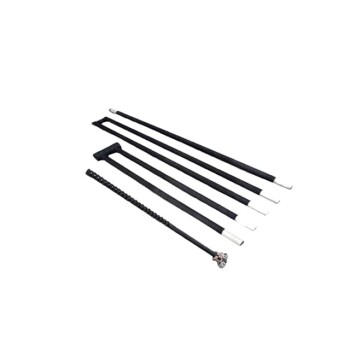
A critical bridge in automated powder processing, rotary heating furnaces and induction heating units are integrated directly between the thermal debinding/degreasing stage and the high-speed forging press. Robotic manipulators transfer compacted powder preforms from the lubricant removal furnace into the heating module, where precise, rapid thermal conditioning brings every preform uniformly to its forging temperature—typically 850 °C to 1,150 °C—right before the press closes. This seamless, automated handoff minimizes oxidation, prevents thermal losses, and locks in the exact microstructure needed for high-density, dimensionally accurate parts.
The integration of rotary furnaces or induction heaters is not just about applying heat—it’s a synchronized, atmosphere-controlled, robotically executed step that turns a brittle powder compact into a forgeable blank with zero waiting and zero thermal variation. This is what makes high-volume powder forging both metallurgically sound and economically viable.
The Role of Heat in an Automated Powder Line
In a fully automated powder forging line, every second counts. The thermal conditioning unit isn’t an isolated machine; it’s a timed node in a continuous choreography.
Why Placement Matters
The heating module sits right after the degreasing or pre-sintering furnace. At this point, the compact has had its lubricants evaporated but remains highly sensitive to temperature drops. Delaying heating or breaking the protective atmosphere here would cause surface oxidation and thermal shock.
Continuous Flow, Not Batch Processing
Rotary furnaces are often chosen because their rotating hearth or barrel design processes parts in a non-stop stream. For induction units, the coil layout and part handling are designed for one-piece-after-another flow, perfectly matching the cadence of the downstream forging press.
How Rotary Heating Furnaces Are Integrated
Rotary furnaces bring continuous, uniform radiant heat to the heart of the line. Their integration centers on thermal homogeneity and robotic coupling.
Uniform Preheat Without Hot Spots
The rotating mechanism—whether a hearth or an inclined barrel—ensures every preform sees the same heating profile. Supplementary evidence highlights that the combination of rotation and external electric heating delivers a consistent radial temperature distribution, essential when processing parts that vary slightly in mass or shape but must all arrive at the press within a narrow 850–1,150°C window.
Robotic Transfer into Heated Dies
Robotic manipulators extract preforms directly from the rotary furnace exit and place them into forging dies, which themselves are maintained at 200–300°C. This avoids any cooling between furnace and press, keeping the thermal trajectory intact. The robots are programmed with sub-second repeatability, so the part’s temperature at die contact is a known constant—removing a major variable from the forging process.
Protective Atmosphere Continuity
Because the rotary furnace can be sealed and purged with inert or reducing gases, the entire heating segment prevents oxidation. The supplementary references confirm that rotary furnaces are standard for calcining and roasting granular materials under controlled atmospheres; the same principle applies here for powder metal compacts.
How Induction Heating Units Are Integrated
Induction units offer a different integration model—built for speed, localized precision, and instant on-demand energy.
Pyrometric Closed-Loop Control
The primary reference emphasizes pyrometric temperature monitoring, meaning each induction coil station is instrumented with non-contact sensors. If a preform’s surface temperature deviates, the power to the coil is adjusted in milliseconds. This guarantees every single part hits its exact forging temperature regardless of minor variations in incoming density or mass.
Compact Footprint, High Throughput
Induction heaters are placed directly in the robot’s path after degreasing. Often, the preform pauses under the coil for only a few seconds before the manipulator swivels it into the press. This drastically shortens the “hot” queue, minimizing grain growth and preserving fine microstructures.
Minimized Oxidation Risk
Since heating is flash-fast and can occur under a localized inert gas shroud, oxidation layers are nearly non-existent. The primary reference points out that operation under protective atmospheres is a central advantage, and induction’s speed makes atmosphere management easier compared to extended soaking cycles.
Understanding the Trade-offs
There is no universally superior heating method. Both rotary and induction systems introduce their own constraints.
Rotary Furnace Limitations
A rotary furnace requires a larger floor space and higher thermal mass, which translates to longer start-up and stabilization times. If the production mix changes frequently, cooling and reheating the furnace to a new setpoint can cause downtime. Uniformity, while excellent for bulk loads, may still show slight edge-to-core differences in thick-section parts if the rotation speed isn’t fine-tuned.
Induction Unit Limitations
Induction heating is inherently line-of-sight and can struggle with complex geometries that contain deep recesses or variable cross-sections. Parts with sharp corners may concentrate magnetic flux and overheat. The process demands precise coil design and tight control; initial capital and tooling for each part geometry can be high.
The Atmosphere Challenge
Both technologies promise reduced oxidation, but the integrity of the protective atmosphere must be maintained across all transfer points. A momentary exposure during robotic motion—common if the line hasn’t been fully enclosed—can undo the heating work and lead to subsurface oxides that degrade fatigue life.
Making the Right Choice for Your Process Goals
After reviewing both integration strategies, your decision should map directly to your operational priorities.
- If your primary focus is maximum throughput with uniform bulk heating: Lean toward a rotary furnace with a continuous rotating hearth. Its ability to handle a steady stream of preforms under a single, stable atmosphere simplifies line control and ensures consistent forging temperatures for large production runs.
- If your primary focus is ultra-fast cycle times and individual part precision: Choose a closed-loop induction heating cell. The millisecond-level temperature feedback and rapid energy delivery will keep your microstructures fine and your dimensional scatter minimal.
- If your primary focus is flexible, mixed-part production: Induction offers the quicker recipe change, but you must invest in modular coil designs and programmable handling. Rotary furnaces are better when the part family stays constant for long campaigns.
A well-integrated heating module—whether rotary or induction—transforms a fragile powder compact into a perfectly conditioned forging blank, right on the beat of the press. That synchronization is what separates a pilot line from a profitable, fully automated factory.
Summary Table:
| Integration Parameter | Rotary Heating Furnace | Induction Heating Unit |
|---|---|---|
| Heating Mechanism | Continuous radiant heating via rotating hearth/barrel | Rapid, localized electromagnetic heating |
| Temperature Control | Uniform thermal distribution (850°C–1,150°C) | Millisecond pyrometric closed-loop adjustment |
| Atmosphere Protection | Continuous sealed gas purging (inert/reducing) | Flash-heating under localized inert gas shroud |
| Best Suited For | High-volume, constant part families | Rapid cycle times, individual part precision, & fast recipe changes |
| Key Constraint | Larger footprint & longer startup times | Geometry-dependent coil design & higher initial tooling |
Optimize Your Advanced Powder & Heat Treatment Lines with KINTEK
Achieving precise thermal uniformity and flawless line integration requires robust, high-performance heating technology. At KINTEK, we specialize in comprehensive laboratory equipment and advanced high-temperature furnaces—including customizable rotary, atmosphere, vacuum, tube, muffle, CVD, and induction melting systems engineered to meet your exact metallurgical needs.
Whether you are scaling up a powder metal process or refining specialized lab research, our engineering team is here to help you eliminate thermal variability and boost processing efficiency.
👉 Contact KINTEK Today to Discuss Your Custom Furnace Solution
Related Products
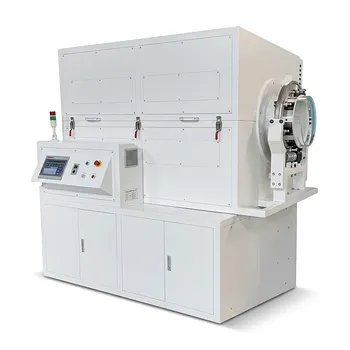
- Split Multi Heating Zone Rotary Tube Furnace Rotating Tube Furnace
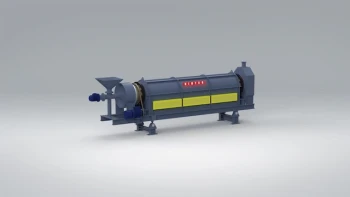
- Electric Rotary Kiln Continuous Working Small Rotary Furnace Kiln for Pyrolysis Plant Heating
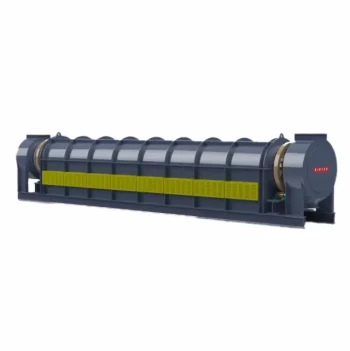
- Electric Rotary Kiln Small Rotary Furnace Biomass Pyrolysis Plant Rotating Furnace
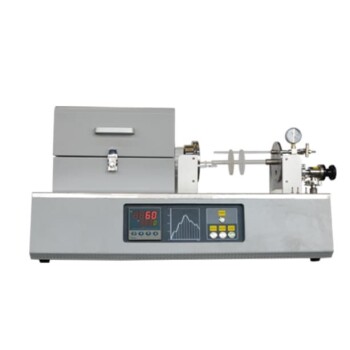
- Vacuum Sealed Continuous Working Rotary Tube Furnace Rotating Tube Furnace
- Laboratory Vacuum Tilt Rotary Tube Furnace Rotating Tube Furnace
People Also Ask
- What are the main applications of multi zone tube furnaces in university laboratories? Unlock Precision in Material Science and Energy Research
- How are multi zone tube furnaces used in ceramics, metallurgy and glass research? Unlock Precise Thermal Control for Advanced Materials
- Why are multi zone tube furnaces particularly useful for nanomaterial research? Unlock Precise Thermal Control for Advanced Synthesis
- What environmental protection applications utilize multi zone tube furnaces? Unlock Precision in Waste Treatment and Green Tech
- What role do multi zone tube furnaces play in new energy research? Unlock Precise Thermal Control for Innovation