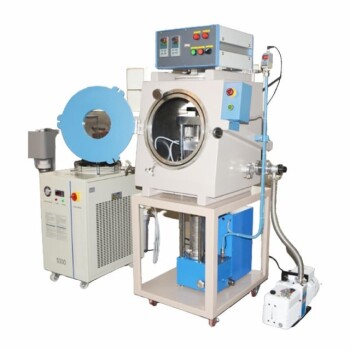
**Cold-wall pressure vessels are the proven architecture behind today's most extreme hot isostatic pressing (HIP) systems. They separate the intense heat of the process from the structural integrity of the vessel by creating a thermally insulated furnace inside a continuously water-cooled shell. This configuration, when filled with inert gas, routinely reaches ~2000°C and 200 MPa—conditions that unlock near-theoretical density in the most demanding materials.
The cold-wall design is what makes these staggering temperatures and pressures possible. It's a masterclass in thermal management: a furnace hot enough to melt steel stays safely contained because a flowing jacket of water keeps the pressure boundary cold and strong. The trade-off is complexity—you're not just building a furnace, you're engineering a carefully choreographed thermal gradient.
The Anatomy of a Cold-Wall HIP Vessel
Understanding how these vessels extract every possible advantage from their design is key to seeing why they dominate advanced ceramics and powder metallurgy.
The Core Design Principle
The cold-wall philosophy is simple but demanding: the vessel wall must never see the furnace temperature. Inside, resistance heating elements (graphite or molybdenum) generate scorching heat, but they're completely enveloped in high-performance thermal insulation. On the outside, water continuously flows through a jacket, pulling heat away from the steel wall. This dual barrier keeps the pressure-containing shell at a low, predictable temperature where steel retains its full strength, even as the payload experiences a thermal extreme.
Sealing the Extreme Environment
Electrical power, control thermocouples, and the pressurizing gas all need a path into this sealed inferno. The solution is dedicated end closures that penetrate the vessel. These are carefully engineered high-pressure feedthroughs. They maintain the pressure boundary while channeling massive electrical current to the heating elements and delicate sensor signals back to the control system—all without creating a weak point or a heat leak that could compromise the vessel’s mechanical integrity.
Pushing Boundaries: Temperature and Pressure Limits
The numbers define the playing field. These systems are designed to operate at the frontier of what heat and pressure can do together.
Peak Performance with Inert Gases
When using inert pressurizing media like argon (Ar) or helium (He), a well-designed cold-wall HIP can sustain temperatures up to ~2000°C while simultaneously holding gas pressures of ~200 MPa (~30,000 psi). That's an environment where the omnidirectional pressure alone is enough to collapse internal pores in ceramic or metal parts, and the temperature makes them soft enough to yield.
The Reactive Atmosphere Ceiling
Performance drops sharply if you need a chemically active atmosphere. Systems modified to use oxygen or nitrogen face fundamental material compatibility problems—the furnace internals, from heating elements to insulation, would rapidly degrade. Consequently, maximum temperature and pressure thresholds are significantly lower in these configurations. There's no universal limit; it depends entirely on the specific material pairings used, but it's always a step back from the inert-gas maximum. This isn't a design flaw, it's a chemical reality.
Understanding the Trade-offs
No design is without its compromises. The cold-wall architecture's immense power comes with inherent complexity and some unavoidable limitations.
The Thermal Stress Paradox
Maintaining a huge thermal gradient—2000°C inside, cool water outside—means the insulation and furnace components live in a constant state of strain. Mismatched thermal expansion between layers must be meticulously managed. A single insulation failure can trigger a runaway heat leak, catastrophically weakening the pressure vessel. This demands rigorous manufacturing precision and a disciplined operating cycle with controlled heating and cooling rates to avoid cracking internal ceramics.
Higher Capital, Higher Capability
Compared to externally heated die systems used in uniaxial hot pressing, cold-wall HIP systems are far more complex and expensive. They require high-pressure gas handling, sophisticated cooling systems, and remote power feedthroughs. The payoff is omnidirectional pressure and the ability to reach much higher pressure limits—free from the mechanical constraints of a press ram. For a turbine blade with internal cooling channels, only that uniform, gas-delivered pressure can densify every surface without crushing delicate features.
Atmosphere Purity as a Process Variable
You can't just pump in argon and walk away. The pressurizing gas must be exceptionally pure, especially at peak temperature. Trace oxygen or moisture can oxidize graphite heating elements and degrade insulation. The system's pressure boundary and gas management subsystem become critical variables themselves, directly impacting furnace uptime and part quality.
Making the Right Choice for Your Goal
Selecting a HIP system or evaluating a service provider requires matching the cold-wall's capabilities to your real-world constraints.
- If your primary focus is achieving maximum density in non-oxide ceramics or superalloys: The cold-wall HIP with inert gas is the gold standard. Insist on a design proven to sustain the full ~2000°C/200 MPa envelope, and scrutinize the purity and availability of its argon/helium supply infrastructure.
- If your primary focus is processing in reactive atmospheres like pure oxygen or nitrogen: Accept that you'll operate well below peak limits. Prioritize a furnace interior built entirely from materials compatible with that specific gas, and work closely with the manufacturer to define a safe de-rated pressure-temperature map. Do not expect to simply swap gases on an inert-gas system.
- If your primary focus is simpler, lower-cost densification of relatively simple shapes: Uniaxial hot pressing, with its external heating and die-based pressure, may suffice. Cold-wall HIP is the tool when you must have both the highest pressures and the ability to densify complex, near-net-shape parts uniformly from all sides.
The cold-wall vessel is the enabler of extreme densification, turning an impossibly hot furnace into a predictable, repeatable industrial tool through relentless thermal engineering.
Summary Table:
| Aspect / Feature | Configuration & Design Detail | Performance & Operating Limits |
|---|---|---|
| Core Architecture | Internal insulation paired with an external water jacket | Keeps shell cool, ensuring structural integrity at thermal extremes |
| Inert Atmosphere (Ar/He) | Graphite/molybdenum heaters enveloped in thermal insulation | Achieves up to ~2000°C and ~200 MPa (~30,000 psi) |
| Reactive Atmosphere | Modified interior materials compatible with $O_2$ or $N_2$ | Significantly de-rated temperature and pressure thresholds |
| Vessel Penetrations | High-pressure power and sensor feedthroughs | Maintains pressure seals while channeling current and control signals |
| Key Advantage | Uniform, omnidirectional gas pressure delivery | Densifies complex, near-net-shape parts to near-theoretical limits |
Elevate your high-temperature material processing with precision-engineered solutions from KINTEK. As leaders in advanced laboratory equipment and consumables, we offer a comprehensive range of high-temperature furnaces—including muffle, tube, rotary, vacuum, CVD, atmosphere, dental, induction melting, and specialized HIP systems—all fully customizable to meet your unique research and industrial needs. Discover how our custom thermal capabilities can enhance your lab's performance and output—contact KINTEK today!
Related Products
- High Pressure Laboratory Vacuum Tube Furnace
- 600T Vacuum Induction Hot Press Vacuum Heat Treat and Sintering Furnace
- Vacuum Hot Press Furnace Machine Heated Vacuum Press Tube Furnace
- Vacuum Hot Press Furnace Machine Heated Vacuum Press
- 9MPa Air Pressure Vacuum Heat Treat and Sintering Furnace
People Also Ask
- What role does a high vacuum tube furnace play in Co-Al sintering? Master High-Purity Porous Material Synthesis
- What are the different types of tube furnaces available? Find the Perfect Fit for Your Lab's Needs
- What are the main advantages of vacuum tube furnaces in the market? Achieve Purity and Precision in Material Processing
- What is the role of a vacuum tube furnace during the final thermal treatment stage of Fe3O4@CSAC catalysts?
- What role does a laboratory tube furnace play in geological and mineralogical research? Unlock Earth's Secrets with Precision