The Frustration of the "Cloudy" Result
Imagine your laboratory has spent weeks perfecting a specialized ceramic green body—perhaps a (Tb0.6Y0.4)3Al5O12 transparent garnet or a complex hydroxyapatite scaffold. You’ve invested in high-purity powders and meticulously controlled the molding process. You move to the final high-temperature vacuum sintering or Hot Isostatic Pressing (HIP), expecting a crystal-clear or structurally perfect result.
Instead, the ceramic emerges dark, cloudy, or riddled with microscopic cracks.
In the world of high-performance ceramics, this is a common and expensive frustration. Many researchers and engineers instinctively look at the final sintering stage or the purity of their raw materials to find the culprit. However, the true cause of failure often lies much earlier in the process, during a stage that is frequently undervalued: debinding.
The Common Struggle: Chasing Ghost Symptoms
When a ceramic batch fails to meet optical or mechanical standards, the typical response is to "over-engineer" the sintering phase. Labs might attempt to increase vacuum levels to $10^{-3}$ Pa or extend sintering times at 1550°C, hoping to "force" the material into density.
The consequences of this trial-and-error approach are significant:
- Project Delays: Weeks of R&D time are lost to failed batches.
- Resource Waste: Expensive rare-earth elements and high-energy vacuum cycles are squandered.
- Structural Failure: In bioceramics like beta-tricalcium phosphate (beta-TCP), improper thermal processing leads to unpredictable shrinkage—sometimes as much as 21%—causing the final component to fail dimensional tolerances.
Despite these efforts, the underlying issues—opacity, color centers, and internal stresses—remain. This is because these problems aren't caused by the sintering itself, but by the "ghosts" left behind by organic binders.
The Root Cause: Why "Good Enough" Debinding Fails
To turn a powder into a shaped "green body," organic resins and binders are essential. But once the shape is formed, these organics become the enemy. If they are not removed perfectly, they leave a trail of destruction that no amount of final sintering can fix.
1. The Carbon Trap and Color Centers
In transparent ceramics like TbYAG, any residual carbon or organic matter acts as a contaminant. During high-temperature vacuum sintering, these residues create pores or "color centers." Even a trace amount of trapped carbon will scatter light, turning a potentially transparent lens into a cloudy, useless piece of stone.
2. Oxygen Vacancies and Valence Imbalance
After vacuum pre-sintering, materials often suffer from oxygen vacancies or an imbalance in ion valence (such as Tb⁴⁺ appearing where Tb³⁺ should be). This chemical imbalance causes the ceramic to appear dark and lose its desired optical properties.
3. The Pressure Cooker Effect
For alumina or HAp scaffolds, debinding isn't just about chemistry; it's about physics. If the temperature rises too quickly, the organic binders volatilize faster than the gas can escape through the ceramic’s pores. This creates internal pressure, leading to micro-cracks, delamination, or "blistering" that compromises the mechanical integrity of the entire structure.
The Solution: Precision Thermal Engineering
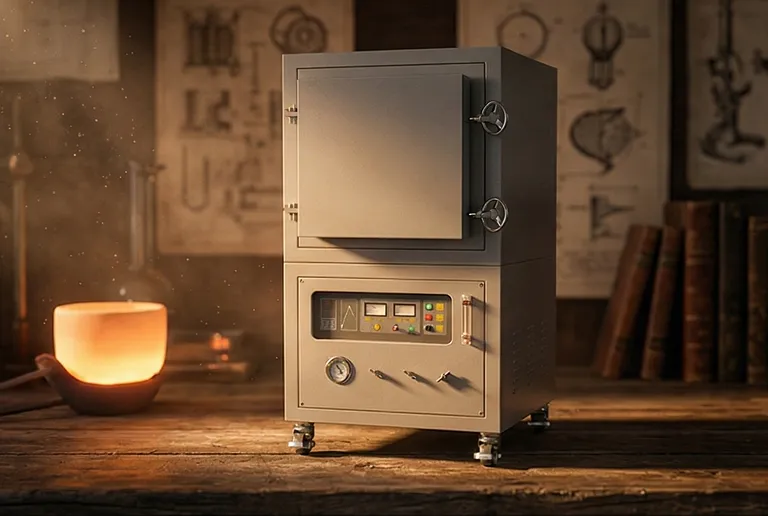
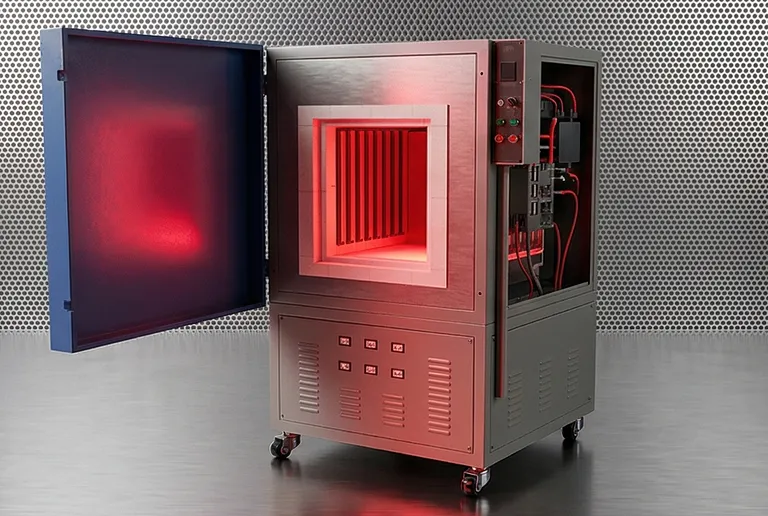
To solve these problems, you don't need a "hotter" furnace; you need a smarter thermal profile in an air-oxygen environment. This is where a high-precision laboratory muffle furnace becomes the most critical tool in your lab.
A KINTEK muffle furnace serves as the "cleanup crew" that prepares the material for its final transformation. It addresses the root causes through three specific mechanisms:
- Atmospheric Re-oxidation: By calcining at 800°C (for debinding) or annealing at 1350°C (for post-sintering) in an air environment, the furnace allows the ceramic to fully re-oxidize. This eliminates oxygen vacancies and regulates ion valence, turning a dark, opaque material into a clear, uniform crystal.
- Complex Multi-Stage Programming: Proper debinding requires more than a "start" button. It requires 48-hour programs with precise isothermal holds at critical points—such as 150°C and 410°C. KINTEK’s programmable controllers ensure that binders decompose slowly and uniformly, preventing the internal stress that causes cracks in thick-walled ceramics.
- Thermal Uniformity: Our furnaces provide a stable, uniform thermal field. Whether you are dehydrating hydrated alumina at 1200°C to achieve a stable alpha-phase or pyrolyzing resins in HAp at 1050°C, every millimeter of your sample experiences the same temperature, ensuring consistent crystallinity and purity.
Beyond the Fix: Opening New Doors in Material Science
When you master the debinding and annealing process, you aren't just "fixing" a problem; you are unlocking new capabilities.
By ensuring a perfectly clean, stress-free green body, you can achieve a relative density of over 99% in your final products. This opens the door to creating larger, more complex ceramic components, from high-transmittance optical lenses to bio-active scaffolds with precise microporous structures and superior mechanical strength.
At KINTEK, we understand that a furnace is not just a box that gets hot—it is a precision instrument designed to control the delicate chemistry of your materials. Whether you are working with transparent garnets, bioceramics, or high-purity alumina, our customizable muffle and vacuum furnaces provide the stability and control necessary to move your research from "cloudy" to crystal clear.
Ready to eliminate the inconsistencies in your ceramic processing? Our technical team specializes in matching thermal solutions to specific material challenges, ensuring your debinding and sintering cycles are optimized for success. Contact Our Experts today to discuss your project requirements.
Related Products
- High Temperature Muffle Oven Furnace for Laboratory Debinding and Pre Sintering
- Laboratory Muffle Oven Furnace with Bottom Lifting
- 1200℃ Muffle Oven Furnace for Laboratory
- 1400℃ Muffle Oven Furnace for Laboratory
- 1700℃ High Temperature Muffle Oven Furnace for Laboratory
Related Articles
- The Hidden Saboteur in Your HT-LiCoO2 Synthesis: Why Precise Ramp Rates Can Make or Break Your Battery Materials
- Why Your High-Temperature Experiments Fail: The Hidden Flaw in Your Furnace
- Why High-Purity Gas Fails Your High-Temp Brazing—And How Mono-Silane Doping Fixes It
- Your Furnace Meets Spec, So Why Are Your Results Inconsistent?
- Why Your Muffle Furnace Might Be Masking Your Alloy Kinetics—And How to Fix It