The High-Stakes Puzzle of the 1150°C Joint
Imagine your laboratory or production line is working with 50Mo-50Re (Molybdenum-Rhenium), an alloy prized for its high-temperature strength and ductility. You set your furnace to the required 1150°C, follow the standard brazing protocols, and wait.
On the surface, the joint looks successful. But under mechanical testing or microscopic inspection, the truth emerges: the joint is brittle, the base material has lost its structural integrity, or the filler metal has simply vanished. Despite reaching the "correct" temperature, the component is a failure.
In high-stakes industries like aerospace, nuclear, or advanced electronics, a "near miss" in brazing isn't just a technical glitch—it’s a costly setback that can lead to project delays, wasted exotic materials, and compromised safety.
The Common Struggle: Why "Hot Enough" Isn't Good Enough
When faced with inconsistent brazing results, many engineers attempt to compensate by adjusting the peak temperature or extending the soak time. They might "over-fire" the furnace to ensure the filler metal flows, or conversely, drop the temperature to protect the grain structure of the base metal.
However, these common fixes often create a new set of problems:
- Excessive Diffusion: Over-firing can cause the base metal to dissolve into the filler, making the joint brittle.
- Grain Growth: Staying at high temperatures for too long leads to abnormal grain growth in the 50Mo-50Re matrix, stripping the alloy of its unique mechanical properties.
- Contamination: Even a slight oversight in the thermal ramp-up can trap organic binders, turning them into carbon impurities that weaken the entire seam.
The result is a cycle of trial and error that drains resources without ever addressing the root cause of the failure.
The Root of the Problem: It’s an Atomic Dance, Not Just Melting
To understand why these joints fail, we have to look at what is happening at the atomic level during the vacuum brazing of 50Mo-50Re. Brazing is not merely "gluing" two pieces of metal together; it is a precisely timed chemical reaction and diffusion process.
1. The Critical Phase Formation
At 1150°C, the goal is to facilitate a controlled "handshake" between Molybdenum (Mo), Rhenium (Re), and Iron (Fe). For a joint to be strong, these elements must diffuse to form specific reinforcing phases, such as σ(Mo₂Re₃) and μ-Mo₆Fe₇. If the temperature deviates by as little as 20°C, or if the 45-minute holding time is inconsistent, these phases either fail to form or grow too large, creating a "weak link" in your component.
2. The Impurity Trap
50Mo-50Re alloys have an extremely low tolerance for oxygen, nitrogen, and carbon. At high temperatures, these elements segregate at grain boundaries, causing immediate embrittlement. If your vacuum isn't maintaining a degree better than 6×10⁻³ Pa, you aren't just heating the metal—you are oxidizing it from the inside out.
3. The Management of Thermal Stress
The failure often happens after the brazing is done. Because the filler and the base material expand and contract at different rates, a rapid cool-down creates massive residual stress. Without a controlled, slow cooling rate (specifically around 6°C/min), the joint can micro-crack before it even leaves the furnace.
The Solution: A Furnace Designed for Surgical Precision

Solving these challenges requires more than just a heating element; it requires a furnace designed to manage the entire thermal lifecycle with surgical precision. This is where KINTEK’s high-temperature vacuum furnaces redefine the process.
Our systems are engineered to treat temperature not as a single target, but as a sophisticated "recipe" of steps:
- Stepped Temperature Control: Our furnaces allow for precise isothermal holds. For example, a 300°C soak ensures all organic binders volatilize completely, eliminating carbon impurities before the brazing even begins.
- Uniformity & Stability: KINTEK furnaces ensure that 1150°C is consistent across the entire work zone, preventing the "hot spots" that cause matrix melting and the "cold spots" that stall diffusion.
- High-Vacuum Integrity: By maintaining a superior vacuum environment, we isolate the alloy from atmospheric impurities, ensuring the metallurgical purity of the 50Mo-50Re joint.
- Programmable Cooling Profiles: Our advanced controllers manage the descent from 1150°C at the exact rate needed to alleviate residual stress, ensuring the mechanical integrity of the final product.
Beyond the Fix: Unlocking New Potential
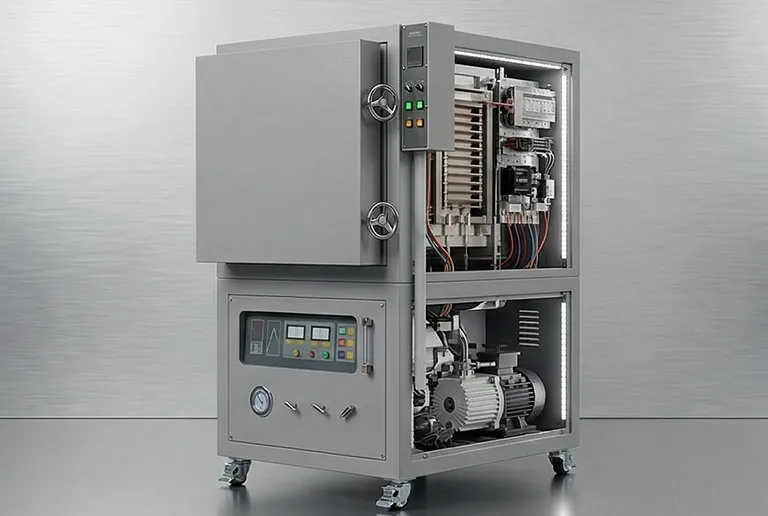
When you move from "approximate" heating to "precise" thermal management, the focus shifts from fixing failures to exploring new possibilities.
With a KINTEK vacuum furnace, you can achieve repeatable, high-density joints that meet the most stringent industrial standards. This reliability allows your team to accelerate R&D cycles, reduce material waste, and confidently utilize exotic alloys in more complex geometries. Whether you are developing the next generation of aerospace components or conducting fundamental materials research, the ability to control the atomic interface of your materials is the key to innovation.
The complexity of materials like 50Mo-50Re demands a partner who understands the science behind the heat. At KINTEK, we specialize in translating these complex thermal requirements into reliable, customizable laboratory and industrial solutions. If you are struggling with inconsistent brazing results or need a furnace capable of meeting the rigorous demands of advanced metallurgy, our team of experts is ready to help you design the perfect thermal profile for your unique application.
Contact Our Experts today to discuss how we can optimize your high-temperature processes.
Related Products
- Vacuum Heat Treat Sintering and Brazing Furnace
- Vacuum Heat Treat Sintering Furnace Molybdenum Wire Vacuum Sintering Furnace
- Magnesium Extraction and Purification Condensing Tube Furnace
- Molybdenum Vacuum Heat Treat Furnace
- Vacuum Heat Treat Sintering Furnace with Pressure for Vacuum Sintering
Related Articles
- Why 10⁻⁶ mbar Vacuum Isn’t Enough for Perfect Brazing—And the Missing Link to Oxide-Free Surfaces
- Why Your High-Temperature Aerospace Joints Fail—and the Science of the Perfect Vacuum Weld
- Why Your 3D-Printed Maraging Steel Parts Aren't Performing—And How to Fix the Structural Weakness
- Why Your Vacuum Brazed Joints Are Failing—And the Precise Pressure Fix You’ve Been Missing
- Beyond Inert: The Physics and Psychology of Perfecting Joints in a Vacuum Furnace