The Invisible Flaw
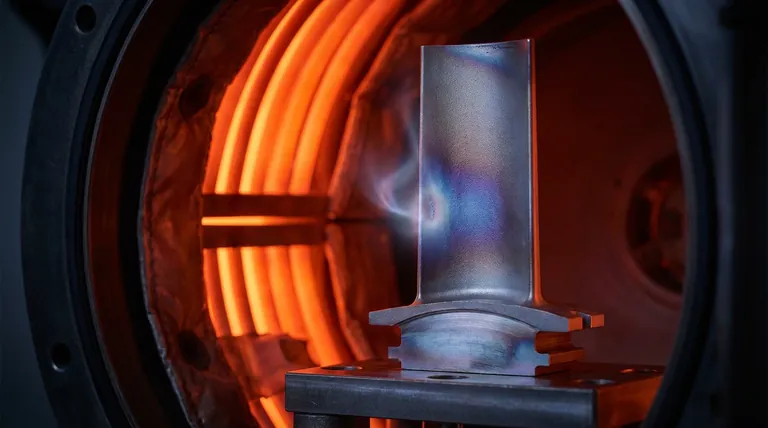
An engineer inspects a freshly brazed component under bright light. The dimensions are perfect, the metallurgy sound, but there’s a subtle discoloration on the surface—a ghostly blue tint where none should be. The cycle ran correctly, the temperature was precise, the vacuum pump operated flawlessly.
The culprit wasn't a catastrophic failure. It was an invisible intruder: the atmosphere.
A microscopic leak, imperceptible to the eye, allowed a trickle of air into the chamber. At 1000°C, those few stray molecules of oxygen were enough to compromise the part. This is the quiet, constant battle every high-temperature process faces.
The Allure of a Simple Number
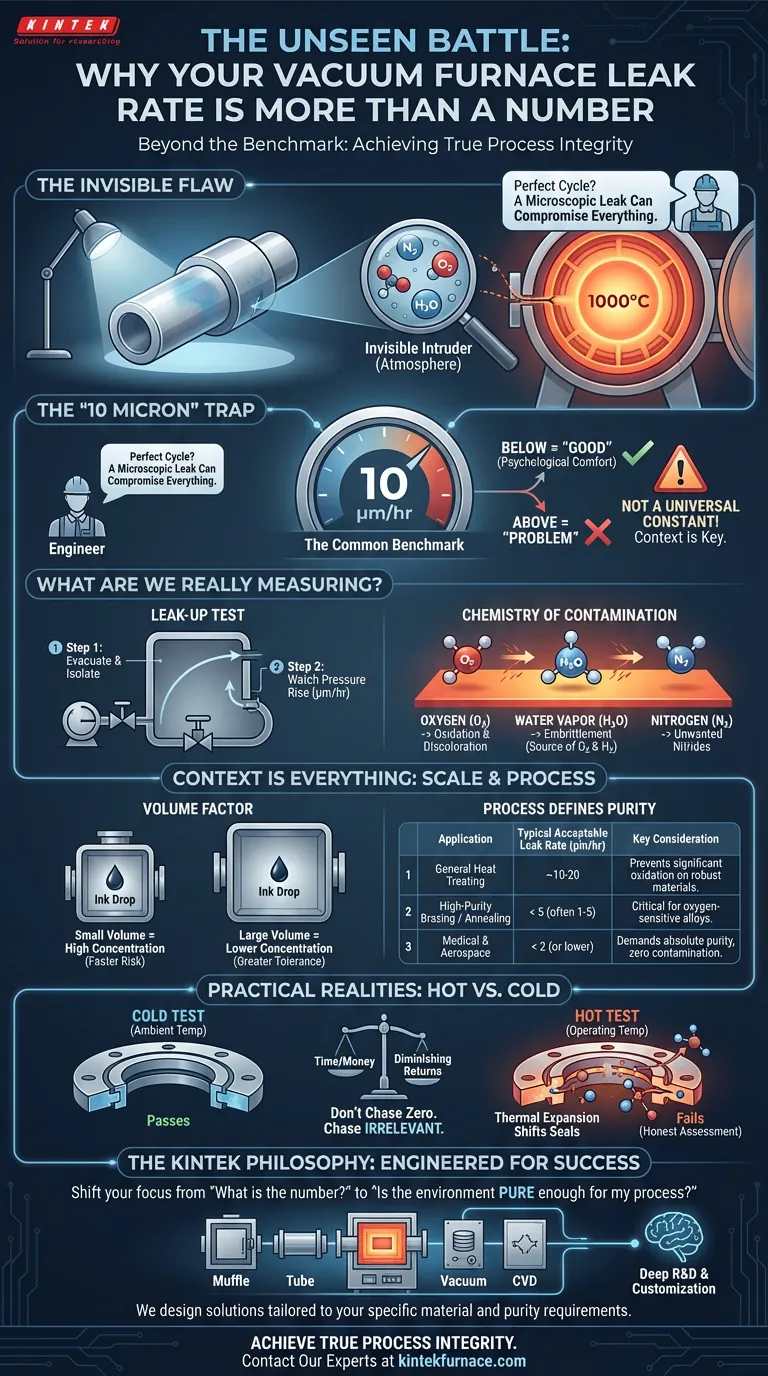
In the world of vacuum furnaces, the number you hear most often is 10 microns per hour. It's presented as the gold standard for an acceptable leak rate.
Our minds crave these simple benchmarks. They provide a clear, measurable target in a complex system. If your furnace is below 10 µm/hr, you're "good." If it's above, you have a problem.
But this psychological comfort is a trap. A "good" leak rate is not a universal constant; it's a variable deeply tied to your specific process. Fixating on a single number without understanding its context is like judging a marathon runner solely by their heart rate, without knowing if they are sprinting or resting.
What Are We Really Measuring?
When we perform a "leak-up" test, we aren't just measuring a pressure change. We are listening to the furnace confess how much of the outside world it's letting in.
The Leak-Up Test: A Chamber's Confession
The test is simple in principle: evacuate the chamber, isolate it from the pumps, and watch the pressure rise. The result, in microns per hour (µm/hr), is a direct measure of the chamber's integrity. A higher number means a larger breach in your defenses against the atmosphere.
The Chemistry of Contamination
That breach allows atmospheric gases—mostly nitrogen, oxygen, and water vapor—to become unwelcome guests at a high-temperature party. At ambient temperatures, they are benign. At the scorching heat of a furnace cycle, they become highly reactive agents of chaos.
- Oxygen causes oxidation and discoloration.
- Water Vapor is a potent source of oxygen and hydrogen, which can lead to embrittlement.
- Nitrogen can form unwanted nitrides on the surface of certain materials.
For a sensitive process like brazing a medical implant or annealing titanium, even a trace amount of this contamination can mean the difference between a perfect metallurgical bond and a costly product failure.
Context Is Everything: Beyond the Benchmark
The 10 µm/hr rule of thumb collapses under the weight of context. What is perfectly acceptable for one process can be disastrous for another.
Scale Matters: The Volume Factor
Imagine adding a single drop of ink into a glass of water versus a swimming pool. The concentration of the contaminant is vastly different.
The same principle applies to furnace volume. A 10 µm/hr leak will raise the partial pressure of contaminants far more quickly in a small laboratory furnace than in a massive industrial chamber. A larger furnace can often tolerate a numerically higher leak rate while maintaining the required purity for the process.
Process Defines Purity
The most critical factor is the application itself. Your process requirements should be the ultimate judge of your leak rate.
| Application | Typical Acceptable Leak Rate (µm/hr) | Key Consideration |
|---|---|---|
| General-Purpose Heat Treating | ~10-20 | Prevents significant oxidation on robust materials. |
| High-Purity Brazing / Annealing | < 5 (often 1-5) | Critical for oxygen-sensitive alloys and clean surfaces. |
| Medical & Aerospace Components | < 2 (or as low as possible) | Demands absolute purity to prevent any contamination. |
If you are hardening a simple steel tool, 15 µm/hr might be fine. If you are manufacturing components for a satellite, that same leak rate is an invitation for failure.
The Practical Realities of an Imperfect Seal
Achieving a perfect vacuum is a theoretical ideal. In practice, we must balance performance with reality.
Chasing Zero: The Point of Diminishing Returns
Finding and fixing leaks costs time and money. Striving for a leak rate of 1 µm/hr when your process only requires 10 µm/hr can lead to excessive downtime and maintenance costs for no tangible improvement in product quality. The goal is not zero leaks; it is a leak rate low enough to be irrelevant to your outcome.
The Hot vs. Cold Deception
A furnace can be deceptive. A chamber that passes a leak-up test with flying colors when cold can develop significant leaks when hot. Thermal expansion causes flanges, seals, and fittings to shift, opening new paths for the atmosphere to sneak in. A "hot leak-up test," performed at or near operating temperature, provides a much more honest assessment of your furnace's integrity during a real cycle.
From a Number to a Philosophy
The ultimate goal is not to hit an arbitrary number on a vacuum gauge. The goal is to consistently produce perfect parts.
Shift your thinking from "What is my leak rate?" to "Is my vacuum environment pure enough for my process?" The leak rate is merely a diagnostic tool, a single data point in the larger pursuit of process integrity. When discoloration, brittleness, or other quality issues appear, your current leak rate—regardless of the number—is too high.
This philosophy demands more than an off-the-shelf furnace built to a generic standard. It requires a system engineered with your specific materials and outcomes in mind. True process control is achieved by design, where the furnace's integrity is tailored to the sensitivity of the application. At KINTEK, our expertise lies in this exact approach, providing customizable Muffle, Tube, Vacuum, and CVD furnace systems backed by deep R&D. We design and manufacture solutions to meet the precise, stringent purity requirements your work demands.
The battle against the atmosphere is won not by chasing a universal number, but by creating an environment engineered for success. If you're ready to move beyond benchmarks and achieve true process integrity, Contact Our Experts.
Visual Guide
Related Products
- Vacuum Hot Press Furnace Machine Heated Vacuum Press Tube Furnace
- Vacuum Hot Press Furnace Machine Heated Vacuum Press
- 600T Vacuum Induction Hot Press Vacuum Heat Treat and Sintering Furnace
- 2200 ℃ Tungsten Vacuum Heat Treat and Sintering Furnace
- Vacuum Heat Treat Sintering Furnace with Pressure for Vacuum Sintering
Related Articles
- How Vacuum Hot Press Furnaces Transform Advanced Material Engineering
- How to Select the Right Vacuum Hot Pressing Furnace Temperature for Your Materials
- Beyond the Parts List: The Real Reason Your Vacuum Hot Press Fails (And How to Fix It)
- Why Your High-Temperature Materials Fail: The Hidden War Inside Your Furnace
- Is Your Material Data Real? Why Temperature Gradients Are Sabotaging Your Cu2Se Resistivity Measurements