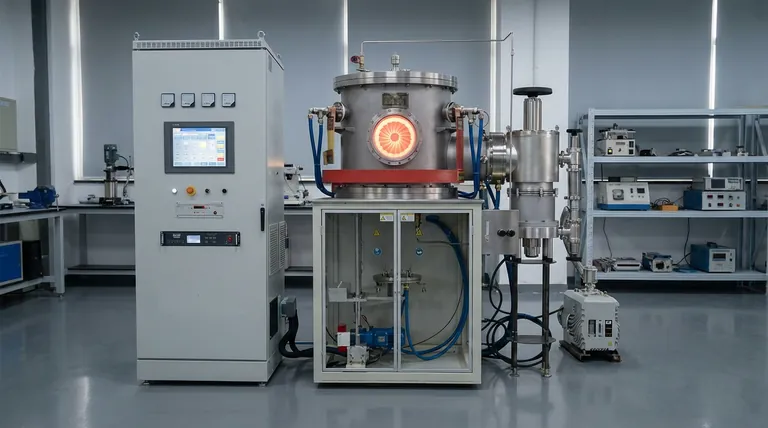
An aerospace engineer stares at a hairline fracture on a turbine blade. The alloy is flawless, the design impeccable. Yet, it failed under stress tests. The culprit wasn't the material or the geometry; it was a hidden ghost in the machine—internal stress introduced during its creation.
This scenario reveals a fundamental truth in materials science: the most critical failures often originate not from what we add, but from the environment in which a component is forged. We tend to focus on temperature, but the real variable is the atmosphere.
The Tyranny of the Atmosphere
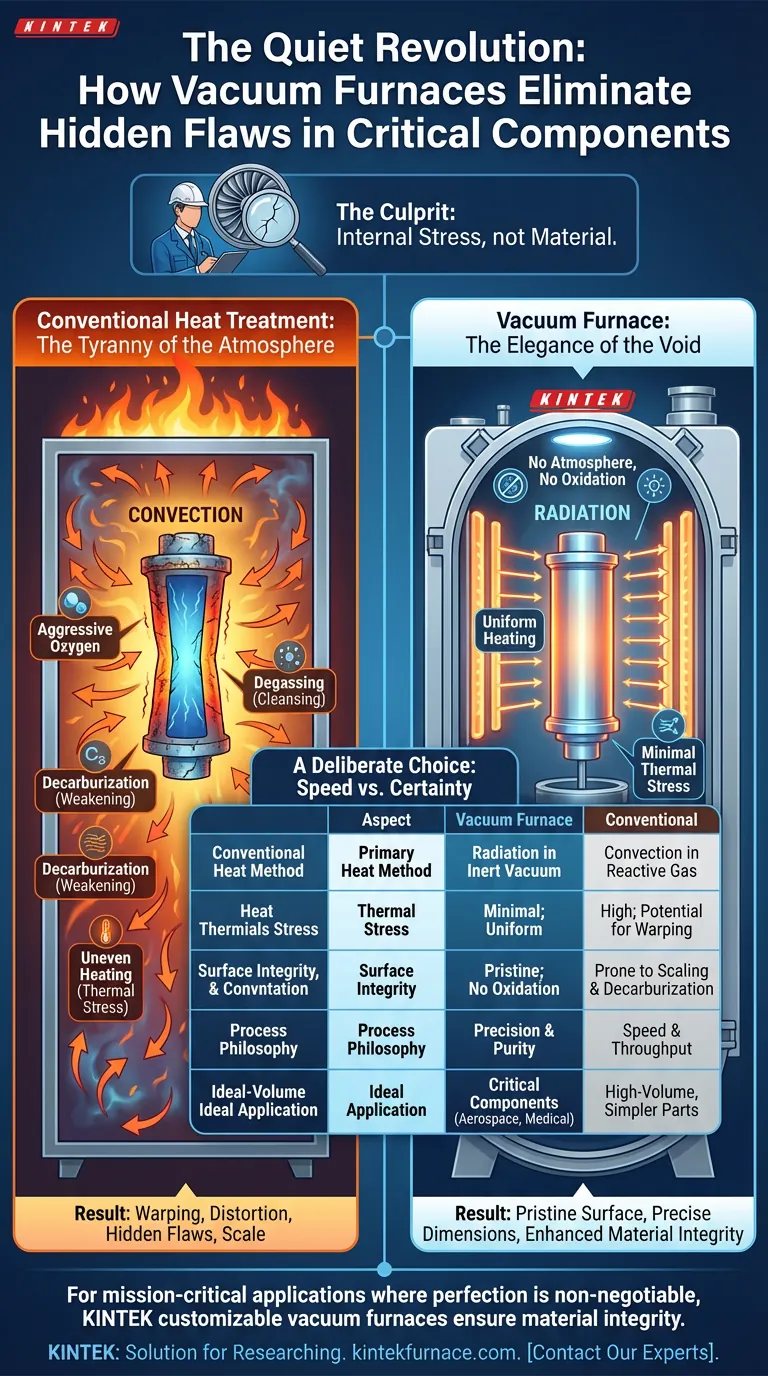
Conventional heat treatment is a battle. A workpiece is placed in a furnace, and hot gas is forced around it. This is convection—a fast, efficient, but chaotic way to transfer heat.
The atmosphere, whether it's air or a specific gas mixture, is an active and often hostile participant.
- It attacks: Oxygen molecules aggressively bond with the hot surface, creating scale (oxidation).
- It steals: It can pull carbon from the surface of steel (decarburization), weakening it.
- It creates chaos: Convective currents heat the part unevenly, with edges and thin sections getting hotter much faster than the dense core.
This temperature difference between the surface and the core is the genesis of thermal stress. The part's exterior expands while its interior lags, creating an internal tug-of-war that can lead to warping, distortion, and the kind of microscopic fractures that doom a turbine blade.
The Elegance of the Void
A vacuum furnace operates on a radically different philosophy: control the environment first, and the physics will follow.
The process begins by removing the atmosphere. The chamber becomes a void, an environment of profound quietness. With no air, there is no medium for convection.
Heat is instead transferred through radiation. Heating elements glow, bathing the workpiece in pure thermal energy that travels unimpeded, just as sunlight travels through the vacuum of space. This method is slower, more deliberate, but incredibly uniform.
Achieving this level of control isn't magic; it's a function of precise engineering. Systems like the customizable vacuum furnaces from KINTEK are designed to create and maintain this pristine environment, transforming heat treatment from a brute-force process into a form of industrial artistry.
The Physics of a Flawless Form
This shift from convection in air to radiation in a vacuum has profound consequences for the workpiece.
Taming Thermal Stress
Because radiant heat is gentle and uniform, the temperature difference between the component's surface and its core remains minimal throughout the cycle. The entire part heats up and cools down as one, drastically reducing the internal stresses that cause distortion. The final product respects its design dimensions with microscopic precision.
Preserving Perfect Surfaces
In the absence of oxygen and other reactive gases, the surface remains immaculate.
- No Oxidation: The part emerges bright and clean, without any scale to remove. This often eliminates the need for secondary cleaning processes like sandblasting.
- No Contamination: The vacuum actively purifies the component, pulling trapped gases like hydrogen out of the metal (degassing) and vaporizing surface contaminants. The material becomes not just heated, but cleansed.
A Deliberate Choice: Speed vs. Certainty
The choice between conventional and vacuum heating is a psychological one as much as it is an engineering one. It’s a classic trade-off between the desire for speed and the need for certainty.
Conventional heating is faster and often cheaper. It is the right choice for high-volume parts where minor surface blemishes or slight dimensional variances are acceptable.
Vacuum heating is a commitment to perfection. It is the non-negotiable choice for mission-critical components in aerospace, medical implants, or high-performance tooling, where a hidden flaw is not an inconvenience but a catastrophic failure waiting to happen.
| Aspect | Vacuum Furnace Heating | Conventional Atmosphere Heating |
|---|---|---|
| Primary Heat Method | Radiation in an inert vacuum | Convection in a reactive gas |
| Thermal Stress | Minimal; slow, uniform heating | High; potential for warping and distortion |
| Surface Integrity | Pristine; eliminates oxidation & cleanses | Prone to scaling and decarburization |
| Process Philosophy | Precision and material purity | Speed and high throughput |
| Ideal Application | Critical components, complex geometries | High-volume production, simpler parts |
The most advanced manufacturing isn't always about what you add to a material. Sometimes, it's about what you take away: the atmosphere, the contaminants, the stress.
For engineers and researchers navigating these critical applications, having a partner who understands the nuances of environmental control is key. KINTEK specializes in customizable high-temperature systems, from advanced vacuum furnaces to CVD platforms, ensuring your process is built for perfection. For applications where material integrity cannot be compromised, understanding this distinction is the first step. To take the next, Contact Our Experts.
Visual Guide
Related Products
- Vacuum Hot Press Furnace Machine Heated Vacuum Press Tube Furnace
- Vacuum Hot Press Furnace Machine Heated Vacuum Press
- 600T Vacuum Induction Hot Press Vacuum Heat Treat and Sintering Furnace
- 2200 ℃ Tungsten Vacuum Heat Treat and Sintering Furnace
- Vacuum Heat Treat Sintering Furnace with Pressure for Vacuum Sintering
Related Articles
- How Vacuum Hot Press Furnaces Transform Advanced Material Engineering
- How to Select the Right Vacuum Hot Pressing Furnace Temperature for Your Materials
- Beyond the Parts List: The Real Reason Your Vacuum Hot Press Fails (And How to Fix It)
- Why Your High-Temperature Materials Fail: The Hidden War Inside Your Furnace
- Is Your Material Data Real? Why Temperature Gradients Are Sabotaging Your Cu2Se Resistivity Measurements



















