The High-Stakes Struggle of the "Perfect" Joint
You’ve carefully prepared your low-alloy steel substrate and your copper filler metal. You’ve calculated the tolerances and set the temperature. But when the parts emerge from the furnace, the result is a frustration every engineer knows too well: the filler metal hasn't flowed, the joint is brittle, or worse, the surface of your expensive components is discolored and pitted.
In high-precision industries like aerospace or medical device manufacturing, a "close enough" joint isn't just a quality control failure—it’s a massive business risk. Scrapped parts, delayed project timelines, and compromised structural integrity can cost a company thousands of dollars in a single heat cycle.
Why Traditional Heating Often Falls Short
When faced with poor brazing results, the instinctive reaction is often to increase the temperature, apply more flux, or extend the soaking time. However, these "fixes" often create new problems. Excessive heat can warp the substrate, and chemical fluxes—while designed to clean the metal—can leave behind corrosive residues or create "porosity" (tiny gas bubbles) that weakens the final bond.
The reality is that for materials like low-alloy steel and copper, the enemy isn't the temperature itself; it's the environment surrounding the metal. At the typical brazing temperature of 1100°C, the chemistry of the air becomes your biggest obstacle.
The Root Cause: The "Invisible Wall" of Oxidation
Why does brazing fail in a standard atmosphere? The answer lies in two critical physical phenomena:
1. The Instant Oxide Barrier
At 1100°C, oxygen reacts with steel and copper almost instantly. Even a microscopic layer of oxide acts as a physical barrier. Copper filler metal cannot "wet" (spread across) an oxidized steel surface; instead of flowing into the joint via capillary action, it beads up like water on a waxed car. To achieve a true metallurgical bond, the metal surfaces must be atomically clean.
2. The Sublimation Trap
There is a second, more subtle danger. In a pure high-vacuum environment, certain alloying elements in the steel can actually "sublimate"—turning directly from a solid into a gas. This changes the chemical composition of your base metal, potentially making it weaker or more susceptible to corrosion. You need the vacuum to keep things clean, but too much vacuum at high heat can literally pull the metal apart at a molecular level.
The Solution: A Controlled Micro-Environment
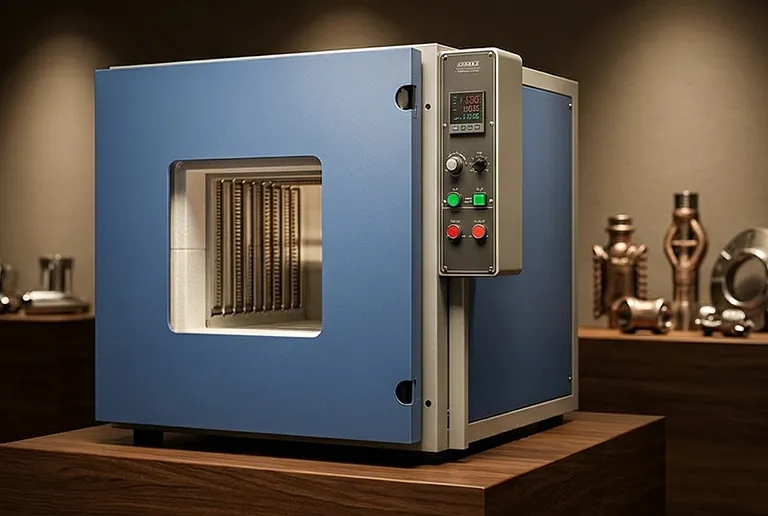
To solve these problems simultaneously, you need more than just a heater; you need a Vacuum Furnace with Inert Gas Protection. This dual-action approach addresses the root causes that standard furnaces ignore:
- Oxygen Elimination (The Vacuum): By evacuating the chamber to pressures as low as 1.33 x 10⁻³ Pa, the furnace removes the oxygen that causes oxidation. This allows the liquid copper to flow perfectly across the steel, creating a dense, leak-proof, and high-strength joint without the need for messy fluxes.
- Atmospheric Stabilization (The Inert Gas): By introducing a controlled partial pressure of an inert gas like Argon, the furnace prevents the sublimation of alloying elements. The gas acts as a "lid," keeping the metal's chemistry stable while also assisting in uniform heat transfer throughout the chamber.
At KINTEK, our vacuum furnaces are engineered specifically to handle these delicate transitions. They aren't just ovens; they are precision instruments designed to facilitate the pure metallurgical reactions required for critical applications.
Beyond the Fix: Unlocking New Engineering Potential
When you master the environment, you stop worrying about "will it bond?" and start focusing on "what else can we build?"
By utilizing a vacuum furnace with inert gas protection, you transition from a process plagued by rework to one defined by repeatable excellence. This precision allows for the production of complex, flux-free assemblies that are ready for use in high-vacuum or high-pressure environments immediately after cooling. You can explore thinner, lighter materials and more intricate geometries, knowing that the structural integrity of every joint is guaranteed.
Whether you are struggling with inconsistent brazing results or looking to scale up a complex metallurgical project, the right thermal environment is the foundation of your success. Our team at KINTEK specializes in customizing high-temperature vacuum and atmosphere furnaces to meet the exact requirements of your most challenging materials. Contact Our Experts today to discuss how we can optimize your thermal processes and eliminate the guesswork from your production line.
Related Products
- Vacuum Heat Treat Sintering and Brazing Furnace
- Vacuum Heat Treat Sintering Furnace with Pressure for Vacuum Sintering
- 1400℃ Controlled Inert Nitrogen Atmosphere Furnace
- Molybdenum Vacuum Heat Treat Furnace
- Vacuum Sealed Continuous Working Rotary Tube Furnace Rotating Tube Furnace
Related Articles
- Why 10⁻⁶ mbar Vacuum Isn’t Enough for Perfect Brazing—And the Missing Link to Oxide-Free Surfaces
- Why Your High-Temperature Aerospace Joints Fail—and the Science of the Perfect Vacuum Weld
- Why Your 3D-Printed Maraging Steel Parts Aren't Performing—And How to Fix the Structural Weakness
- Why Your Vacuum Brazed Joints Are Failing—And the Precise Pressure Fix You’ve Been Missing
- Beyond Inert: The Physics and Psychology of Perfecting Joints in a Vacuum Furnace



















