The Crucible of Creation
Imagine you're engineering a turbine blade for a next-generation jet engine. It will operate under stresses and temperatures that would turn lesser metals to liquid. A single, microscopic impurity—a stray oxygen atom bonded where it shouldn't be—could create a structural weak point. Under load, that point could propagate a crack, leading to catastrophic failure.
This isn't just about chemistry; it's about reliability measured in millions of cycles. In high-stakes material science, the absence of something—in this case, reactive atmospheric gases—is as critical as the materials themselves.
This is the world of vacuum furnaces. But the path to perfection is paved with trade-offs.
The Illusion of a Simple Choice
The intuitive leap is to assume that "more vacuum" is always better. If the goal is to eliminate contaminants, why not always choose the system that removes the most?
This is a psychological trap. It mistakes a technical specification for a strategic goal.
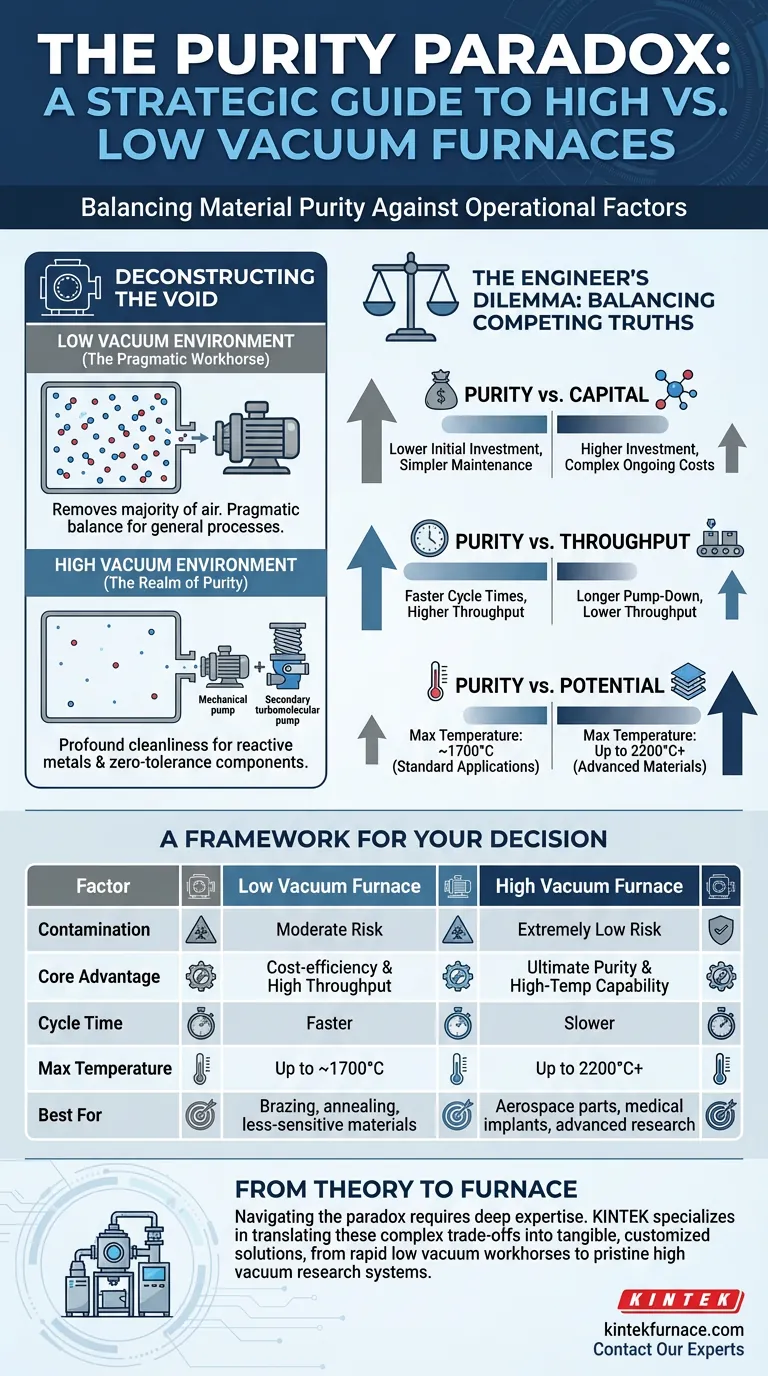
The choice between a low and high vacuum furnace is not simply about minimizing contamination. It is a strategic decision that balances the required material purity against critical operational factors like cost, cycle time, and temperature capability.
Deconstructing the Void: Two Levels of Nothingness
A vacuum furnace's primary function is to forcibly evict unwanted guests—oxygen, nitrogen, water vapor—from a sealed chamber before heat is applied. The "level" of vacuum dictates how thoroughly the room is cleared.
The Low Vacuum Environment: The Pragmatic Workhorse
A low vacuum furnace, often called an atmosphere furnace, uses robust mechanical pumps to remove the vast majority of air. It’s an effective and rapid process.
However, a "low vacuum" is not empty. It still contains a measurable population of residual molecules. For many heat treatment processes like general annealing or brazing, this environment is perfectly adequate. It represents a pragmatic balance, providing sufficient protection for a wide range of materials.
The High Vacuum Environment: The Realm of Purity
High vacuum systems are a different class of machine. They begin where low vacuum systems stop.
After an initial mechanical pump does the heavy lifting, a secondary pump—like a turbomolecular pump—takes over. This stage is less about bulk removal and more about molecular sniping, capturing the far more elusive remaining gas molecules.
The result is an environment of profound cleanliness, essential for processing reactive metals like titanium or manufacturing components with zero tolerance for impurities.
The Engineer's Dilemma: Balancing Competing Truths
The superior purity of a high vacuum furnace is not a free lunch. It comes at a cost, forcing engineers and managers to confront a series of critical trade-offs.
Purity vs. Capital: The Cost of Emptiness
The sophisticated multi-stage pumping systems, advanced sensor arrays, and robust chamber engineering required for high vacuum come with a significantly higher price tag.
- Low Vacuum: Lower initial investment, simpler maintenance, and lower operational costs.
- High Vacuum: Higher initial investment and more complex, costly ongoing maintenance.
Purity vs. Throughput: The Price of Patience
Achieving a state of near-perfect vacuum is a delicate, time-consuming process. The pump-down cycle for a high vacuum furnace is considerably longer than for its low vacuum counterpart.
This isn't just a minor delay; it directly impacts production throughput. For high-volume manufacturing, the faster cycle times of a low vacuum system are a decisive economic advantage.
Purity vs. Potential: The Temperature Frontier
High vacuum furnaces are built for the most demanding applications. This engineering rigor often means they are also capable of reaching higher maximum temperatures—sometimes exceeding 2200°C.
This capability unlocks the potential to process advanced ceramics, refractory metals, and exotic alloys that are simply out of reach for standard low vacuum furnaces, which typically top out around 1700°C.
A Framework for Your Decision
Making the right choice requires aligning the furnace's capabilities with your specific material needs and business goals.
| Factor | Low Vacuum Furnace | High Vacuum Furnace |
|---|---|---|
| Contamination | Moderate Risk | Extremely Low Risk |
| Core Advantage | Cost-efficiency & High Throughput | Ultimate Purity & High-Temp Capability |
| Cycle Time | Faster | Slower |
| Max Temperature | Up to ~1700°C | Up to 2200°C+ |
| Best For | Brazing, annealing, tempering less-sensitive materials | Aerospace parts, medical implants, advanced research |
From Theory to Furnace
Navigating this paradox of purity versus pragmatism is where deep expertise becomes invaluable. The "right" furnace is rarely an off-the-shelf solution; it's a system precisely tailored to your process variables, material sensitivities, and operational targets.
At KINTEK, we specialize in translating these complex trade-offs into tangible solutions. Leveraging our in-house R&D and advanced manufacturing, we provide a spectrum of high-temperature furnaces, from versatile Tube and Muffle furnaces to highly specialized Vacuum and CVD systems. Our strength lies in deep customization, ensuring that whether you need the rapid cycling of a low vacuum workhorse or the pristine environment of a high vacuum research system, your equipment is a perfect fit for your goals.
Choosing the right vacuum level is one of the most critical decisions in material processing. It dictates not only the quality of your product but also the efficiency of your operation. To ensure you're making the most strategic choice for your application, Contact Our Experts
Visual Guide
Related Products
- Vacuum Hot Press Furnace Machine Heated Vacuum Press Tube Furnace
- Vacuum Hot Press Furnace Machine Heated Vacuum Press
- 600T Vacuum Induction Hot Press Vacuum Heat Treat and Sintering Furnace
- 2200 ℃ Tungsten Vacuum Heat Treat and Sintering Furnace
- Vacuum Heat Treat Sintering Furnace with Pressure for Vacuum Sintering
Related Articles
- How Vacuum Hot Press Furnaces Transform Advanced Material Engineering
- How to Select the Right Vacuum Hot Pressing Furnace Temperature for Your Materials
- Beyond the Parts List: The Real Reason Your Vacuum Hot Press Fails (And How to Fix It)
- Why Your High-Temperature Materials Fail: The Hidden War Inside Your Furnace
- Is Your Material Data Real? Why Temperature Gradients Are Sabotaging Your Cu2Se Resistivity Measurements