The Invisible Flaw
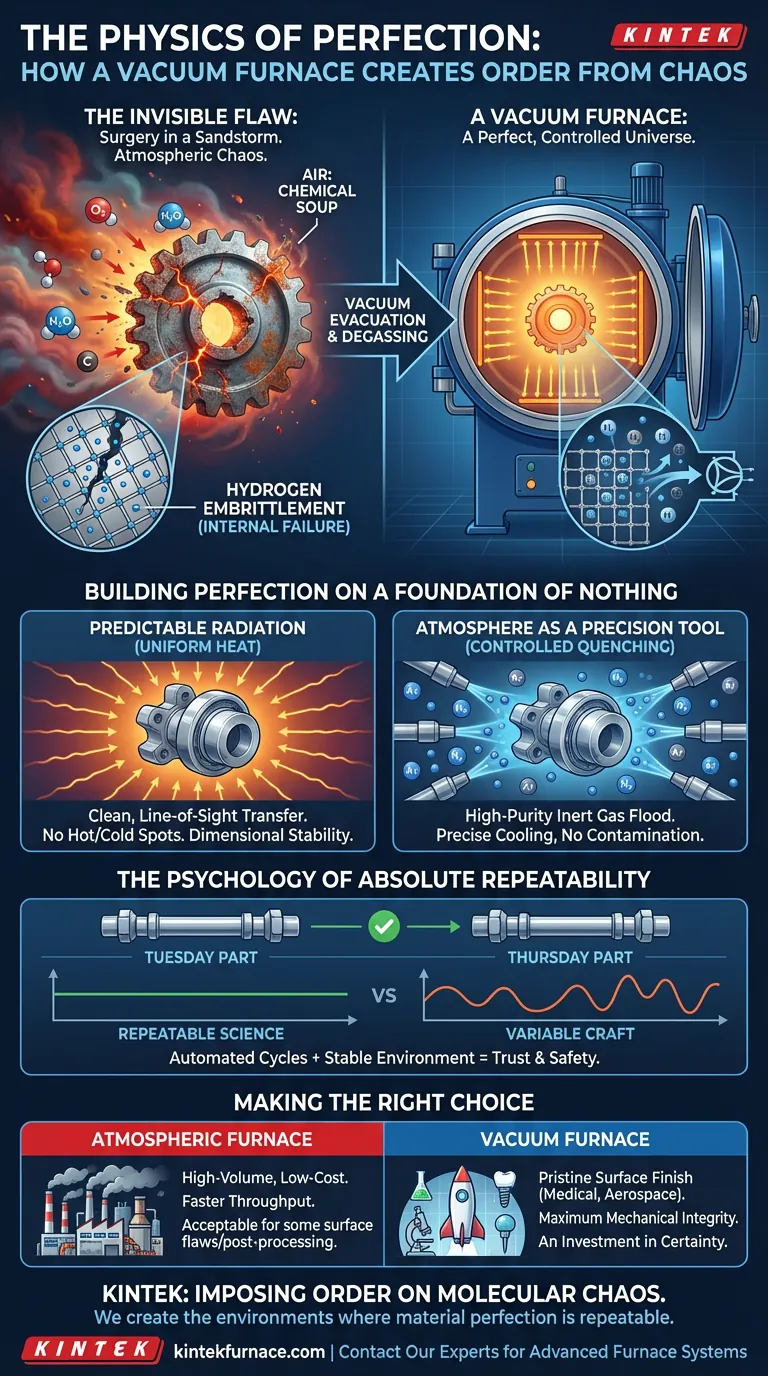
Imagine a critical bolt on an aircraft landing gear. It’s forged from a high-strength steel alloy, engineered to withstand immense stress. Yet, during a routine inspection, a microscopic crack is found. The failure didn't come from external force, but from within—a phenomenon called hydrogen embrittlement.
The culprit? A few stray hydrogen atoms, trapped inside the metal during a conventional heat treatment process.
This is the central challenge in material science: the biggest failures often start with the smallest, most invisible contaminants. Heat treating in the air we breathe is like trying to perform surgery in a sandstorm. The atmosphere, rich with reactive gases, is an agent of chaos.
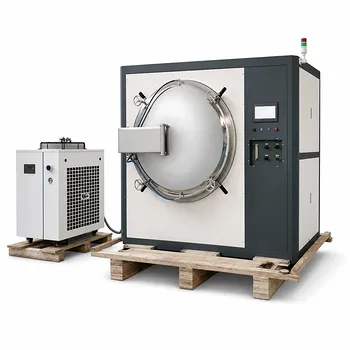
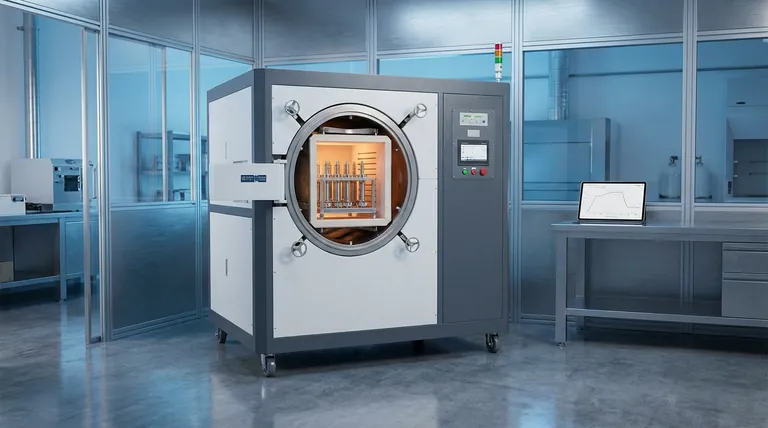
A vacuum furnace is the answer. But its genius isn't just about removing the air; it's about creating a fundamentally different, perfectly controlled universe in a box.
From Atmospheric Chaos to a Blank Slate
The air around us is a chemical soup. At high temperatures, the oxygen, water vapor, and carbon molecules it contains become aggressive reactants.
Eliminating the Obvious Enemies
Heating metal in the open air is an invitation for oxidation. Oxygen bonds with the material's surface, creating a brittle scale layer that compromises both finish and structural integrity.
Similarly, carbon can be stripped from the surface of steel, a process known as decarburization. This leaves the surface softer and weaker than the core—a hidden vulnerability.
A vacuum furnace directly addresses this by physically removing the atmosphere. It doesn't just reduce the contaminants; it evacuates them, creating a chemically neutral environment. The result is a bright, clean part that requires no secondary cleaning.
Purifying the Material from Within
The true elegance of a vacuum environment is what it does to the material itself.
Under low pressure, trapped gases within the metal's crystalline structure are drawn out. This process, called degassing, pulls out the very hydrogen atoms that lead to catastrophic embrittlement.
The vacuum doesn't just protect the surface; it purifies the core, creating a material that is intrinsically stronger and more reliable.
Building Perfection on a Foundation of Nothing
Once this near-perfect vacuum—this "blank slate"—is achieved, true control begins. By starting from a state of deliberate emptiness, we can introduce known variables with absolute precision.
The Predictability of Radiation
In a conventional furnace, heat moves through convection—unpredictable currents of hot air that create hot and cold spots. This leads to thermal stress, which can warp and distort precision components.
In a vacuum, heat transfer is dominated by radiation. It's a clean, direct, line-of-sight energy transfer. Every part of the component, regardless of its shape, receives heat uniformly. This ensures dimensional stability and minimizes internal stress.
The Atmosphere as a Precision Tool
With the chaotic, unknown atmosphere gone, we can introduce a single, high-purity gas, like argon or nitrogen, as a deliberate part of the process.
This is the key to modern gas quenching. A high-pressure flood of inert gas can cool a part rapidly to achieve desired hardness, but without the violent thermal shock and potential for contamination that comes with oil or water quenching. The atmosphere becomes a precise, controllable ingredient, not a contaminant.
The Psychology of Absolute Repeatability
For engineers working on aerospace, medical, or high-performance tooling applications, "good enough" is a failing grade. What they need is certainty.
Modern vacuum furnaces, with their fully automated cycles, provide this certainty. The vacuum level, temperature ramp, soak time, and quenching protocol are managed by a computer.
This transforms heat treatment from a variable craft into a repeatable science. When combined with the inherently stable vacuum environment, it guarantees that the part made on Tuesday is physically identical to the part made on Thursday. This isn't just a matter of quality; it's a matter of trust and safety.
The Investment in Certainty
Of course, this level of control comes with trade-offs.
- Higher Initial Cost: Vacuum systems are more complex than their atmospheric counterparts.
- Longer Cycle Times: Pulling a hard vacuum takes time.
- Specialized Maintenance: Keeping a vacuum system pristine requires expertise.
These are not drawbacks so much as they are the price of admission for achieving a level of material perfection that is otherwise unattainable. It is an investment in eliminating the unknown.
Making the Right Choice
Your application dictates the necessary level of control.
| Requirement Focus | Best Solution | Why? |
|---|---|---|
| Pristine Surface Finish | Vacuum Furnace | Prevents all oxidation and contamination. Ideal for medical and aerospace parts. |
| Maximum Mechanical Integrity | Vacuum Furnace | Prevents decarburization and removes embrittling gases for high-strength parts. |
| High-Volume, Low-Cost | Atmospheric Furnace | Faster throughput for applications where post-processing or some surface flaws are acceptable. |
Ultimately, choosing a vacuum furnace is a decision to conquer the invisible variables that compromise material integrity. It is an act of imposing order on molecular chaos.
At KINTEK, our expertise in R&D and manufacturing allows us to build advanced, highly customizable furnace systems—from Muffle and Tube to advanced CVD and Vacuum Furnaces—that give you this precise control. We create the environments where material perfection is not just possible, but repeatable.
If your work demands absolute certainty and superior material integrity, we can help you build the right solution. Contact Our Experts
Visual Guide
Related Products
- Vacuum Hot Press Furnace Machine Heated Vacuum Press Tube Furnace
- Vacuum Hot Press Furnace Machine Heated Vacuum Press
- 600T Vacuum Induction Hot Press Vacuum Heat Treat and Sintering Furnace
- 2200 ℃ Tungsten Vacuum Heat Treat and Sintering Furnace
- Vacuum Heat Treat Sintering Furnace with Pressure for Vacuum Sintering
Related Articles
- How Vacuum Hot Press Furnaces Transform Advanced Material Engineering
- How to Select the Right Vacuum Hot Pressing Furnace Temperature for Your Materials
- Beyond the Parts List: The Real Reason Your Vacuum Hot Press Fails (And How to Fix It)
- Why Your High-Temperature Materials Fail: The Hidden War Inside Your Furnace
- Is Your Material Data Real? Why Temperature Gradients Are Sabotaging Your Cu2Se Resistivity Measurements