The Frustrating Mystery of the "Perfect" Press
Imagine you have sourced the highest-grade steel powder and used a high-tonnage press to create a "green compact" that is as dense and solid as possible. You expect a flawless finished part. Instead, after hours in the sintering furnace, the batch comes out with surface blistering, internal micro-cracks, or structural weaknesses that render the parts useless.
In the world of powder metallurgy, the drive for maximum density often feels like the ultimate goal. However, many engineers find themselves in a cycle of trial and error, wondering why their "dense" parts are failing while parts that felt "less solid" before sintering actually perform better.
The Common Struggle: The High-Pressure Trap
The natural instinct in manufacturing is to minimize "empty space." We often assume that the closer the green compact (the pressed powder before heating) is to 100% density, the stronger the final product will be. This leads many shops to over-compact their materials.
The consequences of this "maximum pressure" approach are often hidden until it is too late. When you push porosity too low—below the critical 10% threshold—you aren't just making the part denser; you are sealing its fate. This leads to:
- Internal Gas Trapping: Expansion of air or lubricants that cannot escape, causing "bloating."
- Incomplete Sintering: Parts that look fine on the outside but remain brittle at the core.
- Wasted Resources: High scrap rates and the massive energy costs of running industrial furnaces for failed batches.
The Science of the "Breathing" Metal
Why does the industry standard fixate on a narrow window of 10% to 12% porosity? To understand this, we have to look at the "interconnected pore" network.
Think of a green compact not as a solid block, but as a rigid sponge. At 10-12% porosity, the tiny gaps between powder grains are not isolated bubbles; they are interconnected channels. This "open-cell" architecture is the secret to a successful sinter for two scientific reasons:
- Effective Degassing: As the furnace temperature rises, lubricants used in the pressing process (like waxes or stearates) begin to vaporize. If the porosity is too low (under 10%), these gases become trapped. Under the intense heat of a sintering furnace, that trapped gas expands with immense pressure, creating internal fractures.
- Chemical Reduction: For steel to sinter properly, internal oxides must be removed. In a vacuum or protective atmosphere furnace, reducing gases (like Hydrogen) must be able to penetrate the entire part to "clean" the surfaces of the internal grains. Interconnected channels act as highways, allowing these gases to reach the very center of the part and exit with the oxygen they’ve stripped away.
If you drop below 10% porosity, these "highways" are blocked. If you go above 12%, the part becomes too fragile to handle (low "green strength") and will never reach the required final density.
Engineering the Solution: Beyond the Press
Understanding the 10-12% rule is only half the battle. Once you have achieved that delicate balance of porosity, the success of the part depends entirely on how the furnace manages the exchange of gases through those channels.
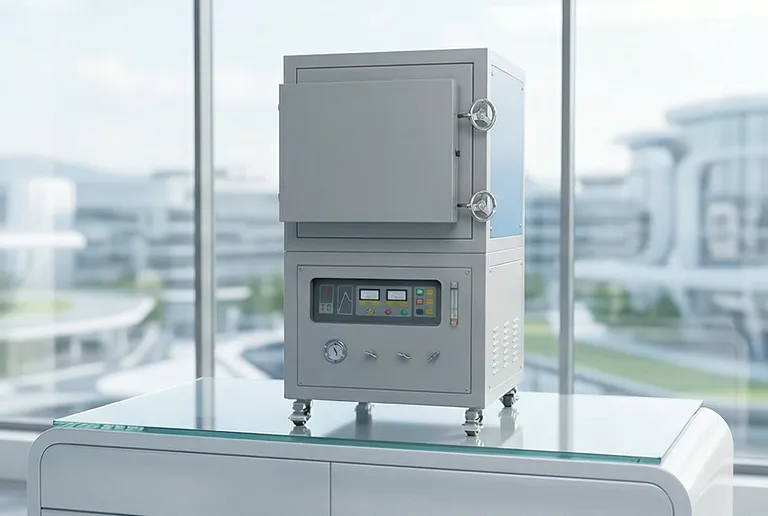
This is where KINTEK’s thermal processing technology becomes an essential partner in your production line. Our range of vacuum sintering and atmosphere furnaces is engineered specifically to exploit the physics of green compact porosity.
Whether you are using a KINTEK vacuum furnace for high-purity aerospace components or a protective atmosphere tube furnace for mass-produced automotive parts, our systems provide:
- Precision Ramp Control: Ensuring lubricants are evacuated slowly through the 10-12% pore network without causing structural "shock."
- Atmosphere Uniformity: Guaranteeing that reducing gases reach every internal channel of your compact for a 100% oxide-free bond.
- High-Temp Stability: Maintaining the exact thermal environment required to close those pores only after the chemical cleaning is complete.
Opening New Doors in Powder Metallurgy
When you stop fighting against the physics of porosity and start working with it, your production capabilities shift. By mastering the 10-12% window and pairing it with a KINTEK high-temperature furnace, you can move beyond simple shapes into complex, high-performance geometries that were previously prone to failure.
You gain the ability to reduce scrap rates to near zero, accelerate your sintering cycles, and produce steel parts with a level of structural integrity that rivals forged components.
Solving the "porosity puzzle" is a critical step in optimizing your lab or production facility. Whether you are dealing with inconsistent sintering results or looking to scale up a new powder metallurgy project, our team is here to help you match the right thermal technology to your material science challenges.
Contact Our Experts today to discuss your specific sintering requirements and find the ideal furnace configuration for your application.
Related Products
- Vacuum Heat Treat Sintering Furnace with Pressure for Vacuum Sintering
- Vacuum Heat Treat Sintering Furnace Molybdenum Wire Vacuum Sintering Furnace
- 2200 ℃ Tungsten Vacuum Heat Treat and Sintering Furnace
- Small Vacuum Heat Treat and Tungsten Wire Sintering Furnace
- 9MPa Air Pressure Vacuum Heat Treat and Sintering Furnace
Related Articles
- Why Your Sintered Parts Fail: It’s Not Just About Heat, But Pressure and Purity
- Why Your Stainless Steel Parts Fail Pressure Tests—and How Vacuum Sintering Fixes the Density Gap
- Why Your Electrochromic Electrodes Fail During Sintering—And How Vacuum Control Restores Transparency
- Why Your 3D-Printed Maraging Steel Parts Aren't Performing—And How to Fix the Structural Weakness
- How Vacuum Pressure Sintering Furnaces Elevate Material Performance Across Industries