The Unseen Enemy in Every Workshop
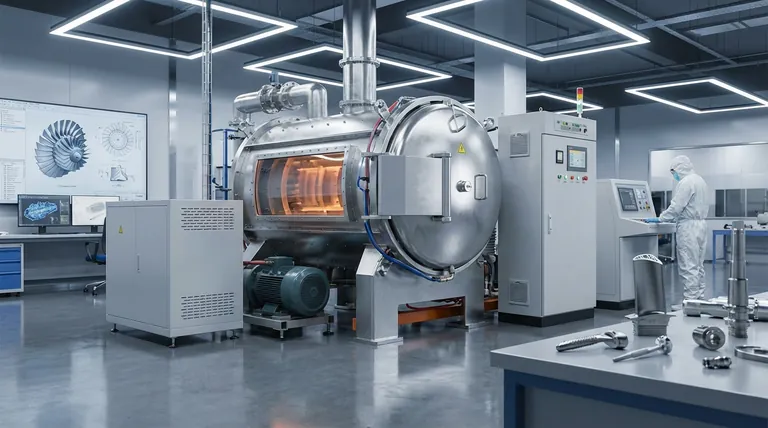
Imagine an engineer designing a turbine blade for a jet engine. The stresses are immense, the temperatures biblical. Every calculation is precise, every curve of the airfoil optimized. Yet, the greatest threat to this component isn't turbulence or heat—it's the air we breathe.
At high temperatures, metal and oxygen have a destructive affinity for one another. This chemical reaction, oxidation, is the unseen enemy in every conventional furnace. It compromises a material's surface, alters its chemistry, and sows the seeds of future failure.
The most profound solution isn't to add a protective layer or a new coating. It's to remove the problem entirely. It’s to create an environment of absence. This is the simple, yet revolutionary, principle behind the vacuum furnace.
The Physics of Absence: What a Vacuum Truly Accomplishes
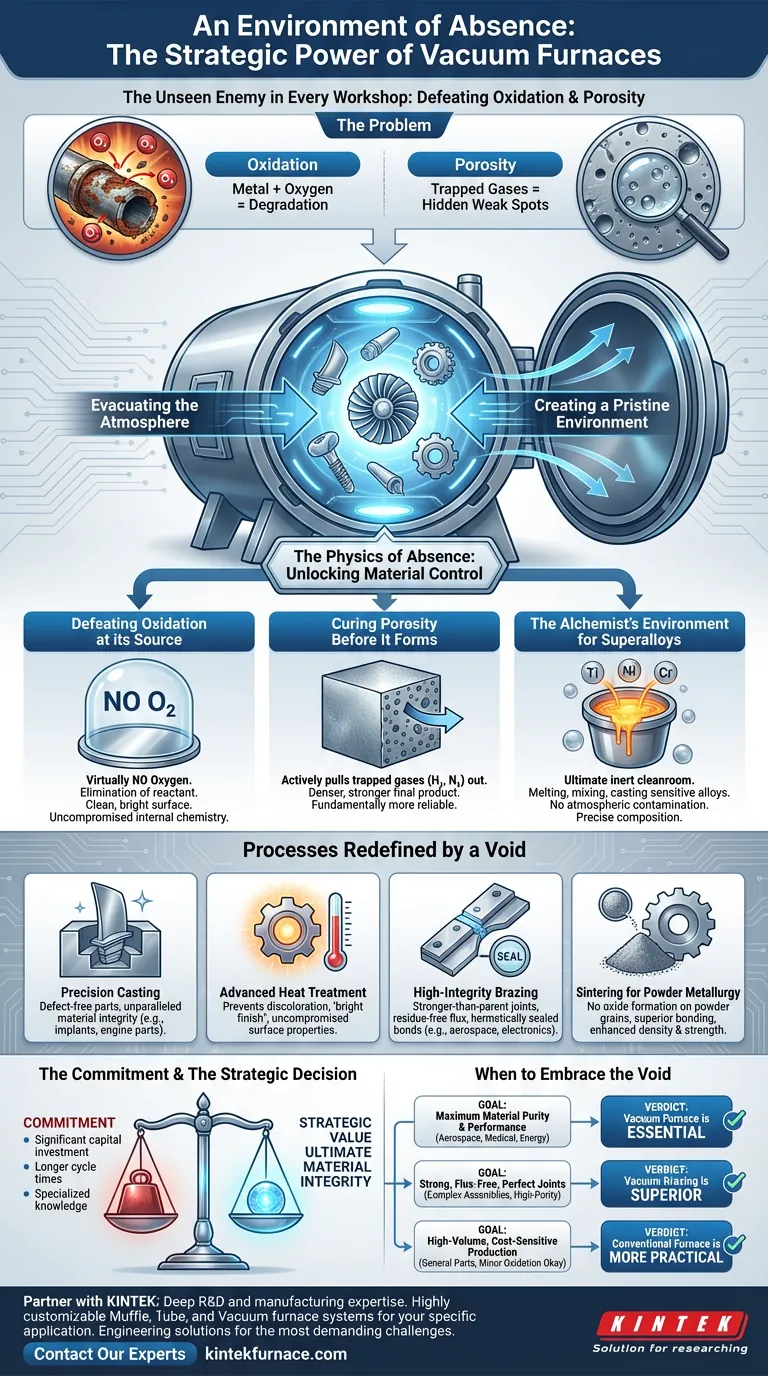
The advantage of a vacuum furnace is not what it adds, but what it takes away. By evacuating the atmosphere, it creates a pristine environment that unlocks a level of material control impossible to achieve otherwise.
Defeating Oxidation at its Source
When you heat metal in the air, you are inviting oxidation. A layer of oxide forms, which can flake off, weaken the structure, and ruin the component’s carefully engineered properties.
A vacuum environment has virtually no oxygen. It's not a shield against oxidation; it is the elimination of the reactant. This guarantees a clean, bright surface and, more importantly, ensures the material's internal chemistry remains exactly as designed.
Curing Porosity Before It Forms
Molten metal is like a sponge for dissolved gases like hydrogen and nitrogen. As the metal cools and solidifies, these gases are forced out of solution, forming microscopic voids and bubbles. This defect, known as porosity, creates hidden weak spots that can lead to catastrophic failure under stress.
A vacuum actively pulls these trapped gases out of the molten material. It forces the metal to exhale its impurities, resulting in a final product that is denser, stronger, and fundamentally more reliable.
The Alchemist's Environment for Superalloys
Industries like aerospace and medical implants depend on exotic superalloys and reactive metals like titanium. Creating them is like executing a flawless chemical recipe where even a trace of an unwanted ingredient can spoil the entire batch.
Atmospheric contamination is that unwanted ingredient. A vacuum furnace provides the ultimate inert cleanroom for metallurgy. It allows these sensitive alloys to be melted, mixed, and cast without compromising the precise composition that gives them their extraordinary properties.
From Concept to Component: Processes Redefined by a Void
The controlled environment of a vacuum furnace doesn't just improve old processes; it enables entirely new levels of manufacturing precision.
- Precision Casting: For components like medical implants or engine parts, the internal structure is as critical as the external shape. Vacuum casting produces defect-free parts with unparalleled material integrity.
- Advanced Heat Treatment: Performing heat treatment in a vacuum prevents surface discoloration and degradation. The resulting "bright finish" is not merely cosmetic; it's a visible confirmation that the material's surface properties are uncompromised.
- High-Integrity Brazing: Vacuum brazing creates joints that are often stronger than the parent materials themselves. The vacuum acts as a perfect, residue-free flux, producing clean, hermetically sealed bonds essential for complex aerospace and electronic assemblies.
- Sintering for Powder Metallurgy: Sintering fuses powdered metals into a solid mass. A vacuum ensures no oxides form on the individual powder grains, allowing for superior bonding and creating a final component with enhanced density and strength.
The Commitment: Understanding the Trade-offs
Embracing vacuum technology is a strategic commitment. It is not always the easiest or cheapest path.
Vacuum furnaces are complex systems. They represent a significant capital investment. Their cycle times can be longer due to the need to pump down the chamber. Operating them requires specialized knowledge.
This isn't a failure of the technology. It's a reflection of the profound problem it solves. Achieving a near-perfect void is an engineering marvel, and that comes with costs. The decision to use a vacuum furnace is a conscious choice to prioritize ultimate material integrity above all else.
The Strategic Decision: When to Embrace the Void
The choice to use a vacuum furnace is driven by the non-negotiable requirements of the final product. Your goal dictates the necessary tool.
| If Your Goal Is... | The Implication | Verdict |
|---|---|---|
| Maximum Material Purity & Performance | For aerospace, medical, or energy parts where failure is not an option. | A vacuum furnace is essential. |
| Strong, Flux-Free, Perfect Joints | For complex assemblies or high-purity components. | Vacuum brazing is the superior choice. |
| High-Volume, Cost-Sensitive Production | For general parts where minor surface oxidation is acceptable. | A conventional furnace is more practical. |
This decision requires more than just a spec sheet; it requires a partner who understands the nuances of material science. At KINTEK, our deep R&D and manufacturing expertise allow us to provide highly customizable Muffle, Tube, and Vacuum furnace systems tailored to your specific application. We don't just sell equipment; we engineer solutions for the most demanding challenges in modern manufacturing.
Whether you're pioneering new alloys or building critical components, achieving the perfect material properties starts with creating the perfect environment. Contact Our Experts
Visual Guide
Related Products
- Vacuum Hot Press Furnace Machine Heated Vacuum Press Tube Furnace
- Vacuum Hot Press Furnace Machine Heated Vacuum Press
- 600T Vacuum Induction Hot Press Vacuum Heat Treat and Sintering Furnace
- 2200 ℃ Tungsten Vacuum Heat Treat and Sintering Furnace
- Vacuum Heat Treat Sintering Furnace with Pressure for Vacuum Sintering
Related Articles
- How Vacuum Hot Press Furnaces Transform Advanced Material Engineering
- How to Select the Right Vacuum Hot Pressing Furnace Temperature for Your Materials
- Beyond the Parts List: The Real Reason Your Vacuum Hot Press Fails (And How to Fix It)
- Why Your High-Temperature Materials Fail: The Hidden War Inside Your Furnace
- Is Your Material Data Real? Why Temperature Gradients Are Sabotaging Your Cu2Se Resistivity Measurements