The "Silent Killer" of High-Performance Joints
Imagine your team has spent weeks machining high-value titanium and gold components. You follow the brazing protocol, the filler metal melts perfectly, and the finished joint looks flawless to the naked eye. But under mechanical stress, the bond snaps like glass.
This "brittle failure" is the nightmare of R&D engineers and lab managers alike. In vacuum brazing, a joint that looks successful on the surface can be structurally compromised at the microscopic level. The culprit isn't usually a lack of heat; it’s a lack of precision. When your furnace temperature fluctuates by even a few degrees, you aren't just heating metal—you are inadvertently changing the chemistry of the bond itself.
The Common Struggle: Why "Close Enough" Isn't Enough
In many laboratories, the standard response to a weak brazed joint is to increase the dwell time or bump up the temperature "just to be safe." However, this often exacerbates the problem.
Without high-precision control, researchers often find themselves trapped in a cycle of inconsistent results:
- The Brittle Phase Trap: Excessive heat leads to the overgrowth of Intermetallic Compounds (IMCs). Instead of a flexible bond, you create a layer of "ceramic-like" brittleness.
- Base Metal Erosion: Overheating causes the filler metal to dissolve too much of the substrate, thinning out critical components.
- Contamination Issues: Failure to maintain precise "steps" in the heating cycle prevents organic binders from volatilizing completely at lower temperatures (like 300°C), leaving carbon impurities that weaken the seam.
The business consequences are clear: scrapped high-value materials, delayed project timelines, and a frustrating inability to move from the prototype stage to reliable production.
The Root Cause: The Delicate Dance of Atoms
The secret to a perfect brazed joint lies in Reaction Diffusion. At high temperatures, atoms from the base metal and the filler metal migrate across the interface. This creates a transition zone that "locks" the materials together.
However, this process is hyper-sensitive to temperature. For example, in Titanium-Gold (Ti-Au) brazing, the difference between 1105°C and 1125°C is not just a 2% change in heat—it is the difference between a healthy metallurgical bond and the formation of a thick, brittle Ti-Au intermetallic layer.
Similarly, in Aluminum-Titanium reactions, precise temperature determines whether you achieve a complete conversion to Al3Ti or are left with an unreacted, weak core. If the temperature rises too fast or stays too high for even a few minutes too long, these microscopic layers grow out of control, turning a structural reinforcement into a point of failure.
The Solution: A Furnace That Acts as a Chemical Reactor
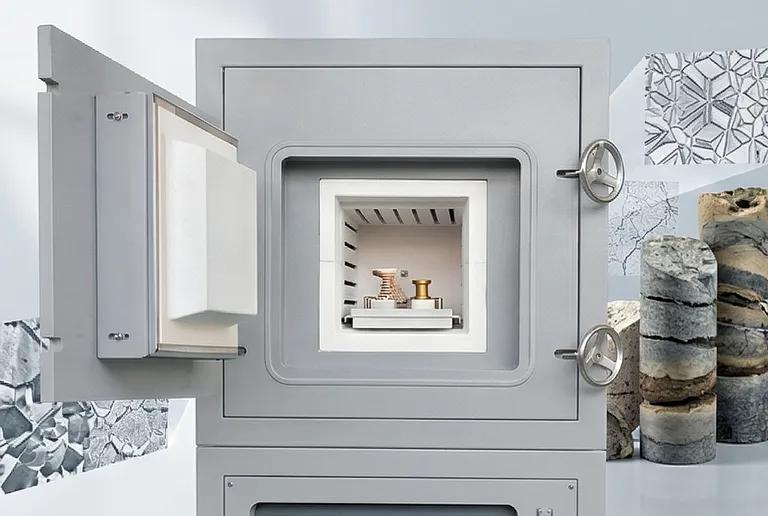
To solve the problem of brittle joints, you need a tool that treats temperature as a precise chemical variable, not just a heat setting. This is where the engineering of a KINTEK Vacuum Furnace changes the equation.
Our systems are designed to manage the three critical pillars of interfacial microstructure:
- Stepped Temperature Accuracy: KINTEK furnaces allow for rigorous preheating and insulation procedures. By holding a constant temperature at 300°C, we ensure binders are completely removed before the brazing begins.
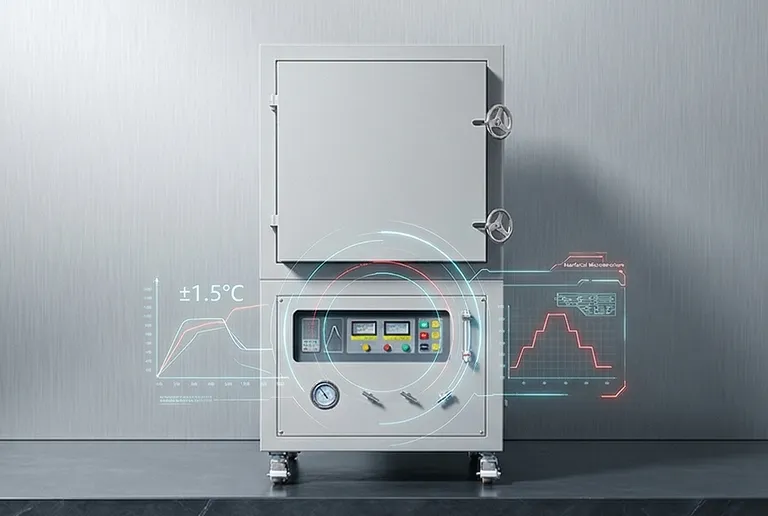
- Unrivaled Precision: With thermocouple indicated values reaching a precision of ±1.5°C, we give you the power to regulate the diffusion rate of elements like Molybdenum (Mo) and Rhenium (Re) with surgical accuracy. This ensures the formation of ideal reinforcing phases, such as σ(Mo₂Re₃), while preventing abnormal grain growth.
- Thermal Uniformity: For complex geometries or large batches, KINTEK utilizes radiant heating and forced gas circulation to keep temperature differences within ±5°C across the entire workspace. This prevents "hot spots" that could lead to excessive filler metal loss in one part of the batch while others remain under-bonded.
Beyond the Fix: Unlocking New Material Possibilities
When you master the microscopic interface through precise temperature control, you do more than just fix a "brittle joint" problem. You unlock the ability to work with advanced materials that were previously too difficult to join.
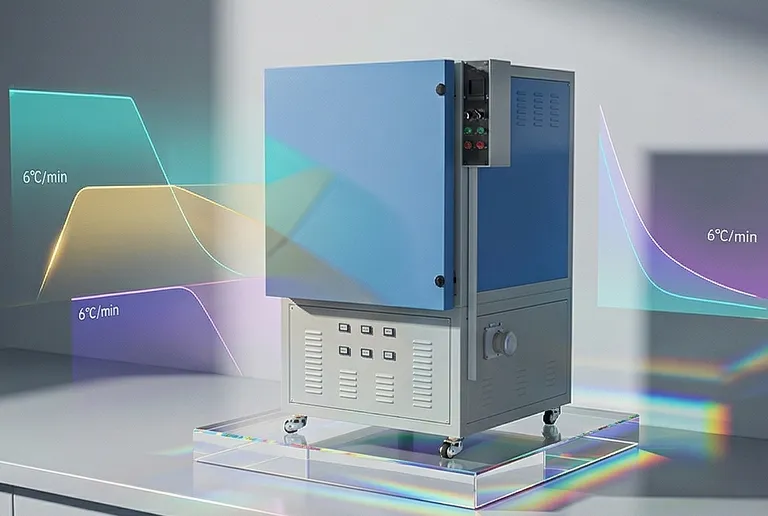
With a stabilized thermal cycle—such as a controlled cooling rate of 6°C/min to alleviate residual stresses—you can successfully bond materials with vastly different thermal expansion coefficients. You can explore thinner, lighter joints for aerospace applications or highly conductive seams for power electronics, knowing that the mechanical integrity is backed by predictable science rather than trial and error.
Mastering the interface means mastering your product's reliability. Whether you are dealing with titanium diffusion or complex boride precipitates, the right thermal environment turns a volatile process into a repeatable success.
Solving these complex metallurgical challenges requires more than just high-quality equipment; it requires a partnership with experts who understand the physics behind the heat. Whether you are struggling with joint brittleness, inconsistent diffusion layers, or complex material compatibility, our team is ready to help you calibrate your process for peak performance. Contact Our Experts to discuss how KINTEK’s precision thermal solutions can advance your next project.
Related Products
- Vacuum Hot Press Furnace Machine Heated Vacuum Press Tube Furnace
- Vacuum Hot Press Furnace Machine Heated Vacuum Press
- 600T Vacuum Induction Hot Press Vacuum Heat Treat and Sintering Furnace
- 2200 ℃ Tungsten Vacuum Heat Treat and Sintering Furnace
- Vacuum Heat Treat Sintering Furnace with Pressure for Vacuum Sintering
Related Articles
- How Vacuum Hot Press Furnaces Transform Advanced Material Engineering
- How to Select the Right Vacuum Hot Pressing Furnace Temperature for Your Materials
- Beyond the Parts List: The Real Reason Your Vacuum Hot Press Fails (And How to Fix It)
- Why Your High-Temperature Materials Fail: The Hidden War Inside Your Furnace
- Is Your Material Data Real? Why Temperature Gradients Are Sabotaging Your Cu2Se Resistivity Measurements



















