The Frustration of the "Perfect" Recipe That Yields Brittle Results
You have followed the phase diagram to the letter. Your temperature ramp is precise, your dwell time is calculated, and your powder purity is high. Yet, when the Zn-Mg (Zinc-Magnesium) alloy samples come out of the furnace, they tell a different story. They are brittle, the porosity is higher than expected, and the mechanical strength is nowhere near the theoretical values required for high-performance applications like biodegradable implants or lightweight aerospace components.
If your experimental data feels like a series of inconsistent "near misses," you aren't alone. In the world of reactive metallurgy, the gap between a successful sinter and a failed batch often comes down to an invisible enemy that standard lab environments simply cannot defeat.
The Common Struggle: Why "Clean" Isn't Clean Enough
When working with magnesium-based composites, many labs attempt to mitigate issues using standard inert gas purging (such as Argon). On paper, this should work. However, the results often remain subpar:
- Surface Passivation: Even in "pure" inert gas, minute traces of oxygen are enough to form a microscopic oxide layer on magnesium particles.
- Dull Finishes and Poor Bonding: This oxide film acts as a physical wall, preventing atoms from diffusing between particles. You end up with a "compact" of pressed dust rather than a unified metallurgical body.
- The Cost of Failure: In a commercial or high-stakes R&D setting, these failures lead to scrapped material batches, delayed project timelines, and unreliable mechanical data that can't be scaled to production.
Many researchers try to compensate by increasing the temperature, only to find they have triggered secondary oxidation or unwanted grain growth, further degrading the material's properties.
The Root Cause: Magnesium’s "Chemical Hunger" for Oxygen
To understand why traditional methods fail, we must look at the underlying chemistry. Magnesium is one of the most chemically active metals used in engineering.
At temperatures as low as 350°C, magnesium doesn't just react with oxygen; it aggressively scavenges it. This creates a persistent Magnesium Oxide ($MgO$) film. While this film is helpful for corrosion resistance in finished products, it is a disaster during sintering. As long as that film exists, "atomic diffusion"—the process where particles actually grow together—is effectively paralyzed.
To truly process Zn-Mg alloys, you don't just need a "closed" environment; you need to fundamentally change the thermodynamics of the chamber. You must lower the oxygen partial pressure to a point where oxidation is physically impossible. This requires a high-vacuum environment (often better than $1 \times 10^{-3}$ Pa) to isolate the magnesium powder from even a single stray molecule of oxygen.
The Solution: A Synergistic Approach to Sintering
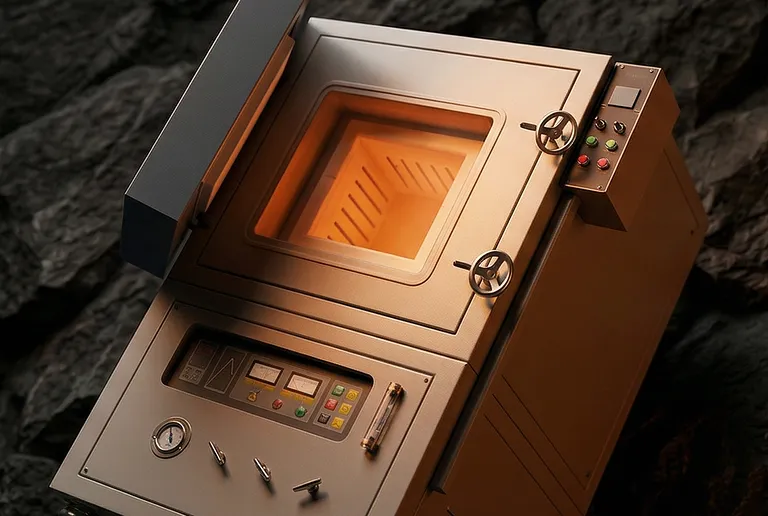
Solving the Zn-Mg challenge requires more than just heat; it requires a tool designed to address the "invisible barrier" of oxide films. This is where the KINTEK Vacuum Hot Pressing Sintering Furnace becomes the essential bridge between raw powder and high-density alloy.
Our technology doesn't just provide a high-temperature environment; it provides a three-pronged solution to the magnesium problem:
- Ultra-High Vacuum Isolation: By maintaining a vacuum level superior to $1 \times 10^{-3}$ Pa, our furnaces eliminate the oxygen and trapped gases within powder gaps. This keeps the particle surfaces "chemically clean," allowing for immediate atomic bonding the moment the temperature rises.
- Uniaxial Pressure Integration: Vacuum alone sometimes isn't enough to break pre-existing oxide films on the raw powder. KINTEK systems apply constant uniaxial pressure (e.g., 10 MPa to 40 MPa). This physical force breaks the brittle oxide "shells" and promotes plastic deformation, ensuring 100% particle contact.
- Precision Thermal Control: Whether processing at 350°C to prevent oxidation or pushing to 550°C-680°C for melt infiltration, our furnaces offer the stability needed to facilitate in-situ reactions without triggering grain coarse-ning.
By coupling high vacuum with external pressing, the alloy melt can fully penetrate interstices, eliminating porosity and achieving a relative density exceeding 97%.
Beyond the Fix: Unlocking New Material Potential

When you move from struggling with oxidation to mastering the vacuum environment, the possibilities for your laboratory expand significantly. You are no longer just "making samples"; you are engineering high-performance materials.
With a controlled, oxygen-free environment, you can consistently produce Zn-Mg-Mn alloys with high purity and no oxide inclusions. You can explore complex phase transformations, such as the formation of fully lamellar structures in advanced alloys, or develop composites with wear resistance and compressive strength that were previously unattainable.
The transition from inconsistent results to repeatable, high-density success isn't just about a better furnace—it's about removing the barriers between your expertise and your results.
At KINTEK, we understand that every alloy system presents a unique set of challenges. Whether you are dealing with the extreme reactivity of magnesium or the high-temperature demands of titanium-aluminides, our team of specialists can help you configure a vacuum sintering or hot-pressing solution tailored to your specific research goals. Don't let oxidation compromise your innovation. Contact Our Experts today to discuss how we can help you achieve theoretical density in your next project.
Related Products
- Magnesium Extraction and Purification Condensing Tube Furnace
- 2200 ℃ Tungsten Vacuum Heat Treat and Sintering Furnace
- Vacuum Heat Treat Sintering Furnace Molybdenum Wire Vacuum Sintering Furnace
- 9MPa Air Pressure Vacuum Heat Treat and Sintering Furnace
- Molybdenum Vacuum Heat Treat Furnace
Related Articles
- Mastering the Void: How Tube Furnaces Forge the Atoms of Innovation
- Why Your Crystal Growth Experiments Are Failing: The Hidden Culprit in Your Tube Furnace
- Beyond Heat: Mastering the Controlled Universe Inside a Tube Furnace
- More Than a Dial: The Psychology of Precision in Tube Furnace Control
- Mastering the Void: How Tube Furnaces Engineer Predictable Outcomes



















