The Hidden Saboteur in a Simple Process
Imagine an aerospace engineer examining a fractured turbine blade under a microscope. The mission failed not because of a grand design flaw, but because of an enemy that was invisible: oxygen. During its heat treatment, trace amounts of air reacted with the metal at a microscopic level, creating imperceptible weaknesses. Under extreme stress, these micro-flaws became the origin point of a catastrophic failure.
This scenario reveals a fundamental truth in materials science: heating a material is easy, but transforming it with absolute fidelity is an art. The primary obstacle isn't temperature; it's the atmosphere itself.
Redefining the Goal: From Heating to Purification
At its core, the function of a vacuum furnace is not merely to get hot. Its purpose is to create a controlled, sterile void—an environment where a material can be thermally transformed without being corrupted by the outside world.
The Atmospheric Problem
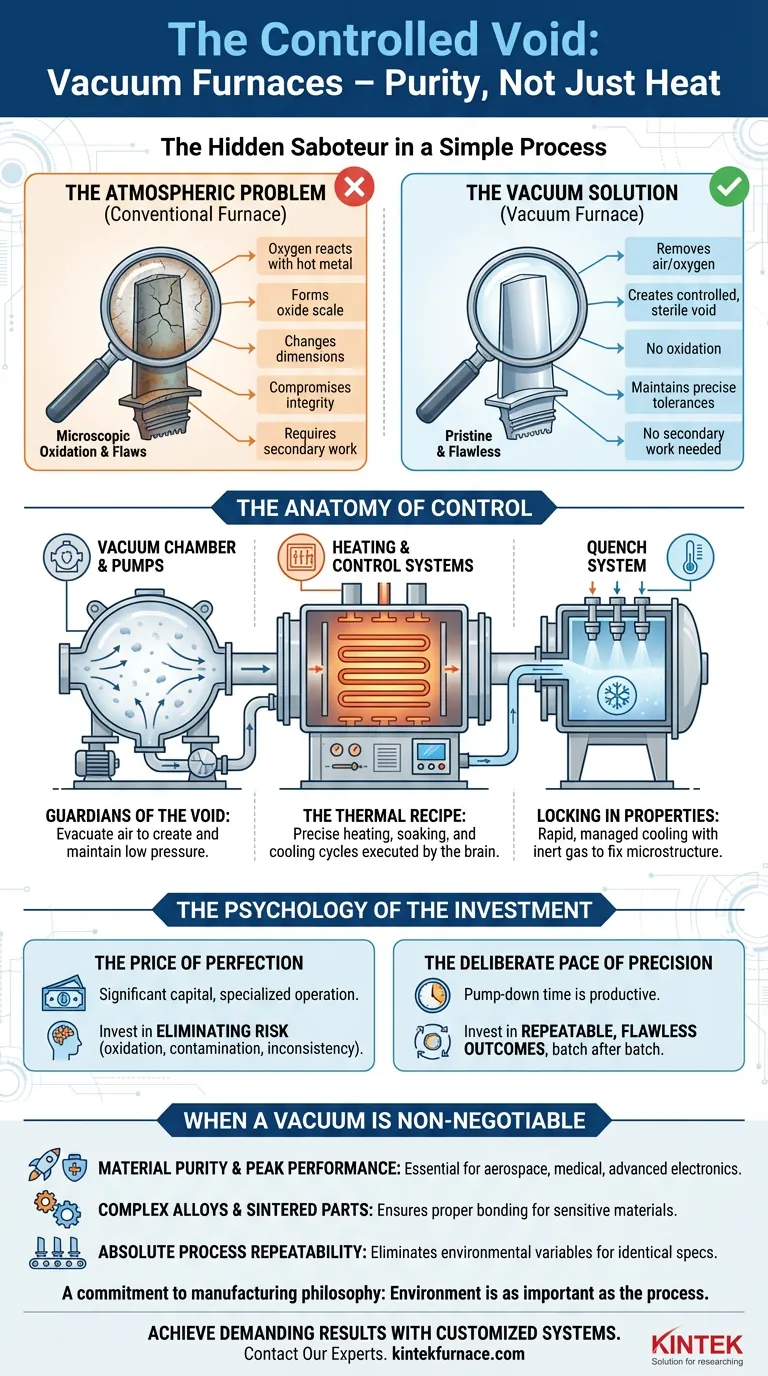
When we heat reactive metals in air, we invite chemistry to the party. Oxygen, ever-present and highly reactive, eagerly bonds with the hot metal surface, forming a layer of oxide scale. This isn't just discoloration; it's a fundamental alteration of the material.
- It changes dimensions: The oxide layer adds thickness, throwing precise tolerances out of whack.
- It compromises integrity: This brittle surface can flake off or create stress points, weakening the final component.
- It requires secondary work: The part must be cleaned, machined, or polished, adding steps and potential for error.
The atmosphere acts as a saboteur, quietly undermining the integrity of the work.
The Vacuum Solution: Engineering Emptiness
A vacuum furnace defeats this enemy with elegant simplicity: it removes the battlefield. By pumping the vast majority of air molecules out of a sealed chamber, it starves the oxidation reaction of its key ingredient.
The goal isn't to create "nothing," but to engineer a pristine environment. This allows the thermal cycle—the carefully plotted sequence of heating, soaking, and cooling—to work on the metal and only the metal. The result is a bright, clean part, emerging from the heat exactly as intended.
The Anatomy of Control
A vacuum furnace is a system where every component serves the singular goal of control. It's a beautiful interplay of brute force and delicate precision.
The Chamber and Pumps: Guardians of the Void
The vacuum chamber is the fortress, built to withstand immense heat from within and atmospheric pressure from without. The pump system is its engine, a multi-stage heart that evacuates the air to create and maintain the required low-pressure state. This is the foundation upon which all else is built.
The Heating and Control Systems: The Thermal Recipe
Heating elements, often made of graphite or refractory metals, provide the raw thermal energy. But the true genius lies in the control system. It is the brain, executing a precise thermal recipe—ramping up the temperature at a specific rate, holding it steady for a calculated duration, and initiating the cool-down at the perfect moment. This is what transforms a lump of metal into a material with specific, engineered properties like hardness, ductility, or tensile strength.
The Quench System: Locking in the Properties
Heating is only half the story. The rate of cooling determines the final microstructure of the metal. A vacuum furnace's integrated cooling system, often using high-pressure inert gas like argon or nitrogen, provides the final layer of control. This rapid, managed cooling—or quenching—locks the desired crystalline structure into place.
The Psychology of the Investment
Choosing a vacuum furnace is a decision about priorities. It involves acknowledging a different kind of cost-benefit analysis, one that prioritizes certainty over speed.
The Price of Perfection
A vacuum furnace is a significant capital investment. Its complexity demands specialized knowledge for operation and maintenance. This isn't a downside; it's the upfront cost of eliminating variables. You are paying for the removal of risk—the risk of oxidation, contamination, and inconsistency.
The Deliberate Pace of Precision
The pump-down time required to achieve a vacuum adds to the overall cycle time. In a world obsessed with volume and speed, this can seem inefficient. But from an engineering perspective, this "delay" is the most productive part of the process. It is the time spent preparing the perfect environment. It's an investment in a repeatable, flawless outcome, batch after batch.
The Decision Framework: When a Vacuum is Non-Negotiable
The choice between a vacuum and a conventional atmospheric furnace boils down to your ultimate goal.
- For material purity and peak performance: If your application in aerospace, medical, or advanced electronics demands components free from any surface oxidation, a vacuum is the only path.
- For complex alloys and sintered parts: When fusing metal powders or creating sensitive alloys, the pristine environment is essential to ensure proper bonding and prevent the formation of unwanted compounds.
- For absolute process repeatability: For industries where every single part must meet identical specifications, the sealed, controlled nature of a vacuum furnace eliminates the environmental variables that plague atmospheric systems.
Understanding this distinction is key. You aren't just choosing a piece of equipment; you're choosing a manufacturing philosophy. It's a commitment to the idea that the environment you create is just as important as the process you run.
For laboratories and R&D teams pushing the boundaries of material science, this level of control is not a luxury; it is a necessity. Achieving these demanding results requires equipment that is not only powerful but also precisely tailored to the task at hand. KINTEK specializes in developing such systems, from Muffle and Tube furnaces to advanced CVD and Vacuum systems, all built with a deep understanding of process purity and a strong capability for deep customization.
If your work demands an environment as pure as your materials, Contact Our Experts.
Visual Guide
Related Products
- Vacuum Hot Press Furnace Machine Heated Vacuum Press Tube Furnace
- Vacuum Hot Press Furnace Machine Heated Vacuum Press
- 600T Vacuum Induction Hot Press Vacuum Heat Treat and Sintering Furnace
- 2200 ℃ Tungsten Vacuum Heat Treat and Sintering Furnace
- Vacuum Heat Treat Sintering Furnace with Pressure for Vacuum Sintering
Related Articles
- How Vacuum Hot Press Furnaces Transform Advanced Material Engineering
- How to Select the Right Vacuum Hot Pressing Furnace Temperature for Your Materials
- Beyond the Parts List: The Real Reason Your Vacuum Hot Press Fails (And How to Fix It)
- Why Your High-Temperature Materials Fail: The Hidden War Inside Your Furnace
- Is Your Material Data Real? Why Temperature Gradients Are Sabotaging Your Cu2Se Resistivity Measurements