The Illusion of Emptiness
We tend to think of a vacuum as nothingness. An empty space.
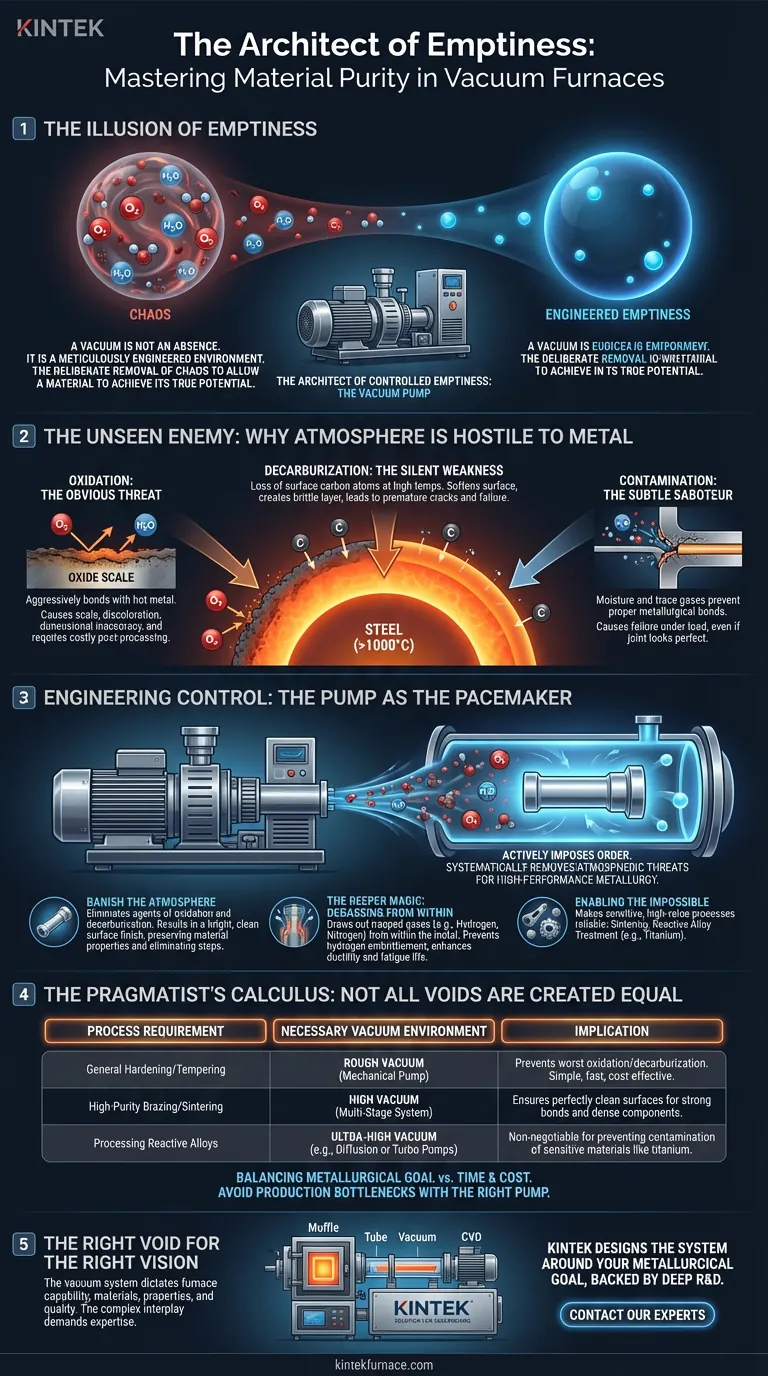
In metallurgy, however, a vacuum is not an absence. It is a presence. It is a meticulously engineered environment, created and sustained with incredible force and precision. It is the deliberate removal of chaos—the oxygen, moisture, and contaminants of the open air—to allow a material to achieve its true potential.
The vacuum pump, then, is not merely a component that removes air. It is the architect of this controlled emptiness. It is the heart of the modern furnace, enabling a level of purity and performance that is simply impossible in a standard atmosphere.
The Unseen Enemy: Why Atmosphere is Hostile to Metal
Imagine a perfectly machined steel alloy component, heated to over 1000°C. In the open air, it is under relentless attack on a molecular level. The atmosphere, which we find so life-sustaining, is profoundly hostile to hot metals.
Oxidation: The Obvious Threat
Air is 21% oxygen, a highly reactive element that aggressively bonds with hot metal surfaces. This creates oxidation—a layer of scale or discoloration. It's not just a cosmetic flaw; it's a compromise of surface integrity, a source of dimensional inaccuracy, and a problem that requires costly and abrasive post-processing to fix.
Decarburization: The Silent Weakness
An even more insidious threat is decarburization. At high temperatures, the carbon atoms near the surface of a steel alloy can be stripped away by atmospheric gases. This loss of carbon softens the surface, creating a brittle outer layer that can lead to premature cracks and component failure under stress. It’s a hidden flaw, invisible to the naked eye but catastrophic in its implications.
Contamination: The Subtle Saboteur
Beyond oxygen, the air is filled with moisture and other trace gases. For sensitive processes like high-purity brazing, even a microscopic layer of contamination can prevent a proper metallurgical bond from forming. A joint that looks perfect can fail under load, all because of an unwanted reaction with an unseen atmospheric molecule.
Engineering Control: The Pump as the Pacemaker
The role of the vacuum pump system is to actively impose order where chaos would otherwise reign. It systematically removes these atmospheric threats, creating the pristine conditions necessary for high-performance metallurgy.
The First Mandate: Banish the Atmosphere
By evacuating the furnace chamber, the pump system directly eliminates the agents of oxidation and decarburization. The result is a bright, clean surface finish straight out of the furnace. This isn't just about aesthetics; it’s about preserving the material’s intended surface properties and eliminating entire steps from the manufacturing workflow.
The Deeper Magic: Degassing from Within
A powerful vacuum does more than protect the surface; it purifies the material from the inside out. As the external pressure drops, trapped gases within the metal itself—like hydrogen and nitrogen—are drawn out.
This process, known as degassing, is critical. Removing dissolved hydrogen, for example, can prevent hydrogen embrittlement, a dreaded failure mode that can cause high-strength steels to fracture unexpectedly. The vacuum actively enhances the material's ductility and fatigue life.
Enabling the Impossible
Certain advanced processes are not just improved by a vacuum; they are entirely dependent on it.
- Sintering: Fusing powdered metals into a solid, dense part requires a vacuum to prevent gas pockets and ensure component integrity.
- Reactive Alloys: Treating materials like titanium, which are extremely reactive with oxygen and nitrogen at high temperatures, is only feasible in a high-vacuum environment.
The pump system makes these sensitive, high-value processes reliable and repeatable.
The Pragmatist's Calculus: Not All Voids are Created Equal
Achieving a perfect vacuum is a theoretical goal. In practice, engineering is about trade-offs. The level of vacuum required is a direct function of the metallurgical goal, balanced against time and cost. The sophistication of the pump system must match the ambition of the process.
| Process Requirement | Necessary Vacuum Environment | Implication |
|---|---|---|
| General Hardening/Tempering | Rough Vacuum (Mechanical Pump) | Prevents the worst oxidation and decarburization. Simple, fast, and cost-effective. |
| High-Purity Brazing/Sintering | High Vacuum (Multi-Stage System) | Ensures perfectly clean surfaces for strong bonds and dense, pure components. |
| Processing Reactive Alloys | Ultra-High Vacuum (e.g., Diffusion or Turbo Pumps) | Non-negotiable for preventing any contamination of sensitive materials like titanium. |
There is a constant tension between the time spent pumping down to the target pressure and the throughput requirements of a manufacturing operation. Choosing the right pump is about meeting the metallurgical need without creating a production bottleneck.
The Right Void for the Right Vision
Ultimately, the vacuum system is the defining feature of a furnace's capability. It dictates the materials you can process, the properties you can achieve, and the quality you can deliver. The choice is a commitment to a certain level of control.
This is why a one-size-fits-all approach to furnace design is insufficient. The complex interplay between process requirements, material science, and system engineering demands expertise. KINTEK's strength lies in understanding this calculus, offering a range of customizable high-temperature furnaces—from Muffle and Tube to advanced Vacuum and CVD systems—backed by deep R&D. We design the system around your metallurgical goal.
Whether you are preventing simple oxidation or pioneering new alloys, the precision of your vacuum environment is paramount. Designing the perfect system requires a deep understanding of both metallurgy and engineering. Contact Our Experts
Visual Guide
Related Products
- Vacuum Hot Press Furnace Machine Heated Vacuum Press Tube Furnace
- Vacuum Hot Press Furnace Machine Heated Vacuum Press
- 600T Vacuum Induction Hot Press Vacuum Heat Treat and Sintering Furnace
- 2200 ℃ Tungsten Vacuum Heat Treat and Sintering Furnace
- Vacuum Heat Treat Sintering Furnace with Pressure for Vacuum Sintering
Related Articles
- How Vacuum Hot Press Furnaces Transform Advanced Material Engineering
- How to Select the Right Vacuum Hot Pressing Furnace Temperature for Your Materials
- Beyond the Parts List: The Real Reason Your Vacuum Hot Press Fails (And How to Fix It)
- Why Your High-Temperature Materials Fail: The Hidden War Inside Your Furnace
- Is Your Material Data Real? Why Temperature Gradients Are Sabotaging Your Cu2Se Resistivity Measurements