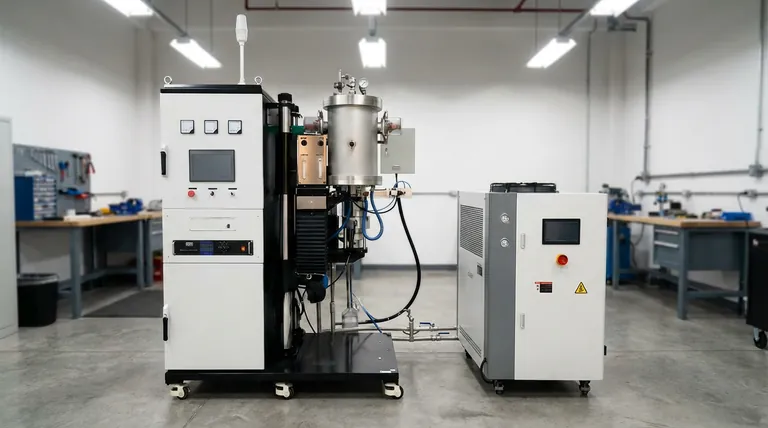
The Hidden Architect of Failure
A critical component fails. On the surface, it looks flawless—perfectly machined, meeting all dimensional specs. Yet, under stress, a microscopic inconsistency, born in the fire of its creation, blossomed into a catastrophic crack.
This is the engineer's nightmare. The source of this failure often isn't a flaw in the design, but an invisible enemy introduced during heat treatment: contamination and thermal stress. The pursuit of perfection, therefore, begins by controlling the environment where a material's final properties are forged.
Conquering the Invisible Enemy: The Vacuum
The primary function of a vacuum furnace is not just to heat, but to purify. By removing the atmosphere, it removes the variables that compromise material integrity.
The War on Oxygen and Scale
In a conventional furnace, ambient air is the enemy. At high temperatures, oxygen aggressively reacts with a metal's surface, forming a brittle, discolored layer of scale.
A vacuum furnace starves this reaction before it can begin. The result is a component with a bright, clean surface straight from the chamber, eliminating the need for costly and abrasive post-processing like sandblasting or acid pickling.
Expelling Inner Demons: The Science of Degassing
Many materials contain dissolved gases like hydrogen and nitrogen—microscopic saboteurs trapped within the metal's lattice. Under thermal stress, these gases can lead to voids and embrittlement, compromising structural integrity.
The vacuum acts as a powerful extractor, pulling these trapped impurities out of the material. This degassing process yields a purer, denser metal with demonstrably superior ductility and fatigue life.
Guarding the Carbon Fortress
For high-strength steels, carbon is the cornerstone of hardness and wear resistance. A conventional furnace atmosphere can leach carbon from the surface, a process called decarburization, leaving the component with a soft, underperforming skin.
A vacuum environment is inert. It protects the material's surface chemistry, ensuring the carbon content remains exactly as specified. The part retains its designed hardness where it matters most.
The Architecture of Predictability: Precision Thermal Control
Creating a vacuum is only half the battle. True quality comes from imposing absolute, uniform control over the thermal cycle.
The Tyranny of the Hot Spot
Uneven heating is the architect of internal stress. When one part of a component heats or cools faster than another, it expands or contracts at a different rate, warping and distorting the geometry.
Precision control ensures temperature uniformity across the entire workload. Every section of the part experiences the same thermal journey, minimizing stress and preserving the integrity of complex, delicate designs.
Achieving Metallurgical Zen: The Power of the Soak
The "soaking" phase—holding a material at a specific temperature—is where its final microstructure is set. Even minor temperature fluctuations can result in inconsistent grain size, hardness, and strength.
Rock-solid temperature stability ensures that the desired metallurgical transformation occurs uniformly. It transforms heat treatment from an art of approximation into a science of repeatable, predictable outcomes.
The Tailor's Edge: Why "Custom" is Not a Luxury
Any vacuum furnace is better than none, but a standard, off-the-shelf model is a blunt instrument. Achieving the highest level of quality demands a tool designed for a specific task. Customization is the principle that unlocks this next level of performance.
-
Optimizing the Chamber: A furnace chamber tailored to your typical workload ensures parts are positioned perfectly for uniform heating and efficient quenching. No wasted energy, no compromised zones.
-
Selecting the Heart (Heating Elements): Different processes and materials require different heating technologies. Customization allows you to select graphite, molybdenum, or other elements perfectly matched to your temperature profiles and chemical compatibility, ensuring efficiency and longevity.
-
Dialing in the Void (Vacuum Levels): Brazing doesn't require the same deep vacuum as annealing titanium. A custom-configured pumping system delivers the precise vacuum level needed—no more, no less—optimizing cycle times and operational costs.
At KINTEK, our expertise in deep customization is built on this philosophy. By aligning the furnace design—from Muffle and Tube furnaces to advanced CVD systems—with your specific material and quality goals, we transform the process into a precision instrument.
An Honest Accounting: The True Cost of Quality
A custom-engineered system is a significant commitment, and it's important to understand the investment.
| Aspect | The Commitment | The Return |
|---|---|---|
| Initial Investment | Higher upfront cost than a standard model. | Drastically improved yield, reduced scrap, and elimination of secondary processing. |
| Process Sophistication | Requires deeper metallurgical knowledge to operate. | Unlocks a higher tier of product performance and process control. |
| Specialized Maintenance | Systems require trained personnel for upkeep. | Greater reliability and a longer operational life for a mission-critical asset. |
A Framework for Perfection
To decide if a custom vacuum furnace is right for you, align its capabilities with your primary objective.
- If your goal is pristine surfaces and material purity, focus on a design with high-performance pumps capable of deep vacuums and effective degassing.
- If your goal is ultimate mechanical strength and hardness, prioritize a design with proven temperature uniformity and a precisely controlled quenching system.
- If your goal is processing complex, high-value parts, focus on a custom chamber, fixturing, and heating layout that eliminates thermal stress.
Ultimately, investing in a customized vacuum furnace is a declaration that "good enough" is no longer acceptable. It's a commitment to scientific precision and repeatable perfection. To explore how a tailored high-temperature solution can elevate your results, Contact Our Experts.
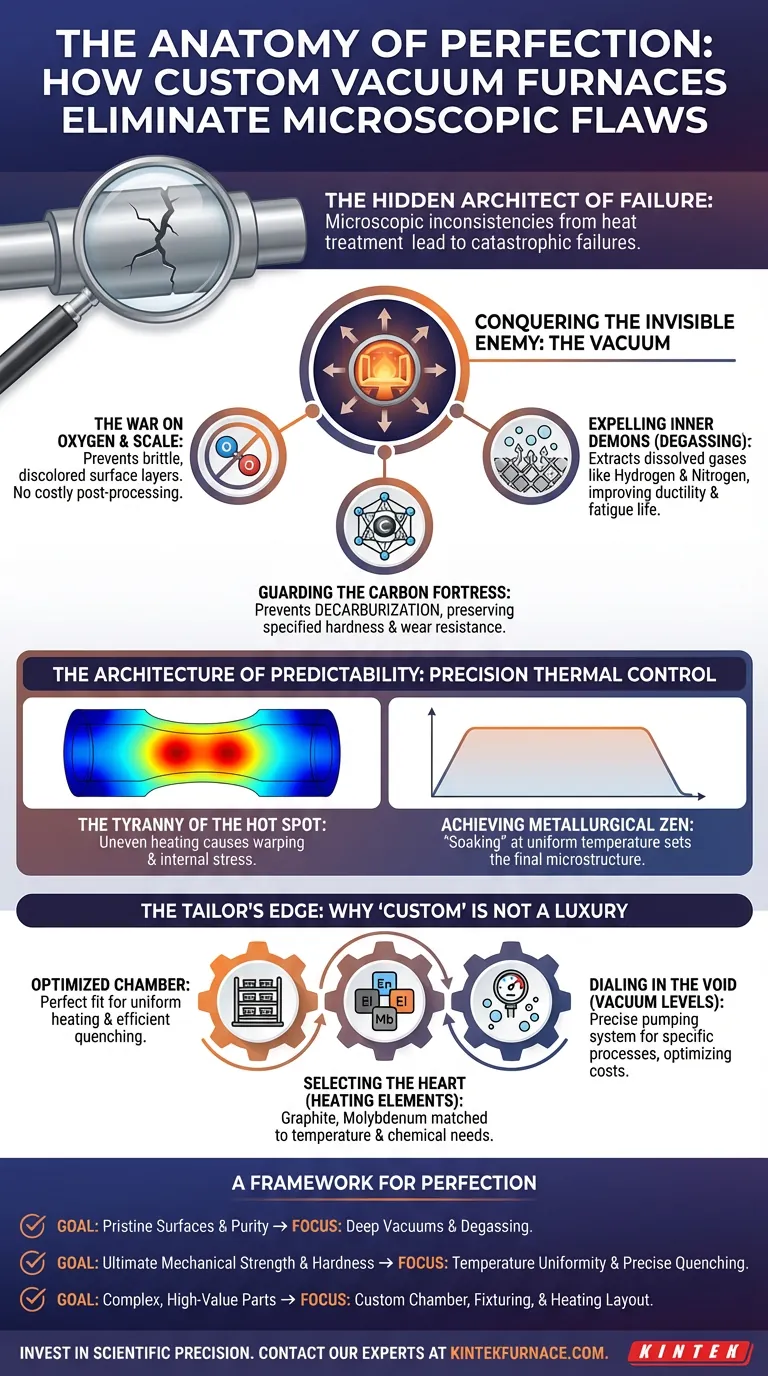
Visual Guide
Related Products
- Vacuum Hot Press Furnace Machine Heated Vacuum Press Tube Furnace
- Vacuum Hot Press Furnace Machine Heated Vacuum Press
- Vacuum Heat Treat Sintering Furnace with Pressure for Vacuum Sintering
- 600T Vacuum Induction Hot Press Vacuum Heat Treat and Sintering Furnace
- Molybdenum Vacuum Heat Treat Furnace
Related Articles
- How Vacuum Hot Press Furnaces Transform Advanced Material Engineering
- How to Select the Right Vacuum Hot Pressing Furnace Temperature for Your Materials
- Beyond the Parts List: The Real Reason Your Vacuum Hot Press Fails (And How to Fix It)
- Why Your High-Temperature Materials Fail: The Hidden War Inside Your Furnace
- Is Your Material Data Real? Why Temperature Gradients Are Sabotaging Your Cu2Se Resistivity Measurements



















