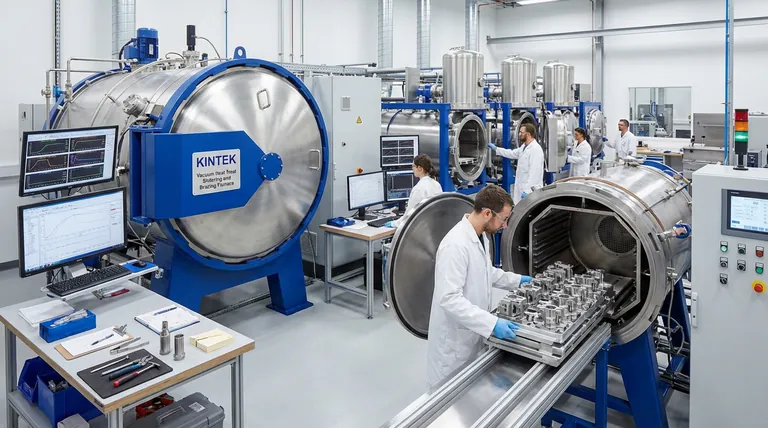
The Hidden Flaw in a Perfect Seam
Imagine a perfectly welded component for an aerospace engine. To the naked eye, the seam is flawless—a clean, strong line. But at the microscopic level, a battle may have been lost.
When metals are heated in the open air, a relentless, invisible enemy attacks: oxygen. It rushes to bond with the hot metal surfaces, forming brittle, microscopic layers of oxide. This contamination acts as a barrier, preventing a true, pure metallurgical bond.
The result is a joint that looks strong but contains a hidden weakness, a potential point of failure under stress. This is the fundamental challenge in high-precision joining: it's not just about heat, but about conquering the environment where that heat is applied.
A Vacuum Is Not Emptiness; It's Control
We tend to think of a vacuum as an empty space, a void. But in materials engineering, a vacuum is the opposite of nothing. It is an active, powerful tool of control.
By removing atmospheric gases, a vacuum furnace doesn't just create an absence of matter; it establishes a pristine environment. It gives engineers the power to dictate the chemical conditions of the joining process.
This is a profound psychological shift. You are no longer simply heating a material and hoping for the best. You are performing atomic-level choreography, ensuring that only the desired metal-to-metal bonds can form, free from the chaos of random chemical reactions.
The Science of an Unblemished Bond
This control manifests in two critical ways that separate a good joint from a perfect one.
Defeating an Invisible Saboteur: Oxidation
Oxygen is the primary saboteur of a strong weld. The oxide layers it forms are structurally weak and prevent the liquid brazing alloy from properly wetting and flowing into the joint.
A vacuum furnace systematically removes this variable from the equation. Inside the chamber, the metal surfaces remain atomically clean as they reach temperature. This allows for direct, intimate contact, creating a metallurgical bond that is as pure and strong as the parent materials themselves.
Imposing Thermal Discipline
The second enemy of precision is thermal stress. Rapid or uneven heating and cooling forces different parts of a component to expand and contract at different rates. This introduces internal stresses that can cause warping, distortion, or even microscopic cracks.
Continuous vacuum furnaces provide highly uniform, programmable thermal cycles. The heating and cooling are slow, deliberate, and even. This isn't brute-force heating; it's thermal discipline. By minimizing temperature gradients, the process preserves the component's precise geometry, which is non-negotiable for parts with tight tolerances.
Where Absolute Integrity Is the Only Option
The demand for this level of control is highest in industries where failure is not an option. The choice of furnace technology is dictated by the material's nature and the component's mission.
| Industry / Material | The Critical Challenge | How the Vacuum Furnace Solves It |
|---|---|---|
| Aerospace & Automotive | Mission-critical parts must withstand extreme temperature, pressure, and vibration without fail. | Creates exceptionally clean, strong, and void-free joints with superior fatigue life. |
| Titanium (Ti) & Molybdenum (Mo) | These metals are highly reactive with oxygen at joining temperatures, leading to severe embrittlement. | Provides the only inert environment pure enough to join these materials without compromising their inherent properties. |
| Advanced Ceramics (Si₃N₄, SiC) | Sintering these materials requires high heat and the removal of trapped gases to achieve maximum density and strength. | The vacuum removes porosity, enabling the creation of near-theoretically dense ceramic components for extreme environments. |
The Engineer's Dilemma: Knowing the Boundaries
Like any powerful tool, a vacuum furnace is not a universal solution. Understanding its limitations is a mark of true engineering wisdom.
The Vapor Pressure Paradox
The primary limitation involves metals with a high saturated vapor pressure. Materials like zinc, lead, manganese, and even copper and aluminum can begin to "boil off" or evaporate under a high vacuum at elevated temperatures.
This phenomenon, known as outgassing, is a paradox: the very environment designed to ensure purity can cause elements of the alloy to vaporize, contaminating the furnace and altering the workpiece's composition. For these materials, an alternative like controlled atmosphere brazing may be required.
The Geometry Puzzle
Achieving perfect thermal uniformity across large or geometrically complex parts remains a challenge. It often requires the design of specialized fixtures and tooling to hold the components and ensure every surface heats and cools at the same rate, adding a layer of complexity to the process.
The Final Equation: Control Over Chaos
Ultimately, the decision to use a vacuum furnace is a decision to prioritize control. It is a commitment to eliminating the random, chaotic variables of the open atmosphere to produce a component with predictable, repeatable, and superior performance.
This level of control is the cornerstone of modern manufacturing. At KINTEK, we specialize in providing these instruments of control. Backed by expert R&D and in-house manufacturing, our line of Muffle, Tube, and advanced Vacuum Furnaces are engineered for precision. Because every application is unique, our deep customization capabilities ensure your furnace is perfectly tailored to solve your specific material and geometric challenges.
Achieve the perfect bond by mastering the environment. Contact Our Experts
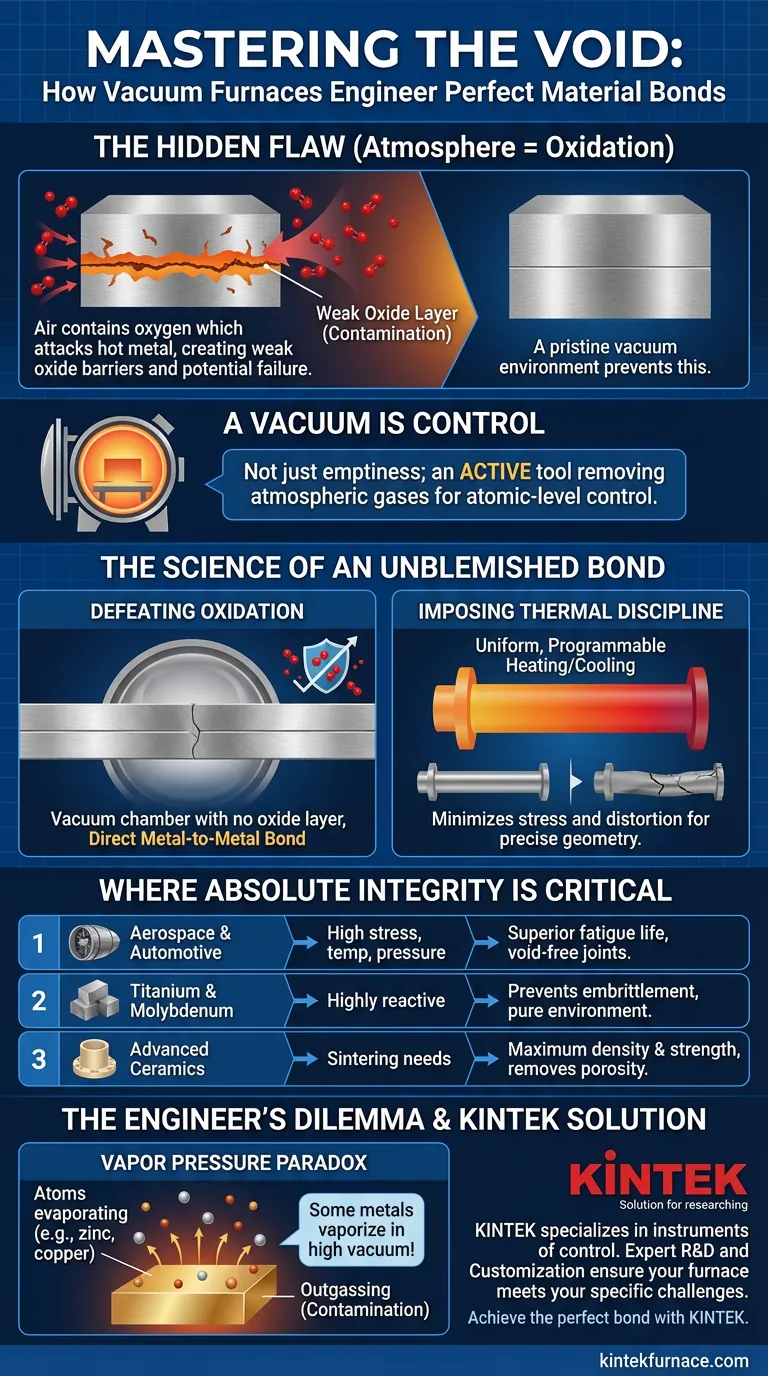
Visual Guide
Related Products
- Vacuum Hot Press Furnace Machine Heated Vacuum Press Tube Furnace
- Vacuum Hot Press Furnace Machine Heated Vacuum Press
- 600T Vacuum Induction Hot Press Vacuum Heat Treat and Sintering Furnace
- 2200 ℃ Tungsten Vacuum Heat Treat and Sintering Furnace
- Vacuum Heat Treat Sintering Furnace with Pressure for Vacuum Sintering
Related Articles
- How Vacuum Hot Press Furnaces Transform Advanced Material Engineering
- How to Select the Right Vacuum Hot Pressing Furnace Temperature for Your Materials
- Beyond the Parts List: The Real Reason Your Vacuum Hot Press Fails (And How to Fix It)
- Why Your High-Temperature Materials Fail: The Hidden War Inside Your Furnace
- Is Your Material Data Real? Why Temperature Gradients Are Sabotaging Your Cu2Se Resistivity Measurements



















