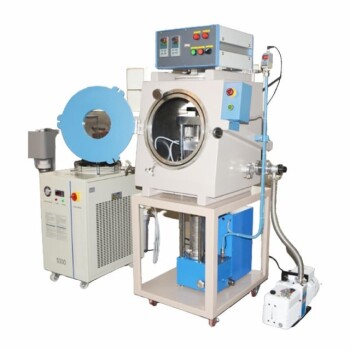
External pressure directly supercharges the driving force for densification.
In standard sintering, the sole engine for pore elimination is the capillary pressure generated by particle surface curvature. When you introduce external mechanical pressure during a furnace heating cycle—either uniaxially in a hot press or isostatically via gas pressure—you add a new, powerful driving force on top of that inherent surface tension. This combined pressure dramatically accelerates mass transport into pores, enabling full density at far lower temperatures and in shorter times than pressureless sintering ever could.
External pressure supplements the weak capillary forces of surface energy, multiplying the effective sintering stress many times over. The result is a leap in densification kinetics that lets you beat grain growth, unlock difficult-to-sinter materials, and often extend the life of your furnace components.
The Fundamental Driving Force in Sintering
To grasp why external pressure is such a game-changer, you first need to see what densification is up against when it has to go it alone.
Why Surface Energy Alone Often Falls Short
Every powder compact carries an excess of surface free energy. Nature wants to minimize that energy, and sintering is the thermal pathway to do so. The trouble is, the force generated by this surface energy is minuscule in practical terms.
For a typical 1 µm ceramic particle, the inherent sintering stress is a mere 75 J/mol. That translates to a capillary pressure around 0.2 to 0.5 MPa—barely enough to drive atomic movement at commercially viable temperatures. Without help, you either need extremely high furnace setpoints or interminable hold times, both of which feed uncontrolled grain growth.
The Math of Capillary Pressure
The classical driving force in pressureless sintering is the Laplace pressure across a curved surface. For a generalized pore-particle geometry, it’s expressed as γs / r, where γs is surface energy and r is the radius of curvature.
This tiny capillary stress creates a vacancy concentration gradient between grain boundaries (under compression) and pore surfaces (under tension). Atoms diffuse from the grain boundary toward the pore, slowly filling it in. In solid-state sintering, that process is inherently slow and easily overtaken by coarsening if temperature pushes too high.
How External Pressure Transforms the Kinetics
Adding an external load during the heating cycle flips the entire densification equation on its head.
The Total Effective Sintering Pressure Equation
In a pressure-assisted furnace, the new driving force for densification becomes:
Pt = (γs / r) + Pappl · f(ρ, geo)
The first term is the familiar capillary pressure; the second is the applied pressure multiplied by a factor that depends on density and particle geometry. That second term is often orders of magnitude larger than the first.
The applied stress does work on the particle system. A modest uniaxial pressure of 30 MPa, typical in hot pressing, adds roughly 750 J/mol of driving force—a tenfold increase over that 75 J/mol baseline. This is why densification rates jump so dramatically.
Stress Intensification at Grain Boundaries
It’s not just a simple addition. The external pressure is amplified at the local contacts between particles. As grains rearrange and necks form, the true stress on a grain boundary becomes:
pe = φ · Pa
Here φ is a stress intensification factor that can range from 1 to well over 10, depending on porosity. Even a moderate applied load can therefore create enormous local compressive stresses right where mass transport is needed most.
An Exponential Leap in Chemical Potential
At the atomic level, external pressure raises the chemical potential of atoms beneath the particle contacts. This steepens the vacancy concentration gradient between the grain boundary (high vacancy concentration under compression) and the pore surface (low vacancy concentration). That steeper gradient directly accelerates diffusion—whether by grain boundary, lattice, or even dislocation-mediated pathways.
In materials that form a transient liquid phase during sintering, pressure also accelerates the solution-precipitation mechanism. It drives faster dissolution at contact points and more rapid reprecipitation into adjacent pores, shortening process times even further.
The Practical Payoff: Lower Temperatures and Finer Microstructures
The thermodynamic advantage translates into real-world benefits that matter to both the process engineer and the material’s final properties.
Outpacing Grain Growth
Grain growth is largely temperature-driven and, crucially, is independent of the applied pressure. By supercharging the densification rate, you can achieve full density at temperatures 100–300°C lower than in pressureless sintering. The result is a dramatic suppression of grain coarsening.
This is especially valuable for nanocrystalline powders or materials like transparent ceramics, where even slight grain growth ruins optical or mechanical performance.
Real-World Examples: From 75 J/mol to 750 J/mol
Consider a difficult-to-sinter covalent ceramic like silicon nitride. Pressureless, it demands ultra-high temperatures and prolonged holds that generate coarse β-Si3N4 grains and degrade fracture toughness. With a 30 MPa hot press, the densification driving force jumps by a factor of ten. Full density is reached at a lower setpoint, preserving a fine, interlocking grain structure that gives the ceramic its legendary strength.
The lower processing temperatures also reduce thermal load on furnace heating elements, extending their service life—a direct line-item saving in maintenance and consumables.
Understanding the Trade-offs
Pressure-assisted sintering is not a universal cure. It brings its own set of constraints and costs that must be weighed honestly.
Equipment Complexity and Cost
Hot presses and gas pressure sintering furnaces are substantially more expensive than standard atmosphere furnaces. They require robust die materials (graphite, refractory metals) and precise hydraulic or gas-pressure control systems. The capital outlay and maintenance are higher, limiting their use to high-value or hard-to-sinter components.
Shape Limitations and Contamination Risks
Uniaxial hot pressing is inherently directional. It produces discs or simple blocks easily, but complex geometries demand expensive machined graphite tooling. Even then, density gradients can occur if the die design isn’t perfect. Hot isostatic pressing (HIP) solves the shape problem but adds even more cost and cycle time.
There is also a risk of contamination from the die or pressure-transmitting medium. Carbon pickup from graphite tooling, for instance, can alter the stoichiometry and properties of sensitive ceramics.
Making the Right Choice for Your Application
Your specific sintering challenge dictates whether external pressure is worth the investment. Use these goal-oriented guidelines to decide.
- If your primary focus is achieving near-theoretical density in a hard-to-sinter material: Pressure-assisted furnaces are often the only viable route. The tenfold jump in driving force closes porosity that surface energy alone cannot eliminate.
- If your primary focus is preserving an ultra-fine grain size: Hot pressing or gas pressure sintering at reduced temperature lets you outrun grain growth, locking in nano- or submicron microstructures critical for strength or transparency.
- If your primary focus is producing net-shape parts with complex geometry at scale: Pressureless sintering or injection molding may be more practical. Reserve HIP for densifying already-shaped preforms, accepting the added cycle time and cost.
- If your primary focus is minimizing furnace consumable and maintenance costs: Lower processing temperatures extend heating element lifespan, but this must be balanced against the higher complexity of pressure systems. A lifecycle cost analysis will reveal the true breakeven.
External pressure during furnace heating cycles doesn’t just speed things up—it fundamentally rewrites what’s possible in solid-state densification. By understanding exactly how it amplifies the chemical potential at grain boundaries, you can harness that extra driving force to achieve otherwise unattainable microstructures and material performance.
Summary Table:
| Feature | Pressureless Sintering | Pressure-Assisted Sintering (HP/GPS) |
|---|---|---|
| Driving Force | Capillary pressure (~0.2–0.5 MPa) | Capillary + Applied pressure (10–100+ MPa) |
| Required Temp | Higher (promotes grain growth) | 100–300°C lower (suppresses grain growth) |
| Densification | Slow, limited by surface energy | Rapid; accelerates mass transport & diffusion |
| Microstructure | Coarser grains, residual pores | Ultra-fine, near-theoretical density |
Elevate Your Advanced Material Processing with KINTEK
Achieving near-theoretical density while maintaining precise microstructural control requires high-performance thermal processing equipment. KINTEK specializes in premium laboratory equipment and customizable high-temperature furnaces—including vacuum, atmosphere, tube, muffle, CVD, rotary, and induction melting furnaces engineered to meet your exact R&D and manufacturing requirements.
Whether you need to optimize densification kinetics, extend heating element lifespan, or design custom high-temp furnace setups for hard-to-sinter materials, our technical team is ready to support your goals.
Contact KINTEK Experts Today to Optimize Your Lab
Related Products
- Vacuum Hot Press Furnace Machine Heated Vacuum Press
- 600T Vacuum Induction Hot Press Vacuum Heat Treat and Sintering Furnace
- Vacuum Hot Press Furnace Machine for Lamination and Heating
- Vacuum Hot Press Furnace Machine Heated Vacuum Press Tube Furnace
- High Pressure Laboratory Vacuum Tube Furnace
People Also Ask
- What are the primary components of a vacuum hot press furnace? Master the Core Systems for Precise Material Processing
- What are the benefits of the vacuum environment system in a vacuum hot press furnace? Unlock High-Density Sintering
- What safety features are incorporated in vacuum hot press furnaces? Ensure Operator and Equipment Protection
- What types of heating elements are used in vacuum hot press furnaces? Optimize for High-Temp Performance
- What are the core advantages of using a vacuum hot press furnace? Achieve Near-Forged Density for Ti-6Al-4V Alloys