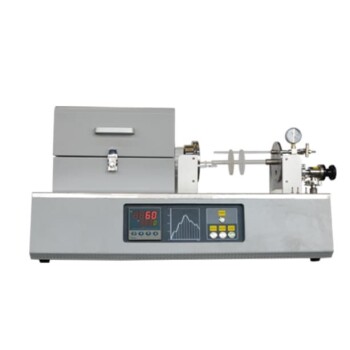
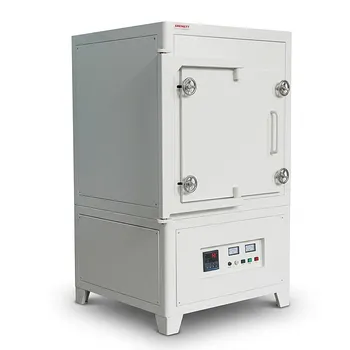
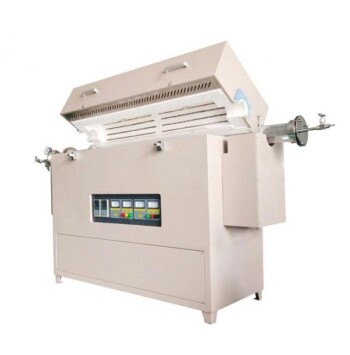
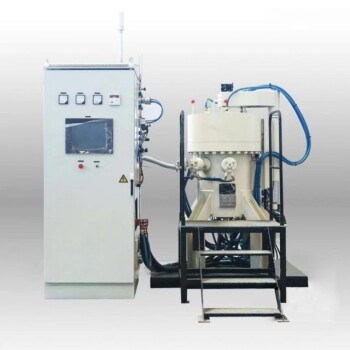
At 1300°C, ceramic sintering transforms a fragile powder compact into a dense, high-strength component. This critical temperature threshold drives two essential processes: partial melting of quartz and silicate phases into a liquid or glassy phase, and the thermal activation of solid-state diffusion. Together they seal internal pores and precipitate a strong crystalline matrix, delivering a leak-free structure. Laboratory high-temperature furnaces make this possible by providing the uniform, precisely controlled heat and atmosphere needed to complete these transformations without damaging the material.
The core purpose of 1300°C firing is to provide the thermal energy for phase transformation and mass transport—converting porosity into density. Without a furnace that can hold that temperature with pinpoint stability, you risk incomplete densification, uncontrolled grain growth, or component failure.
The Physics Driving High-Temperature Sintering
Liquid Phase Formation and Pore Sealing
Many technical ceramics contain quartz and silicate additives. At around 1300°C, these components partially dissolve into a liquid that wets the solid particles and fills the spaces between them.
Upon cooling, this glassy phase solidifies and promotes crystal precipitation within the matrix. The result is a dense, interlocked microstructure with sealed porosity—yielding dramatically improved mechanical strength and gas/liquid impermeability.
Diffusion Kinetics and Defect Activation
Even in purely solid-state sintering, 1300°C is near the 80–90% of melting point range where atomic mobility surges. The concentration of point defects—vacancies and interstitials—increases exponentially with temperature, described by ( C_v \approx \exp(-\Delta h / kT) ).
These defects are the vehicles for grain-boundary and volume diffusion, transporting mass to particle necks and eliminating pores. Without this thermal activation, diffusion remains sluggish, and the compact stays porous and weak.
The Danger of Insufficient Firing
Failing to reach 1300°C leaves high residual porosity. The liquid phase never forms, and diffusion rates are too low to close pores effectively.
You end up with a permeable, low-strength ceramic that may fail under mechanical stress or leak fluids—exactly the problems sintering is meant to solve.
How Laboratory Furnaces Enable Precision Sintering
Precise Temperature Profiling
A lab furnace’s real power lies in programmable heating-rate control. Critical shrinkage events often occur in narrow temperature windows—for example, alumina-zirconia composites densify rapidly between 1210°C and 1440°C.
By programming isothermal holds just before or inside that window, you can allow diffusion to catch up and prevent localized grain overgrowth. This tailoring ensures uniform density throughout the part.
Uniform Heating and Atmosphere Control
Achieving uniform temperature distribution across the entire load prevents hot spots that can cause differential shrinkage and warping. Advanced muffle and tube furnaces use multi-zone heating and high-quality insulation to maintain tight gradients.
When needed, controlled atmospheres (inert, reducing, or oxidizing) can be introduced. This directly manipulates defect chemistry and stoichiometry, enabling targeted microstructures and preventing unwanted phase changes—critical for sensitive systems like chromium-containing shades or negative thermal expansion materials.
Understanding the Trade-offs
The Risk of Exaggerated Grain Growth
While high temperature is essential, it also accelerates grain boundary migration. If the heating profile isn’t carefully managed, surface diffusion—which moves mass without densifying—can dominate early on, causing premature grain coarsening.
The result is large, trapped pores that cannot be removed later. A precisely controlled ramp rate is your defense against this failure mode.
Equipment Complexity and Material Sensitivity
Higher sintering temperatures around 1300°C often demand specialized furnace designs like walking beam furnaces for continuous processing. Certain materials, such as chrome-containing shades, are extremely sensitive to oxygen, making atmosphere control non-negotiable.
This adds cost, maintenance, and process complexity. You must balance the benefit of full densification against the operational demands of the equipment.
Operational Limits and Oversintering
Pushing temperatures too far beyond 1300°C can cause complete melting or glass-phase segregation, destroying the intended properties. Even at the target temperature, excessive soak times can lead to exaggerated grain growth and degraded mechanical behavior.
Laboratory furnaces give you the precision to stay inside the optimal processing window, but the process engineer must define that window correctly.
Making the Right Choice for Your Process
Use these priorities to guide your sintering strategy.
- If your primary focus is achieving maximum density and a leak-free structure: Use a furnace with tight temperature uniformity and the ability to hold at 1300°C long enough for complete liquid phase formation and pore closure.
- If your primary focus is microstructural refinement and controlling grain size: Implement a programmable heating profile that includes isothermal holds before the rapid shrinkage zone to suppress surface diffusion and exaggerated grain growth.
- If your primary focus is sintering defect-sensitive or chromic materials: Select a furnace with precise atmosphere control (e.g., flowing argon or nitrogen) to set the correct defect chemistry and prevent oxidation.
- If your primary focus is scaling up from lab to pilot production: Consider a high-temperature furnace design—like a walking beam or pusher kiln—that delivers the uniform heat and throughput your material demands without sacrificing part quality.
Your furnace is not just a heat source; it is the instrument that translates fundamental sintering physics into a reliable, high-performance ceramic. Match its capability to the specific thermal and atmospheric needs of your material, and that 1300°C threshold will consistently deliver a dense, strong, and functional product.
Summary Table:
| Process Mechanism | Key Furnace Feature | Primary Benefit to Ceramic |
|---|---|---|
| Liquid Phase Formation | Precise 1300°C Thermal Stability | Fills internal pores, forming a strong crystalline matrix |
| Solid-State Diffusion | Programmable Ramp Rates | Activates atomic transport and closes residual porosity |
| Grain Growth Control | Isothermal Holds & Multi-Zone Heat | Prevents exaggerated coarsening and surface defects |
| Atmosphere Control | Flowing Inert/Reducing Gas Setup | Protects defect chemistry and prevents unwanted oxidation |
Achieve flawless material densification and superior mechanical strength with KINTEK! As specialists in premium laboratory equipment and consumables, KINTEK offers a comprehensive range of customizable high-temperature furnaces—including muffle, tube, rotary, vacuum, CVD, atmosphere, dental, and induction melting furnaces tailored to your exact thermal processing specs. Contact KINTEK Experts Today to optimize your sintering workflow!
Related Products
- 1400℃ High Temperature Laboratory Tube Furnace with Alumina Tube
- 1700℃ High Temperature Laboratory Tube Furnace with Alumina Tube
- 1800℃ High Temperature Muffle Oven Furnace for Laboratory
- 1700℃ High Temperature Muffle Oven Furnace for Laboratory
- 1200℃ Muffle Oven Furnace for Laboratory
People Also Ask
- How does zone-melting in tube furnaces synthesize bismuth micro-wires? Master Single-Crystal Thermoelectric Growth
- How do high-temperature laboratory tube furnaces ensure environmental stability? Precision Thermal Reduction Tips
- How are high-temp tube furnaces used to measure diffusion coefficients per Fick's law? Master Precision Annealing
- How are high-temperature laboratory tube furnaces applied in long-term vacuum homogenization heat treatments for intermetallic samples?
- How are high-temperature tube furnaces applied in testing ceramic-supported alloy membranes? Insights