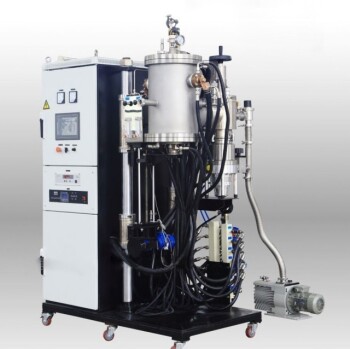
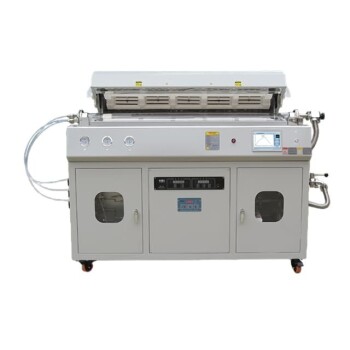
Lead-based electroceramics like PLZT demand an atmosphere furnace with controlled vapor pressure because lead oxide’s extreme volatility at sintering temperatures destroys stoichiometry, creates internal porosity, and releases hazardous fumes. A sealed crucible containing a lead-rich atmosphere powder—typically a PbO and PbZrO₃ mixture—generates a positive equilibrium vapor pressure of PbO around the sample, effectively halting evaporation. This precise environmental control, combined with managed gas flows, is the sole reliable route to fully dense, high-performance components that retain their intended composition and safety envelope.
Controlled vapor pressure sintering transforms a dangerous, destabilizing loss mechanism into a predictable thermodynamic balance. It is the foundation for achieving the exact chemical harmony and pore-free microstructure that define the piezoelectric, dielectric, and optical excellence of advanced electroceramics.
The Fundamental Problem: Lead Volatility at High Temperatures
The Instability of Lead Oxide Above 800°C
Lead oxide (PbO) develops a high vapor pressure long before typical sintering temperatures are reached. Once the furnace climbs above roughly 840°C to 900°C, PbO begins to volatilize rapidly, a process that accelerates as densification and transient liquid phase formation kick in.
In an unprotected environment, this evaporation does not slow down. The ceramic compact behaves like a reservoir continuously losing its most mobile constituent, with the rate of loss dictated by temperature and the absence of any counter-pressure.
How Evaporation Sabotages the Ceramic Body
The immediate consequence is a stoichiometric imbalance—the carefully engineered ratio of elements at the morphotropic phase boundary (MPB) drifts. Lead-depleted regions form, especially at grain boundaries, creating a cascade of microstructural defects.
These regions cannot densify properly. Severe porosity replaces what should be a flawless grain network, and the chemical gradients lock in phases far from the intended crystalline structure. The result is a ceramic that is mechanically weak, optically cloudy, and electrically dead.
Why Standard Furnaces Fall Short
A conventional high-temperature box furnace without active atmosphere management does nothing to combat this. It may reach the correct setpoint, but the open chamber allows volatile PbO to escape into the exhaust stream, permanently removing lead from the sample and posing a toxic hazard.
For lead-based electroceramics, temperature alone is not enough. The furnace must become a sealed, chemically controlled reaction vessel that enforces a specific partial pressure of the volatile species.
Why Stoichiometric Control is Non-Negotiable for Electroceramics
The Delicate Chemistry of the Morphotropic Phase Boundary
In compositions like PZT and PLZT, the morphotropic phase boundary is an extremely narrow compositional window where rhombohedral and tetragonal phases coexist. Here, the material’s piezoelectric and dielectric properties reach their maximum.
Lead loss from the grain boundaries shifts the local chemistry away from this boundary. Even small weight losses—below 1 wt%—can severely degrade the planar coupling coefficient (kp) and the piezoelectric strain coefficient (d33), rendering the ceramic useless for actuation or sensing.
Lead-Deficient Grain Boundaries as Failure Points
Evaporation does not happen uniformly. It concentrates at surfaces and, critically, at the interfaces between grains. Lead-deficient grain boundaries act as weak, high-resistance barriers that scatter electrical and mechanical signals.
This not only lowers the bulk performance but also introduces variability from one batch to the next. Without stoichiometric uniformity at the microscale, reliable production of transparent ceramics or precision actuators is impossible.
Full Density is Impossible Without Chemical Integrity
Achieving >99% relative density requires a coherent liquid phase that wets grains and eliminates pores. When lead evaporates, the chemistry of that liquid phase shifts, its volume fraction drops, and it can no longer perform its capillary-driven pore-filling role.
Thus, the fight against porosity is intrinsically linked to the fight against lead loss. Atmosphere control is not an optional optimization—it is a prerequisite for full densification.
The Atmosphere Furnace Solution: How Equilibrium Vapor Pressure Works
The Sealed Crucible and Packing Powder Technique
Engineers suppress volatility by placing the green ceramic inside a sealed ceramic crucible (alumina or platinum) and surrounding it with a coarse packing powder of identical composition to the sample—typically a mixture of PbO and PbZrO₃.
This arrangement is not a mere physical barrier. As the furnace heats up, the packing powder volatilizes first, flooding the small, enclosed volume with PbO vapor before the sample itself reaches its evaporation threshold.
Creating a Self-Regulating Vapor Pressure
The lead-rich vapor quickly establishes an equilibrium partial pressure inside the crucible. Once the vapor pressure of PbO matches the activity of the solid sample, the net evaporation rate drops to nearly zero.
The system becomes self-regulating: the sample sees a saturated local atmosphere, so lead ions stop leaping into the vapor phase. This thermodynamic lock is what allows sintering to proceed at 1050°C to 1280°C with weight losses below 0.5 wt%.
Integrating with the Background Gas Environment
The atmosphere furnace itself adds another layer of control. A flowing gas environment—such as synthetic air, humidified air, or controlled oxygen—is passed through the chamber outside the sealed crucible.
This flowing gas protects the exterior of the crucible, manages any minute leaks, and, when coupled with oxygen probes, enables real-time adjustment of the oxygen partial pressure. This fine-tuning stabilizes the oxidation state of the ceramic, prevents unwanted decomposition, and harmonizes densification kinetics.
Engineering the Sintering Environment: Crucibles, Powders, and Gases
Crucible Material Selection: Alumina vs. Platinum
Alumina crucibles offer a cost-effective starting point for low-volume, short duration experiments. However, hot PbO vapor is chemically aggressive and slowly corrodes alumina, which can contaminate the sample and limit crucible life.
For repeated processing and long-term stability, platinum crucibles are the preferred choice. They withstand the corrosive lead vapor without degradation, provide an inert seal, and maintain a consistent internal atmosphere over many cycles.
Optimizing the Packing Powder Formulation
The exact makeup of the atmosphere powder matters. Common formulations include PbZrO₃ with excess PbO, or PbZrO₃ + 10% ZrO₂. The excess PbO component boosts the initial vapor pulse, while the zirconate components ensure the vapor composition remains congruent with the sample.
Using a coarse powder ensures ample free volume for rapid vapor equilibration and prevents the packing material itself from sintering into a solid block that would crack the crucible upon cooling.
Monitoring and Controlling the Gas Phase
Integrated oxygen probes in the furnace give precise feedback on the local oxygen activity. This data allows operators to maintain a consistent oxidative environment that prevents reduction of PbO to metallic lead, which would disrupt the vapor balance.
Controlling the flow rate and humidity of the gas further tailors the removal of combustion byproducts from the binder burnout stage and stabilizes the transient liquid phase that drives densification.
Understanding the Trade-offs and Pitfalls
Reactivity Limits Crucible Lifetime
While platinum resists corrosion, it is expensive and susceptible to attack in the presence of certain contaminants. Alumina, though cheaper, degrades over time and can introduce aluminum contamination into the grain boundaries of sensitive PLZT batches.
The engineer must balance budget, throughput, and purity requirements, often reserving platinum for the most transparency-critical runs.
Uniformity Challenges in Scale-Up
The sealed-crucible method works beautifully for small laboratory samples. Scaling to larger or multiple parts requires careful arrangement so that every component sees the same local vapor pressure.
Dead zones inside the crucible, poor packing powder distribution, or inadequate sealing can lead to lead loss at the edges of a large billet, creating property gradients across a single component.
Over-Pressurization and Phase Drift
Too high a vapor pressure of PbO can also be problematic. It may suppress the evaporation of other minor volatile species in a beneficial way, but an excessively lead-rich atmosphere can shift the final stoichiometry toward lead excess, altering phase stability and grain growth behavior.
The goal is a precise equilibrium, not simply a maximum PbO pressure, which demands tight control over powder composition and temperature uniformity.
Making the Right Choice for Your Sintering Process
The path to success depends on your specific performance targets and operational constraints. Here is how to apply these principles:
- If your primary focus is maximum optical transparency (PLZT): Prioritize a platinum sealed-crucible system with a PbO-rich packing powder and precisely controlled oxygen flow to eliminate all porosity and chemical cloudiness.
- If you are scaling up production of PZT actuators: Invest in robust atmosphere furnaces with integrated oxygen probes and develop a reproducible pack-and-seal protocol using lead-compensating mixtures like PbZrO₃ + 10% ZrO₂ to keep weight loss consistently below 0.5 wt%.
- If minimizing cost is critical for early-stage prototyping: Begin with sealed alumina crucibles and a carefully formulated PbO/PbZrO₃ powder bed, but validate lead retention with a post-sintering weight check and expect to transition to platinum for high-value runs.
- If you need precise phase control at the morphotropic phase boundary: Focus on the background gas composition—humidified air can fine-tune oxygen activity and liquid phase amount, enabling a sharper, more homogeneous phase transition.
The controlled vapor pressure environment is what turns a volatile liability into a precision tool. Master it, and you unlock the full dense, chemically pristine potential of the world’s most capable electroceramics.
Summary Table:
| Key Aspect | Problem Without Control | Atmosphere Furnace Solution | Process Benefit |
|---|---|---|---|
| Lead Volatility | Rapid PbO evaporation >800°C | Sealed crucible + Pb-rich packing powder | Suppresses net weight loss to <0.5 wt% |
| Microstructure | Severe porosity & grain defects | Self-regulating equilibrium vapor pressure | Achieves >99% relative density |
| Stoichiometry | Drifts from Morphotropic Phase Boundary | Stable O₂ partial pressure & gas monitoring | Preserves piezoelectric & optical properties |
| Crucible & Safety | Toxic Pb fumes & chamber corrosion | Inert platinum/alumina vessels + gas flow | Protects equipment & ensures high purity |
Master Precision Sintering with KINTEK High-Temperature Furnaces
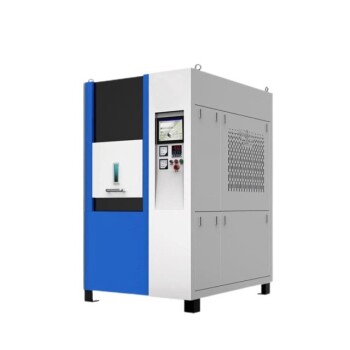
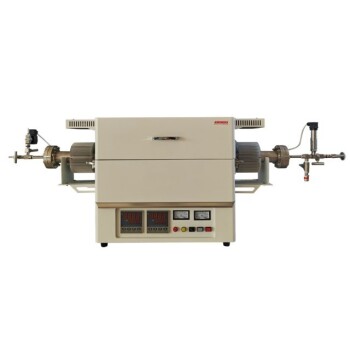
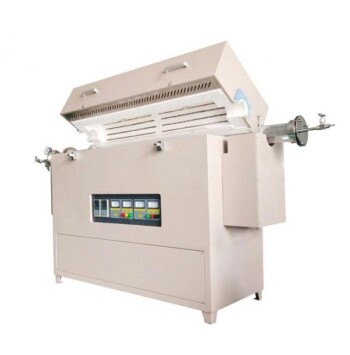
Prevent volatile element loss, maintain exact chemical balance, and achieve defect-free microstructures in your advanced electroceramics. KINTEK specializes in high-performance laboratory equipment and custom high-temperature furnaces—including controlled atmosphere, tube, muffle, vacuum, and CVD systems tailored to your exact gas-flow and thermal control requirements.
Ready to elevate your ceramic sintering efficiency and product quality? Contact us today to explore custom furnace solutions with our technical experts!
Related Products
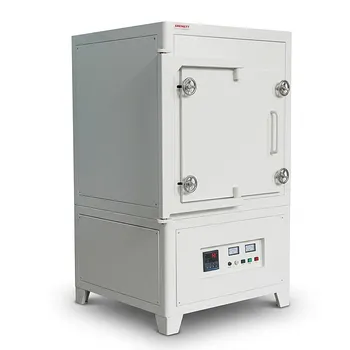
- 1200℃ Controlled Inert Nitrogen Atmosphere Furnace
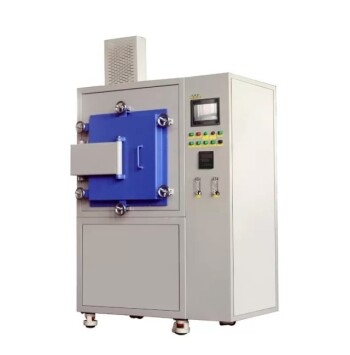
- Controlled Inert Nitrogen Hydrogen Atmosphere Furnace
- 1700℃ Controlled Inert Nitrogen Atmosphere Furnace
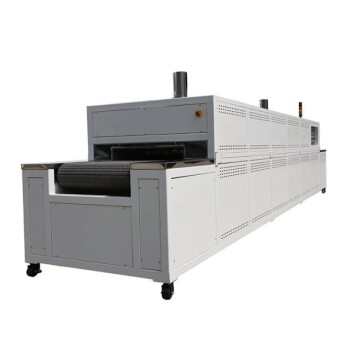
- Mesh Belt Controlled Atmosphere Furnace Inert Nitrogen Atmosphere Furnace
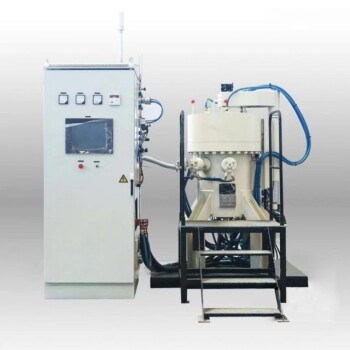
- 9MPa Air Pressure Vacuum Heat Treat and Sintering Furnace
People Also Ask
- What controlled-atmosphere furnace conditions are required for sintering powder metallurgy copper alloy compacts? Ideal Setup
- What Roles Do a Controlled Atmosphere Furnace and Oil Quenching Tank Play in AISI 5140 Steel Heat Treatment?
- How does introducing reactive gases into a controlled atmosphere furnace affect ceramic densification and coarsening?
- What causes discrepancies between theoretical and experimental grain boundary mobility during ceramic sintering? Explained
- What are the core steps in powder metallurgy, and why is a controlled atmosphere furnace necessary for sintering metal alloys?