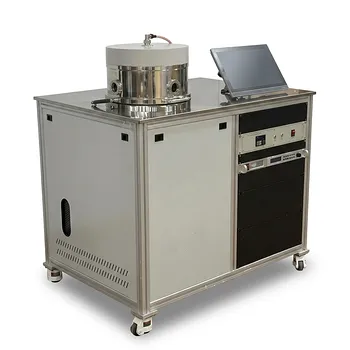
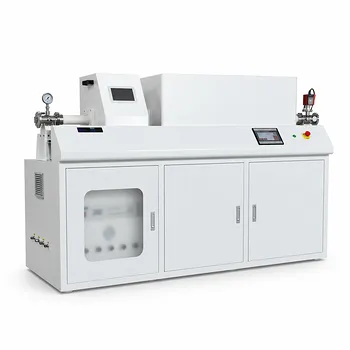
The necessity of an atmosphere-controlled tube furnace for nickel loading on Anatase Titanium Dioxide lies in its ability to facilitate high-temperature reduction in a strictly regulated chemical environment. Specifically, it allows for the introduction of flowing hydrogen and argon gas mixtures, which are required to reduce nickel ions into their active metallic state and induce catalytic oxygen vacancies on the $TiO_2$ surface.
Core Takeaway: To achieve effective catalytic activity, a tube furnace must provide a stable, reducing environment that transforms inactive nickel precursors into metallic catalysts while simultaneously engineering the surface defects of the titanium dioxide support.
Facilitating Chemical Reduction and Active Site Formation
Converting Nickel Ions to Metallic States
In the loading process, nickel typically starts as an ionic precursor that lacks catalytic properties. High-temperature reduction in a hydrogen-rich atmosphere is the only reliable method to convert these ions into the active metallic state required for catalysis.
Creating Critical Oxygen Vacancies
The atmosphere-controlled furnace does more than just affect the nickel; it modifies the Anatase Titanium Dioxide support itself. The flowing gas mixture creates trace oxygen vacancies on the $TiO_2$ surface, which serve as essential catalytic sites for the selective alpha-C alkylation of phenol.
Establishing the Precise Gas Environment
A tube furnace allows for the precise blending of hydrogen and argon gas mixtures. Argon acts as an inert carrier or protective shield, while hydrogen serves as the reducing agent, ensuring the reaction occurs without the interference of ambient oxygen.
Maintaining Material Integrity and Preventing Contamination
Preventing Unwanted Oxidation
In an open-air furnace, high temperatures would cause the nickel to rapidly oxidize back into an inactive oxide state. The sealed environment of a tube furnace excludes atmospheric oxygen, preserving the metallic conductivity and structural integrity of the synthesized material.
Managing Byproducts and Purity
Flowing gas systems within the tube furnace facilitate the removal of gaseous byproducts or impurities that might otherwise settle on the catalyst. This continuous "sweeping" action ensures that the final Anatase $TiO_2$ composite remains pure and highly porous.
Ensuring Thermal Uniformity
Tube furnaces provide a stable and precisely controlled thermal field, which is vital for maintaining the nano-array morphology of the support. This stability ensures that the reduction process is consistent across the entire sample, preventing localized overheating or under-processing.
Understanding the Trade-offs
Equipment Complexity and Safety
Operating a tube furnace with reducing gases like hydrogen introduces significant safety requirements, including leak detection and specialized venting. These systems are more complex and costly to maintain than standard muffle furnaces.
Gas Purity and Consumption
The success of the nickel loading depends heavily on the purity of the gases used. High-purity argon and hydrogen increase operational costs, and any contamination in the gas supply can lead to unintended side reactions or catalyst poisoning.
Throughput Limitations
Tube furnaces are generally designed for smaller batch sizes compared to industrial-scale ovens. While they offer superior environmental control, they may limit the total volume of material that can be processed in a single run.
How to Apply This to Your Project
Recommendations for Material Synthesis
The choice of furnace configuration should depend on your specific catalytic goals and the nature of your precursor materials.
- If your primary focus is maximizing catalytic activity: Use a high-precision tube furnace with a mass flow controller to strictly regulate the $H_2/Ar$ ratio during the reduction phase.
- If your primary focus is preventing substrate degradation: Ensure the furnace is equipped with vacuum-purging capabilities to remove all traces of oxygen before heating above 300°C.
- If your primary focus is morphological stability: Select a furnace with multiple heating zones to ensure an ultra-stable thermal field that prevents the collapse of the Anatase nano-structure.
By mastering the atmosphere within the furnace, you can precisely engineer the surface chemistry and metallic state of your catalysts to achieve peak performance.
Summary Table:
| Feature | Function in Nickel Loading | Impact on Result |
|---|---|---|
| Reducing Atmosphere | Converts Ni ions to metallic state | Activates catalytic properties |
| Oxygen Vacancies | Induced by H2/Ar gas flow | Creates active surface sites |
| Hermetic Sealing | Excludes atmospheric oxygen | Prevents unwanted Ni oxidation |
| Flow Management | Sweeps away gaseous byproducts | Ensures high material purity |
| Thermal Stability | Uniform heating field | Preserves nano-array morphology |
Optimize Your Catalyst Synthesis with KINTEK
Achieve peak performance in your material research with KINTEK’s high-precision atmosphere-controlled tube furnaces. Whether you are performing nickel loading on Anatase TiO2 or complex CVD processes, our equipment provides the rigorous environmental control and thermal stability required for superior catalytic activity.
Why choose KINTEK?
- Versatile Solutions: From rotary and vacuum to multi-zone and CVD furnaces.
- Customizable Designs: Tailored to your specific gas flow and temperature requirements.
- Trusted Quality: Reliable lab equipment and consumables for global research.
Ready to elevate your material integrity? Contact our technical experts today to find the perfect furnace for your laboratory needs!
References
- Xinze Du, Z. Conrad Zhang. Selective nucleophilic α-C alkylation of phenols with alcohols via Ti=Cα intermediate on anatase TiO2 surface. DOI: 10.1038/s41467-023-40101-7
This article is also based on technical information from Kintek Furnace Knowledge Base .
Related Products
- 1200℃ Controlled Inert Nitrogen Atmosphere Furnace
- 1700℃ Controlled Inert Nitrogen Atmosphere Furnace
- 1400℃ Controlled Inert Nitrogen Atmosphere Furnace
- Mesh Belt Controlled Atmosphere Furnace Inert Nitrogen Atmosphere Furnace
- Controlled Inert Nitrogen Hydrogen Atmosphere Furnace
People Also Ask
- What controlled-atmosphere furnace conditions are required for sintering powder metallurgy copper alloy compacts? Ideal Setup
- How does a vacuum or controlled atmosphere furnace facilitate sessile-drop experiments? Optimize Alloy Wetting Analysis
- What are the core steps in powder metallurgy, and why is a controlled atmosphere furnace necessary for sintering metal alloys?
- Why is a controlled atmosphere furnace required for 316L debinding? Ensure Structural Integrity & Zero Cracks
- How do surface oxide layers on ceramic powders like silicon nitride affect sintering? Master Atmosphere Control