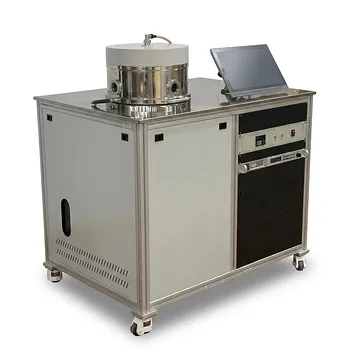
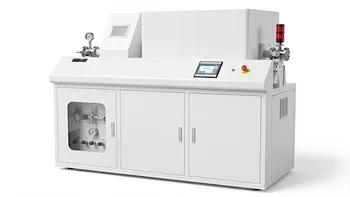
Catalyst activation requires a tube furnace with a gas control system because it provides a precise, isolated environment for the chemical reduction of metal oxides into active metallic states. This setup allows for the simultaneous control of high temperatures and the introduction of specific reducing gases, such as hydrogen, while strictly excluding oxygen. This process is essential to establish the correct valence state of the metal and ensure optimal dispersion of active centers across the catalyst support.
A tube furnace with gas control is indispensable for catalyst activation because it creates a dynamic thermal and chemical environment that facilitates complete reduction, removes inhibitory reaction byproducts, and prevents the thermal sintering of metallic grains.
The Chemistry of Surface Activation
Reduction of Metal Oxides
Metal catalysts are often synthesized as stable metal oxides, such as nickel oxide (NiO) or palladium oxide (PdO), which are catalytically inactive. The tube furnace provides the high-temperature environment—often ranging from 400°C to 800°C—necessary to break these chemical bonds. The gas control system introduces a reducing atmosphere, typically hydrogen (H2), to transform these oxides into zero-valent metallic microcrystals (e.g., Ni, Co, Fe, or Pd).
Precise Valence State Control
The performance of a catalyst depends heavily on the valence state of its active centers. By precisely managing the gas composition (such as using a 5% H2/Ar mixture) and the duration of exposure, researchers can ensure the metal reaches its optimal active state without unintended oxidation. The sealed nature of the tube furnace is critical here, as it successfully excludes air and oxygen that would otherwise reverse the reduction process.
Removal of Impurities and Templates
Beyond reduction, gas-controlled heating is used to remove adsorbed impurities and organic template agents used during synthesis. For example, in zeolite-supported catalysts, a synthetic air flow at controlled heating rates (e.g., 1°C/min) is used to decompose organic templates. This process clears the microporous space, removing steric hindrance and making the active sites accessible for the reaction.
The Role of Dynamic Gas Flow
Breaking Chemical Equilibrium
Unlike static heating environments, a tube furnace with a gas control system enables a dynamic flow of gases through the sample bed. This constant movement is vital for the real-time removal of reaction byproducts, such as water vapor, produced during the reduction of oxides. Effectively "sweeping" these byproducts away helps break chemical equilibrium, driving the reduction reaction to completion more efficiently.
Maintaining Stable Metal Dispersion
Precise control over flow rates and heating profiles prevents the catalyst from degrading during the activation phase. If the temperature rises too quickly or the environment is not properly managed, metal grains can undergo thermal sintering, where they fuse together. A controlled dynamic environment stabilizes the active sites and maintains a high surface area, which is vital for long-term catalyst performance.
Ensuring Temperature Uniformity
Tube furnaces are engineered for excellent temperature uniformity across the heating zone. When combined with a gas management system, this ensures that the entire batch of catalyst undergoes the same chemical transformation simultaneously. This consistency is required to achieve predictable results in sensitive reactions like methane reforming or ethylbenzene disproportionation.
Understanding the Trade-offs and Risks
Thermal Sintering vs. Complete Reduction
A primary trade-off in catalyst activation is the balance between temperature and grain size. Higher temperatures ensure a thorough reduction of metal oxides, but they significantly increase the risk of sintering, which reduces the catalyst's active surface area. Finding the "sweet spot" requires precise ramp-rate control that only a high-quality tube furnace can provide.
Gas Concentration and Safety
Using pure hydrogen maximizes reduction efficiency but introduces significant safety risks and potential for localized overheating (exothermic reduction). Many labs use diluted hydrogen mixtures (e.g., 5% H2 in Argon or Helium) to mitigate these risks. While safer, these mixtures may require longer processing times or higher temperatures to achieve the same degree of activation.
Byproduct Management
If the gas flow rate is too low, byproducts like water vapor can accumulate within the catalyst pores. This can lead to hydrothermal damage of the catalyst support, particularly in zeolites or aluminas. Conversely, excessively high flow rates can cause pressure drops or "channeling," where the gas bypasses parts of the catalyst bed, leading to uneven activation.
How to Apply This to Your Project
Making the Right Choice for Your Goal
- If your primary focus is maximizing active surface area: Prioritize a furnace with high-precision ramp-rate control (e.g., 1°C/min) to prevent sintering during the transition from oxide to metal.
- If your primary focus is complete reduction of stubborn oxides: Ensure your gas control system can handle high-purity hydrogen and maintain temperatures up to 800°C to overcome high lattice energy.
- If your primary focus is scalability and consistency: Invest in a system with a dedicated gas control panel and multiple mass flow controllers to ensure repeatable gas delivery and uniform heat distribution across larger batches.
By integrating precise thermal management with a dynamic atmosphere, the tube furnace transforms a stable chemical precursor into a high-performance engine for molecular transformation.
Summary Table:
| Feature | Role in Catalyst Activation | Primary Benefit |
|---|---|---|
| Precise Temp Control | Facilitates bond breaking (400°C–800°C) | Prevents thermal sintering of metal grains |
| Atmosphere Control | Introduces reducing gases (e.g., H2) | Ensures accurate valence state of active sites |
| Dynamic Gas Flow | Removes water vapor and reaction byproducts | Breaks chemical equilibrium for complete reduction |
| Sealed Environment | Strictly excludes oxygen and contaminants | Prevents unintended oxidation and ensures purity |
| Uniform Heating | Maintains consistent thermal profile | Ensures repeatable results across the entire batch |
Elevate Your Research with KINTEK Precision Furnaces
Achieving the perfect valence state and surface area for your catalysts requires uncompromising control. KINTEK specializes in advanced laboratory equipment, providing a comprehensive range of high-temperature furnaces—including tube, muffle, rotary, vacuum, CVD, and atmosphere furnaces—all fully customizable to meet your specific activation protocols.
Whether you are scaling up production or conducting sensitive material synthesis, our systems ensure superior temperature uniformity and gas management. Contact KINTEK today to discuss your custom furnace needs and see how our expert engineering can drive your lab's efficiency and innovation.
References
- Abdul Karim Shah, Abdulaziz Alhazaa. Design of Nickel Supported Hierarchical ZSM-5/USY Zeolite Bifunctional Catalysts for One-Pot Menthol Synthesis via Liquid-Phase Citral Hydrogenation. DOI: 10.3390/molecules28020743
This article is also based on technical information from Kintek Furnace Knowledge Base .
Related Products
- 1200℃ Controlled Inert Nitrogen Atmosphere Furnace
- Slide PECVD Tube Furnace with Liquid Gasifier PECVD Machine
- Custom Made Versatile CVD Tube Furnace Chemical Vapor Deposition CVD Equipment Machine
- Split Chamber CVD Tube Furnace with Vacuum Station CVD Machine
- Vacuum Sealed Continuous Working Rotary Tube Furnace Rotating Tube Furnace
People Also Ask
- What controlled-atmosphere furnace conditions are required for sintering powder metallurgy copper alloy compacts? Ideal Setup
- What are the four main types of controlled atmospheres used in these furnaces? Optimize Your Heat Treatment Processes
- What causes discrepancies between theoretical and experimental grain boundary mobility during ceramic sintering? Explained
- How does a vacuum or controlled atmosphere furnace facilitate sessile-drop experiments? Optimize Alloy Wetting Analysis
- Why is a controlled atmosphere furnace required for 316L debinding? Ensure Structural Integrity & Zero Cracks