Slow heating is essential because it prevents a pressure catastrophe. During binder burnout, organic additives and adsorbed moisture are vaporized. If the temperature rises too quickly, these volatiles boil violently, generating a surge of gas that the material cannot vent. The resulting internal pressure causes swelling, distortion, and cracking—effectively destroying the component before it ever reaches the densification stage. A heating rate under 2°C/min up to roughly 400–500°C gives these species time to evolve gently, maintaining the structural integrity of the part.
The core purpose of the slow ramp is safety for the green body. You are not just removing a little moisture; you are outgassing a complex mixture of binders, plasticizers, and adsorbed contaminants. A controlled rate below 2°C/min ensures the volume of evolved gas never exceeds the material’s ability to expel it through its pore network, preventing catastrophic failure from internal pore pressurization.
The Physics of Binder Burnout
Why Volatile Species Become Destructive
Organic binders and moisture are not simply “evaporating”; they are undergoing thermal decomposition. When heated rapidly, these constituents transition to the gas phase almost instantaneously.
A large gas volume created in seconds cannot escape through narrow, tortuous pore channels. The result is a sharp spike in internal pressure that acts like a microscopic explosion. This pressure finds the weakest path—often through the bulk of the material itself—causing swelling, delamination, or outright fracture.
How the 2°C/min Threshold Protects Structure
The specific ceiling of 2°C/min is a practical limit derived from decades of ceramic and powder metallurgy processing.
At this rate, decomposition reactions proceed in a thermally staggered manner. Different binder components pyrolyze at different temperatures, slowly feeding gas into the pore network. The material’s permeability can keep pace, so any pressure build-up remains negligible. You are essentially orchestrating a calm, sequential outgassing instead of a violent flash.
Consequences of Ignoring the Ramp Rate
Rapid heating above 2°C/min turns a green body into a miniature pressure vessel. The observable outcomes include:
- Micro-cracks: Invisible to the naked eye but fatal for mechanical strength.
- Swelling and permanent distortion: The part balloons and loses dimensional accuracy.
- Complete structural collapse: The ceramic framework or powder compact simply disintegrates.
These defects are irreversible and render the subsequent high-temperature sintering step useless.
Applying the Principle Across Material Systems
Ceramic Green Bodies and Polymer Templates
In ceramic processing, the binder system—often photosensitive resins or polymer templates—decomposes into a high volume of gaseous species.
A slow ramp gives the fragile ceramic scaffold time to vent the gas gradually. This is especially critical when preserving delicate architectures, such as the filamentary structures of a bio-template or the porous morphology of a synthesized nanostructure. Any gas burst would collapse the fine feature you spent time engineering.
Powder Metallurgy Compacts
Metal powders have a high surface area and adsorb moisture and hydrocarbons. During the initial heat-up, physical desorption releases these contaminants.
If the temperature rises too quickly, the desorbed gas volume can overwhelm the vacuum pumping system, causing a pressure spike even inside a furnace. This leads to internal micro-voids and micro-cracks, degrading the sintered part’s density and fatigue life. A slow ramp holds the outgassing rate below the pump’s capacity.
Special Considerations for Vacuum Furnaces
In a vacuum environment, there is no convective gas flow to help sweep away volatiles. The only exit is through the pump.
Staying under 2°C/min ensures that the rate of gas evolution remains below the effective pumping speed. If the system is overwhelmed, the vacuum level collapses, and the sample can oxidize or re-adsorb contaminants, forming undesirable reaction products with the metal powder.
Understanding the Trade-offs
When Fast Heating is Actually Required
A slow ramp is only a rule for the binder burnout and impurity desorption stage. There are processes—such as the solid-state synthesis of MgB₂—where a fast rate (e.g., 50°C/min) is mandatory.
In those cases, the goal is to bypass unwanted low-temperature reactions and initiate phase formation only at the target isothermal temperature. This is a totally different physical need. The danger is in confusing the requirement: what is catastrophic for a debinding step is essential for kinetic control in a solid-state reaction. The furnace program must separate these stages with razor-sharp precision.
The Risk of Overly Slow Ramps
Slower is not infinitely better. If you ramp at 0.1°C/min, the process time becomes unnecessarily long, and you risk over-oxidizing certain materials or sintering impurities into the grain boundaries.
The 1–2°C/min window balances safety with practicality. It is the sweet spot where gas transport stays well below the failure threshold without wasting energy or time. Programmable high-temperature furnaces make this optimization routine, but the operator must still understand the “why” behind the number.
Making the Right Choice for Your Process
After understanding the physics, the actionable takeaway is to tailor the ramp based on the part and the binder chemistry.
- If your primary focus is structural ceramic integrity: Maintain a rate between 1–2°C/min through the 400–500°C window. This prevents micro-cracks that would doom the final sintered part.
- If your primary focus is preserving a nano-porous template: Use the lower end (1°C/min or even less) to avoid any internal pressure spikes that could collapse the delicate pore structure.
- If your primary focus is powder metallurgy in vacuum: Set the ramp to guarantee that outgassing never exceeds your pumping speed; routinely check that vacuum level is maintained during the burnout hold.
- If your primary focus is a solid-state reaction without binders: Recognize that the slow-debinding rule does not apply. Fast ramping may be needed, but only after all volatile species are removed in a prior, separate step.
The slow ramp during binder burnout is the best insurance for a perfect part. It costs a little time but pays it back tenfold in yield and reliability.
Summary Table:
| Application / Material | Recommended Heating Rate | Core Mechanism | Avoided Risk / Outcome |
|---|---|---|---|
| Ceramic Green Bodies | 1–2 °C/min | Staggered thermal decomposition & gradual venting | Swelling, micro-cracking, and structural collapse |
| Powder Metallurgy (Vacuum) | 1–2 °C/min | Desorption rate stays within pump capacity | Micro-voids, oxidation, and vacuum failure |
| Nano-porous / Bio-templates | ≤ 1 °C/min | Low-volume outgassing protects delicate pores | Collapse of engineered nano-structures |
| Solid-State Reaction (No Binders) | High (e.g., 50 °C/min) | Bypasses unwanted low-temp phase reactions | Direct target phase synthesis (post-debinding) |
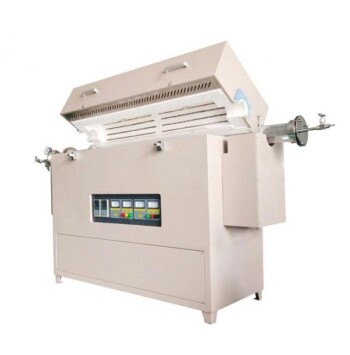
Master precise thermal profiling and protect your green bodies with KINTEK. As experts in high-temperature laboratory equipment and consumables, we offer a comprehensive range of customizable high-temperature furnaces—including muffle, tube, rotary, vacuum, atmosphere, CVD, dental, and induction melting furnaces—designed with programmable ramp controls for flawless binder burnout and sintering. Contact us today to optimize your lab's furnace setup!
Related Products
- 1400℃ High Temperature Laboratory Tube Furnace with Alumina Tube
- 1700℃ High Temperature Laboratory Tube Furnace with Alumina Tube
- 1800℃ High Temperature Muffle Oven Furnace for Laboratory
- 1700℃ High Temperature Muffle Oven Furnace for Laboratory
- 1200℃ Muffle Oven Furnace for Laboratory
People Also Ask
- How does zone-melting in tube furnaces synthesize bismuth micro-wires? Master Single-Crystal Thermoelectric Growth
- How are high-temperature laboratory tube furnaces applied in long-term vacuum homogenization heat treatments for intermetallic samples?
- How do high-temperature laboratory tube furnaces ensure environmental stability? Precision Thermal Reduction Tips
- How are high-temp tube furnaces used to measure diffusion coefficients per Fick's law? Master Precision Annealing
- How are high-temperature tube furnaces applied in testing ceramic-supported alloy membranes? Insights