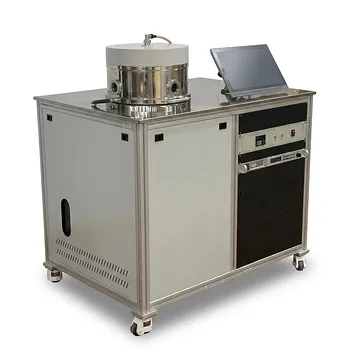
The requirement for a laboratory tube furnace and a nitrogen environment is driven by the need to prevent oxidative combustion while facilitating precise chemical etching of the carbon structure. This setup ensures that the Eucommia ulmoides wood converts into a high-surface-area material rather than simply burning into ash. At temperatures between 350°C and 500°C, the nitrogen acts as a protective shield, allowing the phosphoric acid to create a complex network of pores in an oxygen-free chamber.
To successfully activate Eucommia ulmoides wood, one must balance high thermal energy with a strictly anaerobic environment. The tube furnace provides the necessary thermal precision, while the nitrogen flow ensures the chemical integrity of the carbon skeleton during the activation process.
The Role of the Inert Atmosphere (Nitrogen)
Preventing Oxidative Combustion
At the high temperatures required for activation, carbon naturally reacts with oxygen to form carbon dioxide. Without a nitrogen environment, the Eucommia ulmoides wood would undergo oxidative burnout, effectively destroying the raw material before it can become activated carbon.
Maintaining Chemical Equilibrium
Nitrogen is an inert gas, meaning it does not participate in the chemical reaction between the wood and the activating agent. This allows the phosphoric acid or other agents to react exclusively with the carbon skeleton to develop the desired properties without interference from atmospheric gases.
Facilitating the Removal of Volatiles
The continuous flow of nitrogen within the tube furnace helps sweep away corrosive volatiles and gaseous byproducts generated during pyrolysis. This prevents these byproducts from re-depositing on the carbon surface, which would otherwise clog the developing pores.
Precision Thermal Control in Tube Furnaces
Consistent Temperature Regulation
The activation of Eucommia ulmoides requires a specific temperature range, typically 350 °C to 500 °C, to optimize pore development. A laboratory tube furnace provides the uniform heat distribution necessary to ensure the entire sample reaches the target temperature simultaneously.
Controlled Carbonization and Pyrolysis
The tube furnace allows for precise "ramping" of temperatures, which is critical for the pyrolysis process. This controlled heating ensures the wood biomass converts into a stable, porous biochar structure rather than a brittle, non-porous mass.
Creating an Oxygen-Deficient Reducing Environment
The sealed nature of a tube furnace, combined with gas inlets, creates a strictly anaerobic environment. This reduction-heavy atmosphere is essential for the chemical agents to effectively etch a rich microporous structure into the carbon substrate.
Understanding the Trade-offs and Limitations
Gas Flow Rate Sensitivity
While nitrogen is essential, the flow rate must be carefully calibrated. If the flow is too low, oxygen may leak in or volatiles may linger; if it is too high, it may cause excessive cooling of the sample or waste expensive high-purity gas.
Equipment Maintenance and Corrosive Byproducts
Chemical activation often releases acidic or alkaline vapors that can damage the internal quartz or ceramic tubes of the furnace. Users must implement filtration or scrubbing systems to protect the equipment from the very volatiles the nitrogen gas is designed to remove.
Precision vs. Throughput
Tube furnaces are designed for high precision and high purity rather than high-volume production. While they offer the best environment for research and development of Eucommia ulmoides carbon, scaling this process for industrial use requires significantly different hardware to maintain the same inert conditions.
How to Apply This to Your Project
The use of a nitrogen-flushed tube furnace is the gold standard for producing high-quality, research-grade activated carbon from biomass.
- If your primary focus is maximizing surface area: Ensure a high-purity nitrogen flow and a stable temperature of at least 500 °C to allow for deep chemical etching.
- If your primary focus is equipment longevity: Use a sacrificial liner or regular cleaning cycles to prevent the corrosive volatiles from etching the furnace tube.
- If your primary focus is pore size distribution: Utilize the furnace’s precision controllers to experiment with different heating "ramp rates" to see how they affect the final structure.
By strictly controlling the atmosphere and temperature, you transform raw wood into a sophisticated technical material with optimized adsorption capabilities.
Summary Table:
| Feature | Role in Activation | Key Benefit |
|---|---|---|
| Nitrogen Atmosphere | Prevents oxidative combustion | Preserves carbon skeleton; creates high surface area |
| Inert Environment | Facilitates chemical etching | Ensures activating agents react only with wood structure |
| Thermal Precision | Uniform heat (350°C - 500°C) | Optimizes pore development and pyrolysis consistency |
| Flow Control | Sweeps away corrosive volatiles | Prevents pore clogging and re-deposition of byproducts |
| Sealed Tube Design | Maintains anaerobic conditions | Critical for research-grade, high-purity carbon production |
Elevate Your Material Research with KINTEK Precision
Achieving the perfect pore structure in Eucommia ulmoides activated carbon requires absolute control over atmosphere and temperature. KINTEK specializes in high-performance laboratory equipment and consumables, providing the technical precision your research demands.
Our comprehensive range of high-temperature furnaces includes:
- Tube & Atmosphere Furnaces: Perfect for inert gas processing and biomass activation.
- Rotary & CVD Furnaces: Ideal for uniform material coating and scalable research.
- Muffle, Vacuum, & Induction Melting Furnaces: Designed for diverse thermal applications.
- Custom Solutions: All units are fully customizable to meet your unique laboratory specifications.
Ready to optimize your activation process? Contact KINTEK today to consult with our experts and find the perfect furnace solution for your lab!
References
- Hongyu Su, Ming-Qiang Zhu. Controllable Preparation of Eucommia Wood-Derived Mesoporous Activated Carbon as Electrode Materials for Supercapacitors. DOI: 10.3390/polym15030663
This article is also based on technical information from Kintek Furnace Knowledge Base .
Related Products
- 1200℃ Controlled Inert Nitrogen Atmosphere Furnace
- 1700℃ Controlled Inert Nitrogen Atmosphere Furnace
- 1400℃ Controlled Inert Nitrogen Atmosphere Furnace
- Controlled Inert Nitrogen Hydrogen Atmosphere Furnace
- Mesh Belt Controlled Atmosphere Furnace Inert Nitrogen Atmosphere Furnace
People Also Ask
- What controlled-atmosphere furnace conditions are required for sintering powder metallurgy copper alloy compacts? Ideal Setup
- What causes discrepancies between theoretical and experimental grain boundary mobility during ceramic sintering? Explained
- How does a vacuum or controlled atmosphere furnace facilitate sessile-drop experiments? Optimize Alloy Wetting Analysis
- Why is a controlled atmosphere furnace required for 316L debinding? Ensure Structural Integrity & Zero Cracks
- What Roles Do a Controlled Atmosphere Furnace and Oil Quenching Tank Play in AISI 5140 Steel Heat Treatment?