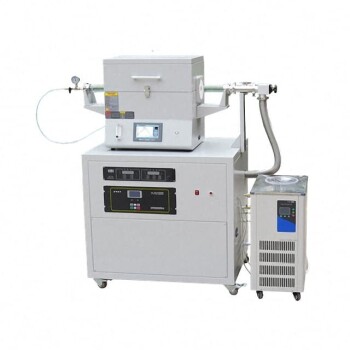
High-precision atmosphere tube furnaces are critical for synthesizing Ni-Co/β-Mo2C@C catalysts because they provide the exact thermal and chemical environment required to transform precursors into the active β-Mo2C phase. This equipment ensures the completeness of the carbonization reaction while simultaneously reducing metal ions into active catalytic species (Ni/Co) and preserving the catalyst's delicate nanorod morphology.
A high-precision atmosphere tube furnace is the only way to achieve the phase purity and structural stability necessary for high-performance electrocatalysis. By strictly controlling gas-solid reaction interfaces and heating ramps, it prevents the oxidation of carbon supports and ensures the uniform distribution of active metal sites.
Achieving Phase Purity and Chemical Transformation
Precise Conversion to β-Mo2C
The transformation of molybdenum precursors into molybdenum carbide (β-Mo2C) is a complex gas-solid heterogeneous reaction. High-precision furnaces allow for the exact temperature programming needed to facilitate this transition without creating undesirable molybdenum oxide impurities.
Regulation of Carbonizing Atmospheres
The furnace must maintain a stable and controllable flow of carbonizing gases, such as CH4/H2 or C2H6/H2 mixtures. Precise regulation of these gas ratios determines the final crystal structure and the number of surface unsaturated sites, which are the primary drivers of catalytic performance.
Prevention of Oxidative Combustion
Because these catalysts utilize carbon supports (@C), any presence of oxygen at high temperatures (600–900 °C) would lead to the oxidative combustion of the material. The furnace provides a strictly inert environment—typically using high-purity nitrogen or argon—to protect the carbon skeleton during treatment.
Maintaining Structural and Morphological Integrity
Stability of the Nanorod Morphology
The electrochemical activity of the Ni-Co/β-Mo2C@C catalyst is highly dependent on its nanorod structure, which provides a high surface area. Precise temperature control prevents the nanostructures from collapsing or sintering, ensuring the microscopic morphology remains intact during high-heat cycles.
Prevention of Metal Aggregation
High-precision heating rates, such as 5 °C per minute, ensure that the Ni and Co metal-organic precursors undergo slow, controlled carbonization. This prevents the active metal particles from aggregating into large, inactive clumps, maintaining high dispersion across the catalyst support.
Pore Structure Development
The controlled volatilization of precursors and additives within the furnace helps induce the formation of porous carbon nanotube structures. This porosity is vital for mass transport during electrochemical reactions, and it can only be achieved through a furnace that manages exact nitrogen flow and heating curves.
Active Metal Reduction and Cooling Protection
Facilitating Complete Reduction to Metallic Ni and Co
The furnace acts as a reduction chamber where hydrogen gas (e.g., 10 vol% H2/N2) interacts with metal oxides. This process ensures that nickel and cobalt are reduced to their zero-valent metallic states (Ni0/Co0), which are the active species required for hydrogenation-dehydrogenation functions.
Protection During the Cooling Stage
Atmosphere control is just as critical during cooling as it is during heating. The furnace prevents the newly reduced, highly reactive metal particles from re-oxidizing as the temperature drops, sealing the catalyst in its most active state.
Understanding the Trade-offs and Pitfalls
Heating Rate vs. Reaction Completeness
Choosing a heating rate that is too fast can lead to "thermal shock," where the internal structure of the catalyst cracks or the carbonization is incomplete. Conversely, excessively slow heating may lead to the over-crystallization of the Mo2C phase, reducing the number of active surface sites.
Gas Flow Sensitivity
If the flow rate of the reducing or carbonizing gas is inconsistent, the catalyst will have a non-uniform phase composition. This inconsistency leads to "hot spots" or "dead zones" within the furnace tube, resulting in a batch of catalysts with unpredictable and non-reproducible electrochemical properties.
How to Apply This to Your Catalyst Synthesis
When selecting a furnace or designing your synthesis protocol, consider the following based on your specific requirements:
- If your primary focus is Phase Purity: Prioritize a furnace with a high-precision PID controller and mass flow controllers (MFCs) to ensure the CH4/H2 ratio remains constant throughout the entire soak time.
- If your primary focus is Morphology Retention: Focus on the cooling capabilities and the ability to program very slow heating ramps (e.g., 1–2 °C/min) to prevent the sintering of nanorods.
- If your primary focus is Scale-Up Consistency: Ensure the tube diameter and heating zone length are sufficient to maintain a uniform temperature gradient across the entire precursor bed to avoid batch-to-batch variation.
By treating the atmosphere tube furnace as a precise chemical reactor rather than just a heat source, you ensure the successful synthesis of highly active and stable Ni-Co/β-Mo2C@C catalysts.
Summary Table:
| Feature | Role in Synthesis | Key Benefit |
|---|---|---|
| Precise Heating | Controlled carbonization & reduction | Prevents sintering & metal aggregation |
| Atmosphere Control | Inert/reducing gas flow (H2, Ar, N2) | Prevents carbon oxidation & ensures phase purity |
| Gas Regulation | Stable CH4/H2 or C2H6/H2 ratios | Optimizes surface unsaturated active sites |
| Cooling Phase | Protective environment during cooldown | Prevents re-oxidation of reactive Ni0/Co0 |
Elevate Your Catalyst Research with KINTEK
Achieving the perfect Ni-Co/β-Mo2C@C structure requires uncompromising thermal precision. KINTEK specializes in advanced laboratory equipment, offering a comprehensive range of high-temperature furnaces—including atmosphere tube, muffle, vacuum, and CVD systems—all fully customizable to your specific carbonization and reduction needs.
Don't let unpredictable temperature gradients or gas fluctuations compromise your results. Partner with KINTEK for reliable, high-performance heating solutions tailored for cutting-edge materials science.
Ready to optimize your synthesis process? Contact our technical experts today!
References
- Xiao Zhang, Chuan Shi. Assembling <scp>2D</scp> Ni‐Co nanosheets onto <scp>Mo<sub>2</sub>C</scp> Nanorod towards Efficient Electrocatalytic Hydrogen Evolution<sup>†</sup>. DOI: 10.1002/cjoc.202400456
This article is also based on technical information from Kintek Furnace Knowledge Base .
Related Products
- 1700℃ Controlled Inert Nitrogen Atmosphere Furnace
- 1400℃ Controlled Inert Nitrogen Atmosphere Furnace
- 1200℃ Controlled Inert Nitrogen Atmosphere Furnace
- High Pressure Laboratory Vacuum Tube Furnace
- 1400℃ High Temperature Laboratory Tube Furnace with Alumina Tube
People Also Ask
- Why is thorough binder burnout necessary before sintering advanced ceramics? Ensure Peak Density & Zero Defects
- How does oxygen partial pressure control affect ceramic sintering? Master Defect Chemistry
- How does real-time dilatometric analysis in a controlled-atmosphere furnace optimize PZT ceramic sintering?
- How do controlled-atmosphere furnaces support polymer pyrolysis? Master SiC & Si3N4 Ceramic Conversion
- Why is controlled-atmosphere heating required for functional ceramics and sensors? Master Defect Engineering