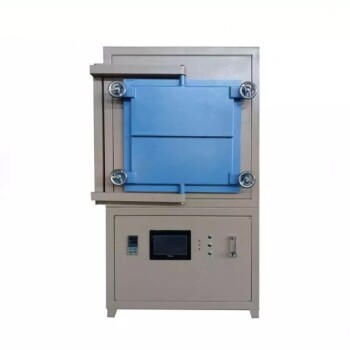
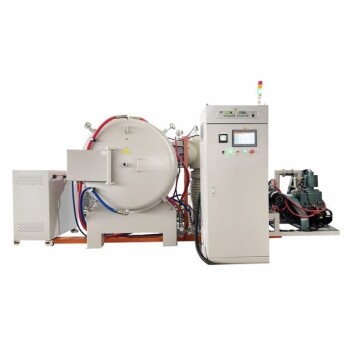
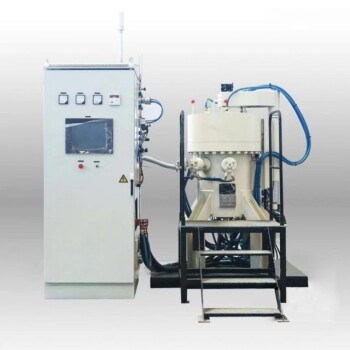
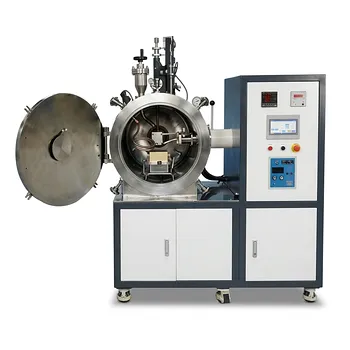
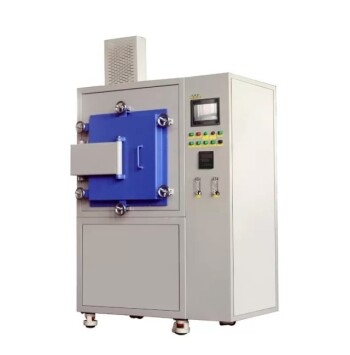
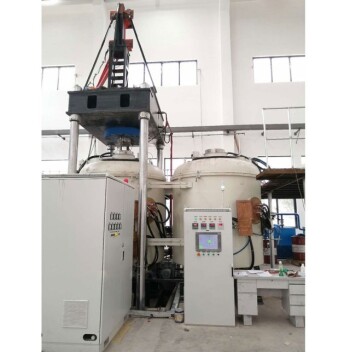
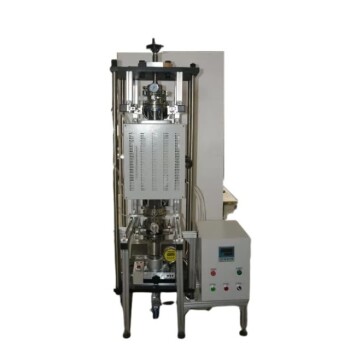
Here’s the critical reason: Vacuum and atmosphere high-temperature furnaces are the backbone of supersolidus liquid phase sintering and activated sintering because both processes hinge on ultra-clean interfaces, precise wetting behavior, and pore‑gas dynamics that can only be orchestrated in a tightly controlled environment. Without the ability to exclude oxygen, manage partial pressures, and evacuate trapped gases, the delicate segregation of activating additives and the internal liquid formation essential for rapid densification simply fail—leading to porosity, embrittlement, or part distortion.
The core truth: Advanced sintering methods demand a furnace that acts not just as a heat source, but as a chemical reactor. A high-purity vacuum or tailored gas atmosphere eliminates oxide skins that ruin wetting, prevents volatile phase loss, and overcomes trapped-gas pressure—turning repulsive capillary forces into the attractive pull that drives full densification.
Why Environment Dictates Success in Advanced Sintering
Activated and supersolidus liquid phase sintering are not ordinary heat‑and‑hold cycles. Their very mechanisms are defined by atomic‑scale events that are exquisitely atmosphere‑sensitive.
Activated Sintering Relies on Grain‑Boundary Purity
In activated sintering, a tiny amount of an additive (like a transition metal) migrates to grain boundaries to create a fast‑diffusion path.
This segregation pattern is what accelerates neck growth and densification at lower temperatures.
However, even trace oxygen or water vapor can oxidize these additive atoms, locking them into inert oxide clusters that sit uselessly at the boundary.
A high‑purity vacuum or dry inert atmosphere preserves the metallic state of the activator, ensuring the rapid boundary diffusion that defines the process.
Supersolidus Liquid Phase Sintering Demands Internal Liquid Control
With supersolidus liquid phase sintering, pre‑alloyed powder is heated just into the solidus–liquidus range so that a liquid phase forms inside each particle.
This internal liquid lubricates particle rearrangement and fills pores with stunning speed—but the temperature window is narrow.
Any surface oxidation of the powder shifts the effective solidus temperature, widens the melting range, or introduces a non‑wetting skin.
A vacuum or reducing atmosphere strips the native oxide and stops new oxide from forming, so the liquid nucleates exactly where intended and spreads uniformly.
The Physics of Liquid‑Phase Sintering and Furnace Atmosphere
The true leverage of atmosphere control becomes clear when you look at the capillary forces that drive densification.
Wetting Angle Turns Force from Attractive to Repulsive
During liquid‑phase sintering, the compressive force pulling solid particles together depends on the liquid wetting angle.
As the angle decreases, the attractive capillary force rises steeply; as the angle increases past a critical point, the force flips to repulsive—pushing particles apart.
Oxide layers are classic wetting-angle wreckers. They raise the angle into the repulsive regime, causing liquid to agglomerate in isolated pools while pores remain stubbornly open.
Vacuum and controlled atmosphere furnaces eliminate this contamination, keeping the wetting angle low so that strong capillary attraction fills every pore channel.
Trapped Gas Pressure Halts Final‑Stage Densification
In the final stage of sintering, isolated pores shrink until the internal gas pressure balances the driving force (4γ_SV / d).
If that gas is insoluble (like argon or nitrogen in alumina), the pore stops shrinking and leaves behind permanent residual porosity.
A high‑temperature vacuum furnace evacuates the ambient gas before pores close, making internal pressurization impossible.
Alternatively, a controlled‑atmosphere furnace using a fast‑diffusing gas (such as hydrogen or oxygen in MgO‑doped alumina) lets trapped atoms diffuse out through the lattice, enabling the material to reach theoretical density.
Protecting Material Integrity Beyond Oxidation
Atmosphere control guards not only against oxide skins but also against a broader set of chemical degradation paths that destroy an otherwise well‑sintered part.
Preventing Volatilization and Disastrous Phase Reactions
Many advanced ceramics decompose or lose key constituents at sintering temperature.
Silicon nitride (Si₃N₄) volatilizes nitrogen unless a nitrogen overpressure is maintained; lead‑based ferroelectrics lose PbO without a controlled PbO partial pressure.
In ceramic‑matrix composites, an oxygen leak can be catastrophic: SiC fibers in an alumina matrix oxidize to SiO₂, which then reacts with the matrix to form aluminosilicates—annihilating the reinforcing fibers.
Vacuum or precisely metered inert/reducing gas chambers suppress these reactions, preserving the designed chemical makeup and mechanical strength.
Stopping Surface Decarburization and Stoichiometry Drift
In powder metallurgy steels, an uncontrolled atmosphere can strip carbon from the surface, lowering the case hardness and fatigue resistance.
Even seemingly minor shifts in oxygen partial pressure can alter defect chemistry and stoichiometry in ionic ceramics, shifting sintering kinetics and final properties.
Temperature‑controlled vacuum and atmosphere furnaces let you track outgassing species, introduce reactive gases (like hydrogen for oxide reduction or nitrogen for nitridation), and lock in the exact surface chemistry required.
Understanding the Trade‑offs
No single atmosphere recipe fits all materials, and a furnace’s capability must match the process physics.
- Vacuum can strip essential elements. High vacuum may preferentially evaporate volatile alloying elements like zinc in brass or lithium in certain ceramics, leaving a depleted surface layer.
- Reactive atmospheres can over‑react. Hydrogen is a brilliant oxide reducer but can cause hydrogen embrittlement in some steels or decarburization if dew point isn’t tightly managed. Nitrogen can unintentionally nitridize surfaces beyond what is wanted.
- Cost and complexity scale sharply. High‑vacuum systems with oil‑free pumping, partial‑pressure control, and gas recovery are engineering marvels—but they require significant capital investment, maintenance, and process development time.
- Not all materials need a sterile environment. Some oxide ceramics sinter perfectly well in air; forcing them into vacuum can actually alter defect chemistry in ways that hinder densification.
The key is to match the atmosphere’s chemical potential to the material’s stability window, rather than blindly chasing the highest vacuum level or the purest gas.
Making the Right Choice for Your Process
Your furnace atmosphere should be treated as a process variable as critical as temperature and time. Use these guides to align your choice with your sintering goal.
- If your primary focus is achieving near‑theoretical density: Use a high‑vacuum furnace to evacuate insoluble gases before pore closure, or select a controlled atmosphere with a fast‑diffusing gas (like H₂) that can escape through the solid.
- If your primary focus is sintering reactive, oxygen‑sensitive powders (e.g., MoSi₂, WC‑Co): Choose a high‑vacuum or ultra‑pure inert gas (Ar, He) environment to prevent oxide skins that ruin wetting and boundary diffusion.
- If you need to prevent decomposition or volatile phase loss: Use a controlled atmosphere with an appropriate overpressure—nitrogen for Si₃N₄, PbO vapor for lead‑based ceramics, or a reducing mix for steels prone to decarburization.
- If you want to combine sintering with surface engineering (nitridation, carburization): Opt for a controlled‑atmosphere furnace that can introduce reactive species at precise times and partial pressures.
When you treat furnace atmosphere as the enabler that governs wetting, diffusion, and pore‑gas dynamics, advanced sintering transforms from a delicate art into a repeatable, high‑integrity manufacturing step.
Summary Table:
| Mechanism / Challenge | Role of Vacuum & Atmosphere Furnace | Key Process Outcome |
|---|---|---|
| Activated Sintering | Eliminates oxygen to keep boundary activators in metallic state | Accelerates grain-boundary diffusion |
| Wetting & Capillarity | Removes surface oxide skins to lower wetting angle | Turns repulsive forces into attractive capillary pull |
| Pore Gas Trapping | Evacuates ambient gas or supplies fast-diffusing species ($H_2$) | Eliminates residual pores for theoretical density |
| Volatilization Control | Maintains precise gas overpressure (e.g., $N_2$ for $Si_3N_4$) | Prevents stoichiometry drift & phase decomposition |
Take your material densification to the next level with KINTEK. As experts in laboratory equipment and consumables, KINTEK offers a comprehensive range of high-temperature furnaces—including vacuum, controlled atmosphere, tube, muffle, rotary, CVD, dental, and induction melting systems—all fully customizable to meet your unique sintering requirements. Enhance your lab's precision and process reliability—contact KINTEK today!
Related Products
- 1400℃ Controlled Inert Nitrogen Atmosphere Furnace
- 1700℃ Controlled Inert Nitrogen Atmosphere Furnace
- 2200 ℃ Tungsten Vacuum Heat Treat and Sintering Furnace
- Molybdenum Vacuum Heat Treat Furnace
- 2200 ℃ Graphite Vacuum Heat Treat Furnace
People Also Ask
- How does nitrogen atmosphere control in high-temperature furnaces prevent the decomposition of silicon nitride during sintering?
- How does oxygen partial pressure control affect ceramic sintering? Master Defect Chemistry
- Why is controlled-atmosphere heating required for functional ceramics and sensors? Master Defect Engineering
- Why is thorough binder burnout necessary before sintering advanced ceramics? Ensure Peak Density & Zero Defects
- How do controlled-atmosphere furnaces support polymer pyrolysis? Master SiC & Si3N4 Ceramic Conversion