
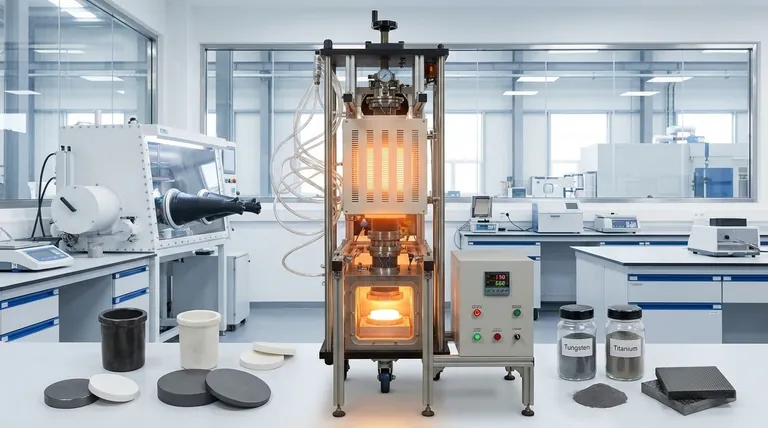
In short, a vacuum hot press furnace is designed to process advanced materials that are difficult or impossible to consolidate using conventional methods. The primary material families include high-performance ceramics, reactive and refractory metals, specialized composites, and various powdered materials that require a pore-free, high-purity final structure.
The core purpose of a vacuum hot press is not simply to heat materials, but to simultaneously apply mechanical pressure in a tightly controlled, oxygen-free environment. This unique combination is essential for creating exceptionally dense components from materials that would otherwise oxidize or fail to sinter properly.
Why a Vacuum and Hot Press are Used Together
To understand the materials that benefit from this process, you must first understand the fundamental problems it solves. The combination of vacuum, heat, and pressure addresses specific material science challenges.
Overcoming Low Diffusivity
Some advanced materials, particularly certain ceramics, have very low diffusion coefficients. This means their atoms are reluctant to move and bond with neighboring particles even at very high temperatures. Applying external pressure physically forces the particles together, promoting densification where heat alone would fail.
Achieving Maximum Density
The mechanical pressure applied during the cycle effectively squeezes out voids and porosity between material grains. This is critical for applications requiring theoretical maximum density. A prime example is the production of transparent ceramics, where even microscopic pores would scatter light and render the material opaque.
Preventing Oxidation and Contamination
Many of the most valuable advanced materials are highly reactive with oxygen, especially at the high temperatures required for sintering. A vacuum environment removes oxygen and other atmospheric contaminants, protecting materials like titanium, aluminum, and refractory metals (tungsten, molybdenum) from oxidation and ensuring the final product maintains its chemical purity.
A Breakdown of Key Material Categories
The principles above make vacuum hot pressing the ideal choice for several distinct classes of high-performance materials.
Advanced Ceramics
This category includes materials like silicon carbide (SiC) and silicon nitride (Si₃N₄). These ceramics are valued for their extreme hardness, high-temperature stability, and wear resistance. Hot pressing is often the only way to produce dense, non-porous parts with the strength and durability required for aerospace, armor, or industrial cutting applications.
Reactive and Refractory Metals
Metals that readily oxidize or have extremely high melting points are prime candidates. The vacuum protects reactive metals like titanium, while the combined heat and pressure aid in the consolidation of refractory metals like tungsten and molybdenum from their powdered form into solid, high-density components.
Composite and Powdered Materials
Vacuum hot pressing is exceptionally effective for creating metal/ceramic composites and other multi-material structures. The process allows for the consolidation of dissimilar materials that might not bond well under other conditions. It is also a cornerstone of powder metallurgy, used to transform metal or alloy powders into fully dense, high-strength parts.
Understanding the Trade-offs
While powerful, vacuum hot pressing is a specialized process with practical limitations that must be considered.
Geometric Constraints
The nature of applying uniform mechanical pressure means that hot pressing is typically limited to producing parts with relatively simple geometries, such as discs, blocks, or cylinders. Complex, near-net-shape components are often not feasible.
Slower Cycle Times
Compared to conventional sintering or casting, vacuum hot pressing is a slower, more deliberate process. The time required to achieve a high vacuum, ramp up to temperature, apply pressure, and cool down can make it less suitable for high-volume production.
High Equipment and Operating Costs
Vacuum hot press furnaces are complex, specialized machines that represent a significant capital investment. Their operation requires precise control and monitoring, contributing to a higher processing cost per part compared to more common manufacturing methods.
Making the Right Choice for Your Goal
Selecting this process depends entirely on the required final properties of your material.
- If your primary focus is material purity and preventing oxidation: The vacuum environment makes this process ideal for reactive metals like titanium or high-purity compounds.
- If your primary focus is achieving near-total density: The combination of heat and pressure is unmatched for eliminating porosity in materials like advanced ceramics or powder metallurgy parts.
- If your primary focus is bonding difficult-to-sinter materials: Vacuum hot pressing excels at creating composites and densifying materials with low atomic diffusion rates.
Ultimately, choosing this method is a strategic decision to achieve specific, high-performance material properties that conventional furnace technologies cannot deliver.
Summary Table:
| Material Category | Key Examples | Key Benefits |
|---|---|---|
| Advanced Ceramics | Silicon Carbide (SiC), Silicon Nitride (Si₃N₄) | High density, wear resistance, non-porous structure |
| Reactive and Refractory Metals | Titanium, Tungsten, Molybdenum | Oxidation prevention, high purity, consolidation from powders |
| Composite and Powdered Materials | Metal/ceramic composites, powder metallurgy parts | Strong bonding, full densification, multi-material integration |
Unlock the potential of your advanced materials with KINTEK's precision vacuum hot press furnaces. Leveraging exceptional R&D and in-house manufacturing, we provide diverse laboratories with advanced high-temperature solutions, including Muffle, Tube, Rotary Furnaces, Vacuum & Atmosphere Furnaces, and CVD/PECVD Systems. Our strong deep customization capability ensures we precisely meet your unique experimental requirements for high-density, pure components. Contact us today to discuss how our tailored furnace solutions can enhance your research and production outcomes!
Visual Guide

Related Products
- Vacuum Hot Press Furnace Machine for Lamination and Heating
- 600T Vacuum Induction Hot Press Vacuum Heat Treat and Sintering Furnace
- Vacuum Hot Press Furnace Machine Heated Vacuum Press Tube Furnace
- Vacuum Hot Press Furnace Machine Heated Vacuum Press
- High Pressure Laboratory Vacuum Tube Furnace
People Also Ask
- What are the primary components of a vacuum hot press furnace? Master the Core Systems for Precise Material Processing
- What safety features are incorporated in vacuum hot press furnaces? Ensure Operator and Equipment Protection
- What are the benefits of the vacuum environment system in a vacuum hot press furnace? Unlock High-Density Sintering
- What industries benefit from the use of vacuum hot press furnaces? Unlock High-Performance Materials for Your Industry
- Why is a high vacuum environment crucial when preparing copper-carbon nanotube composites in a vacuum hot press furnace? Achieve Superior Composite Integrity



















