
In short, modern muffle furnaces offer significant advantages in temperature precision, process purity, and operational efficiency. They achieve this through intelligent digital controllers, advanced insulation and heating elements, and the ability to control the internal atmosphere, moving far beyond the capabilities of older, simpler ovens. These advancements allow for more repeatable, reliable, and energy-efficient thermal processing.
The core technological shift is from crude heating to precise thermal management. Modern muffle furnaces are no longer just boxes that get hot; they are sophisticated instruments that create highly controlled, contaminant-free environments, enabling higher-quality results with significantly less energy and operator oversight.
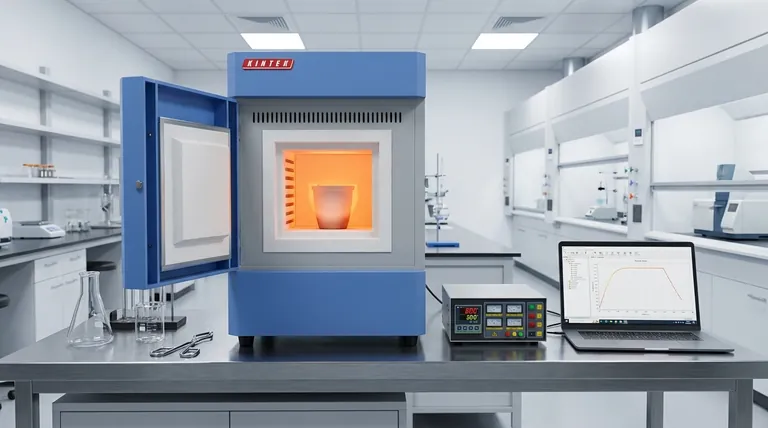
Achieving Unprecedented Temperature Control
The primary function of any furnace is to heat a sample, but modern muffle furnaces excel at doing so with exceptional accuracy and uniformity. This precision is not a minor improvement; it is fundamental to achieving repeatable scientific and industrial outcomes.
Intelligent PID Controllers
Most modern furnaces use Proportional-Integral-Derivative (PID) controllers. These are microprocessor-based systems that continuously monitor the chamber temperature and intelligently adjust power to the heating elements.
Unlike simple thermostats that just turn on or off, a PID controller anticipates temperature changes. It prevents overshooting the setpoint and minimizes fluctuations, ensuring the sample experiences a highly stable thermal environment.
Advanced Heating Elements
The use of materials like silicon carbide (SiC) for heating elements provides rapid, stable, and efficient heating. These elements can reach high temperatures (often over 1000°C) quickly and maintain them with great stability.
This allows for faster heating cycles and quicker temperature recovery when the door is opened, improving throughput and process consistency.
Programmable, Automated Cycles
Modern digital interfaces allow users to program complex, multi-stage heating and cooling profiles. This automation is critical for processes that require precise ramps, soaks at different temperatures, and controlled cooling, eliminating the need for manual adjustments and reducing the potential for human error.
Isolating the Sample for High-Purity Results
A defining feature of a muffle furnace is its ability to protect the sample from contamination. Modern designs enhance this core function, making them essential for sensitive applications.
The Muffle Chamber Design
The term "muffle" refers to the inner chamber that isolates the sample from the heating elements and any potential byproducts of combustion (in fuel-fired models). Heat is transferred to the sample via radiation and convection, not direct contact with the heat source.
This design is crucial for applications like ashing or thermogravimetric analysis (TGA), where even trace contaminants could skew the results.
Atmosphere Control Systems
A key technological leap is the integration of atmosphere control. Advanced furnaces can be sealed and purged with specific gases like nitrogen or argon to create an inert environment, preventing oxidation at high temperatures.
Some models also offer vacuum capabilities or allow for the introduction of reactive gases like hydrogen, opening up new possibilities in advanced materials science and semiconductor research.
Redefining Efficiency and Operational Design
Beyond performance, modern furnaces are engineered to be more cost-effective and user-friendly.
High-Efficiency Ceramic Fiber Insulation
Gone are the days of heavy, inefficient firebricks. Modern furnaces use lightweight, advanced ceramic fiber insulation. This material has low thermal mass and excellent insulating properties.
This results in significantly reduced heat loss, lower energy consumption, and faster heat-up and cool-down times. The lighter weight also leads to more compact, space-saving cabinet designs.
Smart Energy-Saving Functions
Intelligent controllers often include energy-saving modes. Once the setpoint temperature is reached and stabilized, the controller can automatically reduce power output to the minimum level required to maintain it, optimizing energy usage without sacrificing stability.
Modular and Customizable Designs
Manufacturers now offer modular designs that can be customized for specific applications. This includes options for different furnace tube materials, specialized configurations like rotary furnaces for processing powders, and custom dimensions to meet unique production requirements.
Understanding the Trade-offs
While the advantages are clear, selecting a modern muffle furnace requires careful consideration of its complexities.
Cost vs. Capability
Advanced features like atmosphere control, vacuum capability, and complex programmability come at a higher initial cost. It is crucial to avoid over-specifying a furnace with capabilities that your application will never require.
Calibration and Maintenance
A high-precision instrument requires high-precision maintenance. The sophisticated PID controllers and sensors need regular calibration to ensure their accuracy over time. A furnace is only as reliable as its last calibration.
Application Mismatch
Using a furnace designed for general-purpose heat treating for a sensitive trace metal analysis can lead to contaminated results. Conversely, using a high-purity analytical furnace for bulk industrial processes is inefficient and costly. The materials of the furnace liner and elements must be compatible with the process.
Selecting the Right Furnace for Your Application
Choosing the right technology depends entirely on your primary goal.
- If your primary focus is routine sample ashing or basic heat treatment: A standard furnace with a quality PID controller and good ceramic fiber insulation will provide the necessary consistency and efficiency.
- If your primary focus is advanced materials research or sensitive processes: Prioritize models with atmosphere control (gas/vacuum) and highly programmable, multi-stage cycle capabilities.
- If your primary focus is high-throughput production or cost reduction: Focus on energy efficiency ratings, rapid heating/cooling rates, and robust automation features to minimize cycle time and operational expenses.
Investing in a modern muffle furnace is a strategic decision that directly impacts the quality, speed, and cost of your thermal processing work.
Summary Table:
| Feature | Advantage |
|---|---|
| Intelligent PID Controllers | Ensures stable, accurate temperature control for repeatable results |
| Advanced Heating Elements | Enables rapid heating and high-temperature stability |
| Programmable Automation | Reduces human error with multi-stage heating and cooling cycles |
| Atmosphere Control | Prevents oxidation and contamination for high-purity outcomes |
| High-Efficiency Insulation | Lowers energy use and speeds up heat-up/cool-down times |
| Modular Customization | Adapts to specific lab needs with tailored designs |
Ready to elevate your thermal processing with cutting-edge solutions? KINTEK leverages exceptional R&D and in-house manufacturing to provide diverse laboratories with advanced high-temperature furnace solutions. Our product line, including Muffle, Tube, Rotary Furnaces, Vacuum & Atmosphere Furnaces, and CVD/PECVD Systems, is complemented by strong deep customization capabilities to precisely meet your unique experimental requirements. Contact us today to discuss how we can enhance your lab's efficiency and results!
Visual Guide

Related Products
- 1400℃ Muffle Oven Furnace for Laboratory
- 1700℃ High Temperature Muffle Oven Furnace for Laboratory
- 1800℃ High Temperature Muffle Oven Furnace for Laboratory
- 1200℃ Muffle Oven Furnace for Laboratory
- High Temperature Muffle Oven Furnace for Laboratory Debinding and Pre Sintering
People Also Ask
- How does a high-temperature laboratory muffle furnace affect material properties? Transform Anodic Oxide Films Fast
- What is the primary function of a high-temperature laboratory muffle furnace in chemical synthesis? Achieve Precision.
- How does a laboratory high-temperature muffle furnace facilitate the homogenization of borosilicate glass samples? Expert Insights
- How does a laboratory high-temperature muffle furnace contribute to the final formation of Bismuth Oxide nanosheets?
- What function does a muffle furnace perform in perovskite formation? Optimize Your Thermal Synthesis



















