
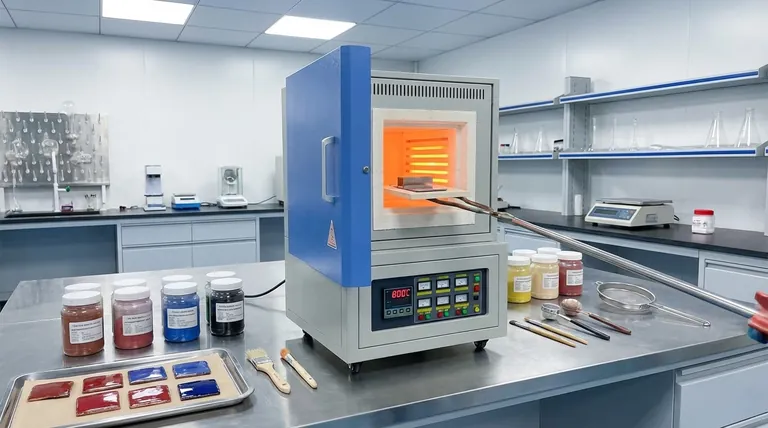
In the process of creating enamel coatings, a muffle furnace provides the essential high, uniform, and contaminant-free heat required for the job. It is the tool that transforms powdered glass, known as frit, into a durable, smooth, and chemically bonded vitreous layer on a metal or ceramic substrate. This fusion process creates the hard, glossy finish characteristic of enamelware.
A muffle furnace is more than just a high-temperature oven. Its defining characteristic is the "muffle"—an internal chamber that isolates the workpiece from the heating elements. This isolation is the key to achieving the flawless, pure finish that high-quality enameling demands.
The Science of Enamel Fusing
To understand the furnace's role, you must first understand the material it works with. Enameling is fundamentally a process of controlled glass melting.
From Powder to a Fused Layer
Enamel begins as a finely ground powder, essentially a mix of silica (glass), fluxes to lower the melting point, and metallic oxides for color. This powder is applied to a prepared surface. The goal is to heat it precisely until it melts, flows together, and bonds chemically to the substrate beneath it.
The Critical Role of Temperature
The temperature is not just about being "hot." Enamels are designed to fuse within a specific temperature window, typically between 750°C and 850°C (1380°F to 1560°F).
If the temperature is too low, the powder won't fully melt, resulting in a rough, sandy, and non-durable surface. If it's too high, the enamel can burn, causing discoloration, or become too fluid and run, creating an uneven coat.
Why a Muffle Furnace is the Essential Tool
Any heat source can melt powder, but creating a perfect enamel finish requires the specific capabilities of a muffle furnace. Its design directly addresses the core challenges of the enameling process.
Contaminant Isolation: The "Muffle" Explained
The term muffle refers to the core feature: a separating chamber, usually made of high-purity ceramic. This chamber holds the workpiece and isolates it from the direct heat source (the electric coils or gas burners).
This separation is critical because it prevents dust, debris from deteriorating heating elements, or byproducts of combustion from falling onto the molten enamel. Any foreign particle would create a permanent flaw in the final glass surface.
Uniform Heating for a Flawless Finish
Muffle furnaces are engineered to distribute heat evenly throughout the internal chamber. This temperature uniformity ensures that the entire workpiece reaches the target temperature at the same rate.
Without uniform heat, one part of the object might be perfectly fused while another is under-fired or burnt. This leads to visual defects and inconsistencies in the coating's protective properties.
Precision Temperature Control
Modern muffle furnaces use advanced digital controllers. These systems allow the operator to set and maintain an exact temperature with very little deviation. This precision is non-negotiable for achieving consistent results, especially when working with sensitive colors that can change shade with minor temperature shifts.
Understanding the Trade-offs and Considerations
While the principle is consistent, not all muffle furnaces are the same. The right choice depends on the specific application.
Electric vs. Fuel-Fired
The vast majority of furnaces used for artistic and high-quality enameling are electric. They provide an inherently cleaner heat source, as there are no combustion fumes to risk contaminating the muffle chamber. Fuel-fired furnaces are more common in heavy industrial settings where efficiency at a massive scale is the priority.
Atmosphere Control
While the muffle isolates the part from heating elements, it does not inherently change the air inside. During heating, oxygen in the chamber can still react with the metal substrate, creating oxidation or "fire scale." Some advanced furnaces allow for the introduction of an inert gas to purge the oxygen, protecting sensitive metals.
Scale and Application
Muffle furnaces range from small, benchtop units perfect for a jeweler or hobbyist to massive, car-sized industrial systems for manufacturing appliances or architectural panels. The core principles of clean, uniform, and controlled heat remain the same regardless of size.
Making the Right Choice for Your Goal
The furnace's capabilities must align with your desired outcome.
- If your primary focus is artistic or jewelry enameling: Prioritize a furnace with exceptionally precise temperature control and a clean electric heating source to ensure color fidelity and a perfect surface.
- If your primary focus is industrial coating for durability: Focus on a furnace with proven temperature uniformity across a large chamber to ensure consistent corrosion and wear resistance on every part.
- If you are simply heat-treating metal (annealing): A muffle furnace is excellent for preventing surface oxidation, but a simpler furnace might be a cost-effective alternative if minor surface scaling is acceptable.
Ultimately, the muffle furnace's unique ability to provide a pristine, stable, high-heat environment is what makes it the indispensable tool for creating a high-quality enamel finish.
Summary Table:
| Key Aspect | Role in Enamel Coating |
|---|---|
| Contaminant Isolation | Prevents impurities from heating elements, ensuring a flawless glass surface |
| Uniform Heating | Distributes heat evenly for consistent fusing and finish across the workpiece |
| Precision Temperature Control | Maintains exact temperatures (750°C-850°C) for proper melting and bonding |
| Application Suitability | Ideal for artistic, jewelry, and industrial enameling with customizable options |
Unlock superior enamel coatings with KINTEK's advanced high-temperature furnace solutions! Leveraging exceptional R&D and in-house manufacturing, we provide diverse laboratories with reliable equipment like Muffle, Tube, Rotary Furnaces, Vacuum & Atmosphere Furnaces, and CVD/PECVD Systems. Our strong deep customization capability ensures precise alignment with your unique experimental needs, whether for artistic, jewelry, or industrial applications. Contact us today to enhance your process with contaminant-free, uniform heating and achieve durable, high-quality finishes!
Visual Guide

Related Products
- Laboratory Muffle Oven Furnace with Bottom Lifting
- High Temperature Muffle Oven Furnace for Laboratory Debinding and Pre Sintering
- 1200℃ Muffle Oven Furnace for Laboratory
- 1800℃ High Temperature Muffle Oven Furnace for Laboratory
- 1400℃ Muffle Oven Furnace for Laboratory
People Also Ask
- Why is a high-temperature laboratory muffle furnace essential for the alkali fusion process in zeolite synthesis?
- What function does a muffle furnace perform in Ba0.75Ca0.25TiO3 calcination? Ensure Phase Purity & Synthesis
- What is the importance of the calcination process? Master High-Purity Calcium Phosphate Nanopowder Production
- Why is a high-temperature muffle furnace required for FeOx-MOx/TiO2? Engineering High-Performance Nanocomposites
- What is the function of a laboratory muffle furnace in the synthesis of g-C3N4? Key for Thermal Polycondensation





