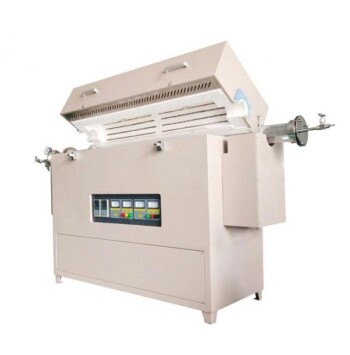
The defining advantage of a high-temperature laboratory furnace lies in its ability to act as a precision thermal instrument, not just a heat source. In the heat treatment of heat-resistant aluminum casting alloys, these furnaces deliver the exacting temperature control and uniformity required to first dissolve coarse intermetallic phases into a supersaturated solid solution, and then precisely precipitate them as a fine, thermally stable dispersion. This two-step orchestration fundamentally determines whether the alloy can retain its tensile strength and resist microstructural coarsening during prolonged service between 200°C and 350°C.
Heat-resistant aluminum castings demand a level of thermal precision that only a laboratory-grade furnace can provide. The primary role of these furnaces is to eliminate the microstructural inhomogeneities of the as-cast state through controlled solutionizing, and then to engineer a dense array of fine, coarsening-resistant precipitates through ramped artificial aging. Without this level of control, the alloy’s high-temperature performance collapses under load.
The Fundamental Challenge of Heat-Resistant Aluminum Castings
Cast aluminum alloys start with an inherent handicap: a coarse, segregated microstructure. Unlike their wrought counterparts, they contain large, brittle intermetallic particles concentrated at grain boundaries. To make them withstand sustained temperatures up to 350°C, you must completely re-engineer this structure in two tightly controlled steps.
Every Step Hinges on Thermal Precision
The furnace is not a passive container; it is the active tool that drives solid-state diffusion and nucleation. A deviation of just a few degrees can mean the difference between a fully dissolved alloy ready for strengthening and a ruined part with incipient melting. The furnace’s role is to make the target temperature a physical reality throughout the entire cross-section of the casting.
Step One: Solution Treatment – Erasing the As-Cast History
The first critical role of the high-temperature laboratory furnace is to create a single-phase solid solution. The as-cast alloy is littered with phases like CuAl₂, Mg₂Si, and complex S-phase compounds that are hundreds of times larger than ideal precipitates.
Dissolving the Obstacles at the Grain Boundaries
The furnace must bring the alloy to a temperature typically around 535°C and hold it there with extreme stability. This thermal energy allows copper and magnesium atoms, locked in coarse intermetallics, to diffuse away and dissolve fully into the aluminum matrix. Without this complete dissolution, the subsequent aging step would produce only a fraction of the possible strengthening.
Homogenizing the Chemical Landscape
Casting inherently creates dendrites with microscopic composition differences. The furnace’s role extends beyond just dissolving particles; it must provide the prolonged, uniform heat that drives atomic diffusion to eliminate these chemical segregations. This transforms a chemically patchy structure into a homogeneous, supersaturated solid solution ready for the next step.
Avoiding the Catastrophic Overheating Zone
The margin between the ideal solutionizing temperature and the point of localized grain boundary melting can be as narrow as 5–10°C. High-temperature lab furnaces fulfill their role by using multi-zone heating and precise PID control to guarantee that no hot spot in the chamber exceeds this critical threshold, preserving the part's integrity.
Step Two: Artificial Aging – Engineering High-Temperature Strength
After quenching locks the supersaturation in place, the furnace takes on its second, equally vital role: controlled precipitation. This is not a simple bake; it is a precision-driven nucleation and growth process performed in an atmospheric lab furnace.
Precipitating the Thermal Defenders
At aging temperatures commonly between 150°C and 180°C, the furnace provides the energy for solute atoms to cluster and form a fine dispersion of intermetallic phases such as Mg₂Si, CuAl₂, and nickel-rich precipitates. The furnace’s uniform thermal field ensures these precipitates form densely and evenly throughout the entire matrix, rather than in sporadic patches.
Engineering Resistance to Coarsening
The specific size and type of precipitate determine the alloy's service life. A lab furnace with precise ramp and dwell capabilities allows you to tailor a precipitation heat treatment that creates a high density of fine precipitates which are specifically designed to resist coarsening at 200–350°C. This directly enhances the material’s high-temperature tensile strength and structural longevity.
Understanding the Trade-offs and Critical Control Factors
The laboratory furnace’s capabilities are only as good as the process they execute. There are inherent material limitations that the furnace itself cannot circumvent, but it can help navigate them.
The Cast Structure Penalty
Due to their coarse grain structure and large as-cast intermetallics, aluminum castings require significantly longer soaking times than wrought alloys to achieve full dissolution—often 10 to 20 hours or more. While the furnace provides a stable environment, the prolonged cycle time is an unavoidable physical necessity to guarantee homogenization.
Balancing Quench Sensitivity
High-temperature heat-resistant alloys are often highly alloyed, making them sensitive to quench-induced distortion. The role of the furnace transitions here: while it doesn't perform the quench, the uniformity it imparts during solutionizing directly affects the residual stress state. A perfectly uniform thermal profile at 535°C reduces the thermal gradient during quenching, lowering the risk of cracking compared to a non-uniform heating process.
The Risk of Incomplete Dissolution
If a furnace has poor temperature uniformity or an inaccurate controller, it will systematically produce under-solutionized parts. The deep need is absolute confidence in the thermal setpoint. Even if the display reads 535°C, actual cold spots in the chamber will result in retained coarse phases, leading to inferior and unpredictable high-temperature properties.
Making the Right Choice for Your Alloy Development or Production Goal
Your objective determines how you should leverage the precision of a high-temperature laboratory furnace. Match your goal to the process control.
- If your primary focus is maximizing high-temperature tensile strength: Prioritize a furnace with the tightest tolerance at the solutionizing stage. Ensure its uniformity survey confirms no point deviates from the setpoint by more than ±3°C during the critical soak, enabling complete dissolution of heat-resistant phases containing nickel and titanium.
- If your primary focus is ensuring microstructural stability over thousands of service hours: Concentrate on the aging cycle. Choose a furnace with programmable ramp rates to carefully navigate the precipitation window, creating a fine, coarsening-resistant distribution of Mg₂Si and CuAl₂ rather than over-aging to a softer state.
- If your primary focus is processing larger or complex castings: A furnace with forced air convection and a proven multi-zone uniformity profile is non-negotiable. This ensures that thick sections and thin flanges all experience the same thermal history during both solution treatment and aging, delivering consistent mechanical properties throughout the part.
Delivering a component that can endure extreme temperatures starts with the one tool that governs the very arrangement of its atoms: a high-temperature laboratory furnace with uncompromising precision.
Summary Table:
| Heat Treatment Stage | Typical Temp Range | Primary Lab Furnace Role | Key Microstructural Result |
|---|---|---|---|
| Solution Treatment | ~535°C (Strict ±3°C) | Dissolves coarse intermetallics & eliminates micro-segregation | Homogeneous solid solution without grain boundary melting |
| Artificial Aging | 150°C – 180°C | Provides uniform thermal fields & controlled ramp rates | Fine, coarsening-resistant precipitate dispersion (Mg₂Si, CuAl₂) |
Optimize Your Alloy Heat Treatment with KINTEK Precision Furnaces
Achieving peak tensile strength and microstructural stability in heat-resistant aluminum castings requires absolute thermal accuracy and zero tolerance for hot spots. KINTEK specializes in advanced laboratory equipment and customizable high-temperature furnaces—including muffle, tube, atmosphere, vacuum, and multi-zone lab furnaces tailored to meet demanding metallurgical standards.
Whether you need tight temperature tolerances for solutionizing or precise ramp rates for artificial aging, KINTEK delivers reliable, high-precision heating systems designed for your exact R&D or production needs.
Ready to elevate your material performance? Contact us today to consult with our thermal processing experts!
Related Products
- 1400℃ High Temperature Laboratory Tube Furnace with Alumina Tube
- 1700℃ High Temperature Laboratory Tube Furnace with Alumina Tube
- 1800℃ High Temperature Muffle Oven Furnace for Laboratory
- 1700℃ High Temperature Muffle Oven Furnace for Laboratory
- 1200℃ Muffle Oven Furnace for Laboratory
People Also Ask
- How does zone-melting in tube furnaces synthesize bismuth micro-wires? Master Single-Crystal Thermoelectric Growth
- How do high-temperature laboratory tube furnaces ensure environmental stability? Precision Thermal Reduction Tips
- How are high-temp tube furnaces used to measure diffusion coefficients per Fick's law? Master Precision Annealing
- How are high-temperature laboratory tube furnaces applied in long-term vacuum homogenization heat treatments for intermetallic samples?
- How are high-temperature tube furnaces applied in testing ceramic-supported alloy membranes? Insights