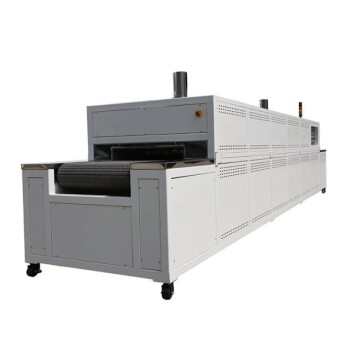
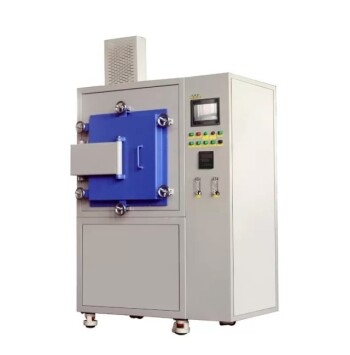
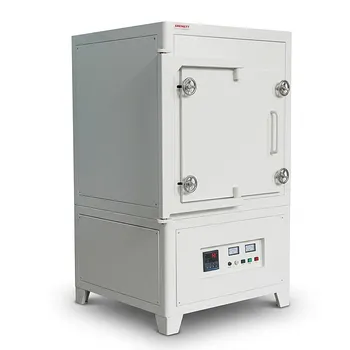
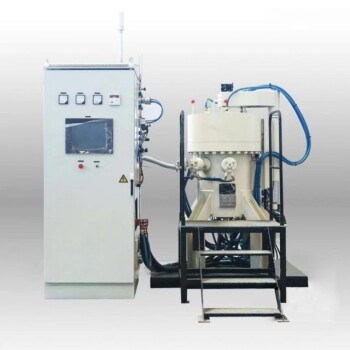
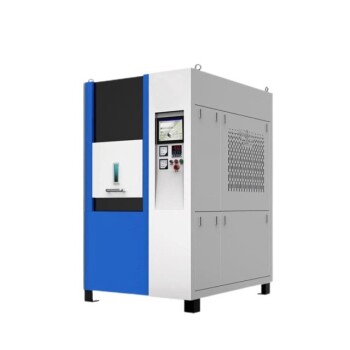
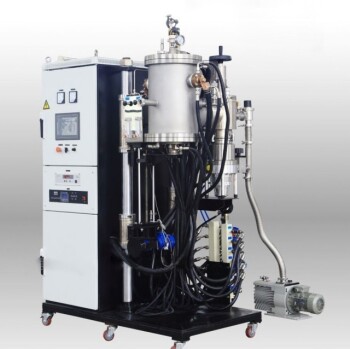
Controlled atmosphere furnaces are the critical enabler for transforming iron oxide or powder metal precursors into high-performance ferrous components. Their primary role is to provide a precisely managed, high-temperature environment where a reducing gas atmosphere strips oxygen from the metal, prevents re-oxidation, and allows for the deliberate absorption of carbon. This dual capacity for oxide reduction and recarburization gives engineers direct control over the final alloy's hardness, toughness, and phase structure.
Achieving complete oxide reduction and uniform carbon uptake in ferrous sintering is impossible without the strict environmental isolation and active chemical control that only a controlled atmosphere furnace can provide. The furnace atmosphere is not a passive shield—it is the central, active agent that dictates the success or failure of the entire sintering cycle.
The Fundamental Role of Atmosphere in Ferrous Sintering
Sintering ferrous metals from oxide-bearing precursors is a thermochemical journey. An uncontrolled furnace would leave the material severely oxidized, porous, and brittle. The controlled atmosphere furnace solves this by acting as both a chemical reactor and a protective envelope.
Driving Complete Oxide Reduction
At temperatures typically exceeding 1120°C, the metal powder compact is chemically active. Any surface oxide films act as diffusion barriers, blocking the particle-to-particle bonding that creates strength.
The furnace's reducing atmosphere, rich in hydrogen, chemically reacts with these oxides. The hydrogen strips away the oxygen, forming water vapor that is swept from the chamber, leaving behind clean, reactive metal surfaces. This establishes the necessary conditions for neck formation between particles.
Preventing Instantaneous Re-Oxidation
Bare metal at sintering temperatures will flash-oxidize if exposed to even trace amounts of oxygen or moisture. The furnace maintains a continuous positive pressure of protective and reducing gases.
This environment isolates the part completely, ensuring that the freshly reduced metal surfaces remain oxygen-free for the entire thermal cycle. Without this isolation, the reduction step would be pointless, as the metal would re-oxidize before bonding could occur.
Enabling Controlled Recarburization
Once oxides are removed, the gas atmosphere can be engineered to introduce carbon back into the metal sponge in a controlled way. This process, recarburization, is essential for setting the final alloy properties.
The furnace environment allows carbon-bearing gas species to diffuse uniformly into the porous matrix. This precise control over carbon content enables the tailoring of the sintered part’s hardness, strength, and phase composition directly from the sintering cycle.
The Multi-Functional Nature of Controlled Atmospheres
While reduction and recarburization are the headline roles, the furnace atmosphere performs several other critical functions that dictate final part quality.
Preparing Surfaces Through Delubrication
Before sintering, powder compacts contain organic binders added for green strength. The initial heating phase must remove these binders cleanly.
The controlled atmosphere actively facilitates delubrication, flushing out decomposition products and preventing their deposition as soot or carbides on the metal surfaces, which would interfere with later sintering bonds.
Regulating Heat Transfer and Diffusion Kinetics
The composition and flow rate of the gas directly affect how heat is transferred to and within the part. Uniform heating is essential to avoid thermal gradients that cause distortion.
Furthermore, the concentration of interstitial elements like nitrogen in the atmosphere (e.g., in a 90% N2 / 10% H2 mix) actively diffuses into the metal, contributing to solid-solution strengthening. Strict control is therefore necessary to make diffusion rates predictable and achieve parts that remain within tight dimensional tolerances, often below ±0.2%.
Mediating Grain Boundary Behavior
The furnace atmosphere influences the very structure of the metal at the atomic level. The gas chemistry can alter interfacial energy at grain boundaries, changing them from immobile, faceted structures to rough, mobile ones.
This control over grain boundary mobility decides whether the material undergoes exaggerated grain growth or maintains a fine, tough microstructure. The atmosphere thus directly impacts the final mechanical properties beyond simple chemical composition.
The Practical Implementation: Gas Mixtures and Control
The promise of controlled atmosphere sintering rests on meticulous engineering of the gas environment.
The Proven 90% N2 / 10% H2 Benchmark
For ferrous alloys processed at or above 1120°C, a tailored synthetic atmosphere of approximately 90% nitrogen and 10% hydrogen has become an industry benchmark.
In this blend, the hydrogen serves as the active reducing agent, efficiently removing oxygen. The nitrogen serves a dual purpose, acting as a protective diluent while also diffusing into the iron matrix as an interstitial strengthener. This single atmosphere simultaneously reduces oxides, protects the surface, and begins alloying.
Consequences of Inadequate Control
Failing to manage the atmosphere invites a cascade of problems. An overly oxidizing potential leads to carbon loss from the alloy surface, sapping its potential hardness.
Inconsistent gas flow or purity can result in surface discoloration and, more critically, non-uniform shrinkage. This leads to dimensional warpage that easily pushes the part outside required tolerances, increasing scrap rates and compromising inter-part consistency.
Understanding the Trade-offs
The active chemical environment is a powerful but unforgiving tool. The very gases that reduce oxides also dissolve into the metal, and their benefits exist on a knife's edge.
- Interstitial Hardening vs. Brittleness: Nitrogen and carbon strengthen the metal but can cause embrittlement if their concentration becomes too high. Tight control is needed to land in the optimal property window.
- Reduction Speed vs. Dimensional Stability: Aggressive reducing conditions can speed up processing but may create steep chemical gradients that distort the part during high shrinkage (13-20% linear shrinkage is common).
- Atmosphere Uniformity: Gas flow patterns inside the furnace can create microclimates around parts. A component in a shielded area might decarburize while another in direct gas flow hardens correctly. Uniform furnace design and loading are critical to avoid property scatter across a batch.
- Cost and Complexity: The infrastructure to generate, purify, and safely exhaust high-purity hydrogen/nitrogen blends adds significant capital and operational expense to a sintering line.
Making the Right Choice for Your Sintering Goals
The role of the controlled atmosphere furnace is not a fixed recipe; it is a set of precise levers you must set based on your design objectives.
- If your primary focus is maximum hardness and wear resistance: Prioritize a carbon-rich atmosphere that ensures deep, uniform recarburization, while carefully managing the cooling rate for martensitic transformation.
- If your primary focus is tight dimensional tolerances and net-shape capability: Optimize gas flow dynamics and heating uniformity to guarantee consistent, predictable shrinkage across the entire part, and use a stable nitrogen/hydrogen blend to fix interstitial content.
- If your primary focus is maximum toughness and ductility: Focus the atmosphere design on complete oxide removal and maintaining a clean, low-impurity grain boundary condition, then control the cooldown to avoid embrittling phase formation.
- If your primary focus is a tailored multiphase microstructure: Use the furnace's atmosphere programming to sequence reduction, carburization, and a controlled sinter-hardening step into a single, integrated thermal cycle.
The controlled atmosphere furnace is the definitive instrument that transforms a pressed metal powder into an engineered material. Your command over its atmosphere is your direct command over the final alloy's soul.
Summary Table:
| Function / Process | Atmosphere Mechanism | Metallurgical & Performance Impact |
|---|---|---|
| Oxide Reduction | Hydrogen ($H_2$) strips surface oxides, creating $H_2O$ | Removes diffusion barriers to allow proper particle bonding |
| Re-Oxidation Prevention | Positive pressure envelope ($N_2$/$H_2$ blend) | Protects clean metal surfaces throughout the high-temp cycle |
| Controlled Recarburization | Carbon-bearing gas species diffuse into matrix | Precisely sets alloy hardness, tensile strength, and phase structure |
| Delubrication | Gas flow sweeps organic binder decomposition products | Prevents soot/carbide deposition that disrupts surface bonding |
| Microstructure Control | Regulates interfacial grain boundary mobility | Prevents exaggerated grain growth and maintains tight tolerances (±0.2%) |
Master Your Ferrous Sintering Process with KINTEK
Achieving complete oxide reduction, precise recarburization, and strict dimensional control requires uncompromised atmosphere management. KINTEK specializes in advanced laboratory equipment and high-temperature furnaces—offering fully customizable atmosphere, vacuum, tube, muffle, CVD, and induction melting furnaces tailored to your precise metallurgical processes.
Whether you are optimizing powder metallurgy research or scaling industrial thermal cycles, KINTEK delivers the temperature precision and atmospheric integrity your alloys demand.
Ready to boost your part performance and reduce scrap rates?
👉 Contact KINTEK Experts Today for a tailored furnace solution!
Related Products
- 1700℃ Controlled Inert Nitrogen Atmosphere Furnace
- Mesh Belt Controlled Atmosphere Furnace Inert Nitrogen Atmosphere Furnace
- 1400℃ Controlled Inert Nitrogen Atmosphere Furnace
- High Temperature Muffle Oven Furnace for Laboratory Debinding and Pre Sintering
- Controlled Inert Nitrogen Hydrogen Atmosphere Furnace
People Also Ask
- How do controlled-atmosphere furnaces support polymer pyrolysis? Master SiC & Si3N4 Ceramic Conversion
- How does oxygen partial pressure control affect ceramic sintering? Master Defect Chemistry
- Why is thorough binder burnout necessary before sintering advanced ceramics? Ensure Peak Density & Zero Defects
- How does real-time dilatometric analysis in a controlled-atmosphere furnace optimize PZT ceramic sintering?
- Why is controlled-atmosphere heating required for functional ceramics and sensors? Master Defect Engineering