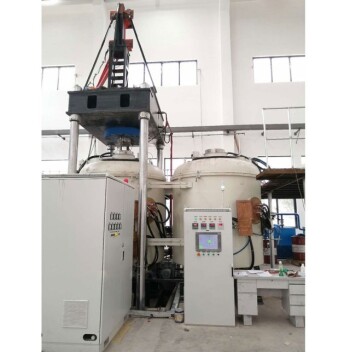
From cold-and-wet raw feed to a structurally robust sinter, the iron ore sintering process is a masterclass in high-temperature material transformation.
During the intense 30-to-40-minute thermal cycle that peaks near 1400°C, the burden undergoes a tightly coupled sequence of physical and chemical changes: moisture vaporization, fuel devolatilization, carbonate decomposition, carbon combustion, iron oxide reduction and re‑oxidation, partial melting to form alumina‑calcium‑silicate phases, and finally re‑solidification as the bed cools. Simulating these exact temperature and atmosphere profiles in a laboratory high‑temperature test furnace is critical because it gives metallurgists the power to deconvolute the complex reaction network, benchmark alternative raw materials, and lock in process parameters before committing to a full‑scale industrial trial.
Reproducing the transient thermal and atmospheric history of a real sinter strand inside a controlled lab furnace is the only way to connect feed characteristics to final sinter quality. Without it, the chain of chemical reactions and phase evolutions remains a black box, inviting weak, inconsistent product at scale.
The Thermal Journey: Key Transformations in Iron Ore Sintering
Moisture Vaporization and Fuel Devolatilization
As the bed first heats, free and capillary‑bound water rapidly flashes off, consuming energy and cooling the immediate zone.
Simultaneously, volatile organic matter in the solid fuel is driven out. This combined evolution of steam and volatile gases influences the flame‑front speed and local oxygen availability.
Carbonate Decomposition and Combustion
With further temperature rise, limestone and dolomite calcine, releasing CO₂ that dilutes the gas phase.
Carbonaceous fuel then ignites and burns, generating the highest bed temperatures and creating localized reducing conditions. The balance between combustion efficiency and heat release determines the peak temperature and the duration of the high‑temperature hold.
Iron Oxide Reduction and Re‑oxidation
Carbon monoxide produced during partial combustion attacks hematite (Fe₂O₃), reducing it to magnetite (Fe₃O₄) or even wüstite (FeO).
Later, as oxygen‑rich gas sweeps through after the flame front passes, these reduced species re‑oxidize. This reduction‑oxidation redox cycling profoundly affects the formation of bonding calcium ferrite phases.
Partial Melting and Slag Formation
At the highest temperatures, low‑melting point components—calcium, alumina, and silica—begin to fuse, creating a transient liquid phase.
This liquid wets the remaining solid grains, drives assimilation, and serves as the medium for rapid diffusion and phase formation. The chemistry of this liquid dictates the final mineralogy and, consequently, the sinter’s cold strength.
Recrystallization and Re‑solidification
As the bed cools, the liquid solidifies into a complex matrix of acicular (needle‑like) calcium ferrite crystals interlocked with silicates and relict iron oxides.
The size, aspect ratio, and interconnectivity of these crystals are what impart the high structural integrity required for blast‑furnace burden.
Why Simulating These Temperature Profiles in a Lab Furnace is Critical
Replicating Industrial Temperature Gradients
In a real sinter strand, gas and solid temperatures evolve non‑linearly with time and bed depth.
Laboratory pot furnaces with bed‑embedded thermocouples at multiple depths (e.g., 5 cm, 35 cm, 75 cm) capture the arithmetic average of gas‑solid temperatures, providing the data needed to validate heat‑transfer models and confirm that lab‑scale simulation faithfully mirrors the industrial thermal wave.
Decoding Reaction Kinetics
Only when heating rate, peak temperature, and hold time are precisely controlled can researchers separate the overlapping steps of calcination, combustion, reduction, and melting.
This kinetic deconvolution reveals which feed variables (e.g., fuel type, flux granulometry, moisture) accelerate or hinder the formation of the high‑strength calcium ferrite network.
Avoiding Microstructural Breakdown
Expanding the high‑temperature zone with sufficient residence time promotes proper mineral bonding and interlocking crystal growth.
Conversely, reheating an already‑solidified refractory framework at suboptimal lower temperatures—or allowing non‑uniform heating across the bed—can break down existing interlocking structures. A laboratory furnace that guarantees temperature uniformity and programmable profiles prevents such degradation and ensures consistent sinter quality.
Enabling Fuel and Feed Optimization
By benchmarking alternative fuels or novel blend ratios in a miniature sinter pot, metallurgists can predict thermal efficiency, reduction‑oxidation behavior, and final mechanical strength.
This step‑wise approach eliminates the economic and safety risks of conducting exploratory tests directly on a production strand.
Understanding the Pitfalls of Poor Simulation
The Danger of Oversimplified Profiles
A simple ramp‑to‑soak program cannot replicate the dynamic flame‑front speed or the moving gas composition gradients of a real bed.
Missing these nuances leads to discrepancies in liquid formation timing and quantity, ultimately producing misleading phase assembly data.
When Hold Times Are Misaligned with Transient Liquid Behavior
Transient liquid phase sintering relies on a precise time‑temperature window to allow the beneficial liquid to form, homogenize, and then dissolve back into the solid matrix.
Insufficient hold time can leave unreacted liquid pockets that become brittle glass upon cooling, while excessive soaking can coarsen the grain structure and negate the strength advantage.
Scaling Mismatches
A small lab pot inevitably has different wall effects, gas flow distribution, and heat‑loss characteristics than a wide industrial strand.
Researchers must carefully engineer boundary conditions and validate against multi‑point thermocouple data; otherwise, the lab‑scale “optimum” may not translate to full‑scale production.
How to Leverage Lab Simulation for Your Sintering Goals
If your primary focus is evaluating alternative fuels: Use programmable multi‑zone furnaces that can emulate the precise combustion profile and transient reducing atmosphere, enabling direct comparison of thermal yield and early‑stage densification rates.
If your primary focus is optimizing raw material blend recipes: Employ sealed pot furnaces with bed‑embedded thermocouples to correlate peak temperature and residence time with the development of high‑aspect‑ratio calcium ferrite crystals, ensuring the final sinter withstands mechanical handling.
If your primary focus is scaling up to industrial production: Validate numerical heat‑transfer models by comparing predicted temperature histories at multiple bed depths against lab‑measured data, then precisely adjust feed granulation, moisture, and fuel loading to lock in the ideal thermal profile before plant trials.
When you treat the laboratory furnace as a miniature sinter strand—not just a heating device—you transform empirical guesswork into a predictable, tunable manufacturing science.
Summary Table:
| Sintering Stage | Key Physical & Chemical Transformations | Lab Furnace Simulation Objective |
|---|---|---|
| Moisture & Devolatilization | Rapid water vaporization and volatile gas release | Control flame-front speed and local oxygen levels |
| Decomposition & Combustion | Carbonate calcination, CO₂ release, fuel ignition | Establish peak bed temperature and thermal profile |
| Redox & Partial Melting | Fe₂O₃ reduction/re-oxidation, liquid slag formation | Optimize transient liquid formation and phase kinetics |
| Cooling & Solidification | Acicular calcium ferrite crystal growth | Guarantee microstructural integrity and cold strength |
Master Your Sintering Process with KINTEK High-Temperature Furnaces
Ready to eliminate empirical guesswork and unlock precise metallurgical reaction kinetics in your lab? KINTEK specializes in premium laboratory equipment and customizable high-temperature furnaces—including atmosphere, tube, muffle, vacuum, and specialized sintering test furnaces designed to replicate dynamic industrial temperature profiles with extreme accuracy.
Whether you are benchmarking alternative feeds, optimizing fuel blends, or validating heat-transfer scale-up models, KINTEK provides engineered thermal solutions tailored to your exact research goals.
👉 Contact KINTEK Experts Today for Custom Solutions
Related Products
- 1400℃ High Temperature Laboratory Tube Furnace with Alumina Tube
- 1700℃ High Temperature Laboratory Tube Furnace with Alumina Tube
- 1800℃ High Temperature Muffle Oven Furnace for Laboratory
- 1700℃ High Temperature Muffle Oven Furnace for Laboratory
- 1200℃ Muffle Oven Furnace for Laboratory
People Also Ask
- How does zone-melting in tube furnaces synthesize bismuth micro-wires? Master Single-Crystal Thermoelectric Growth
- How are high-temperature laboratory tube furnaces applied in long-term vacuum homogenization heat treatments for intermetallic samples?
- How are high-temp tube furnaces used to measure diffusion coefficients per Fick's law? Master Precision Annealing
- How do high-temperature laboratory tube furnaces ensure environmental stability? Precision Thermal Reduction Tips
- How are high-temperature tube furnaces applied in testing ceramic-supported alloy membranes? Insights