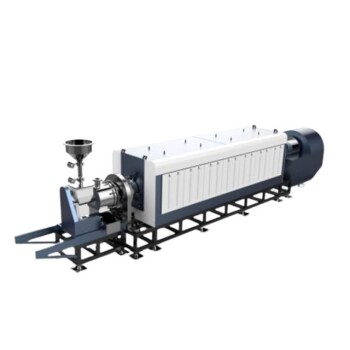
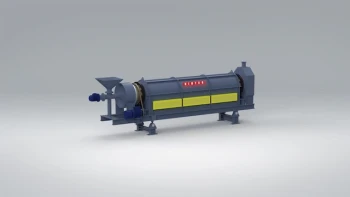
The gas-tight steel retort is the critical boundary layer that transforms a standard furnace into a precision pyrolysis reactor. It functions by isolating biomass from oxygen to prevent combustion while facilitating the uniform heat transfer required for complete thermal decomposition. This ensures that the biomass undergoes a true pyrolytic reaction at temperatures up to 500°C, rather than simply burning away.
The technical significance of the retort lies in its ability to maintain a strictly anaerobic environment and provide high thermal conductivity, which collectively ensure the production of high-quality, uniform biochar.
Maintaining an Anaerobic Environment
Prevention of Material Combustion
Pyrolysis requires the thermal breakdown of organic matter in the absence of oxygen.
The gas-tight design of the steel retort prevents ambient air from entering the reaction zone, which would otherwise cause the biomass to ignite and undergo combustion.
By excluding oxygen, the retort ensures the biomass is converted into biochar, bio-oil, and syngas rather than being reduced to ash.
Precision Atmospheric Control
Modern biomass experiments often require a constant flow of inert gases, such as nitrogen, to sweep away volatile products.
The sealed nature of the retort, equipped with dedicated gas inlets and outlets, allows researchers to maintain a stable, pressurized, or controlled atmosphere.
This configuration is essential for studying specific feedstocks, such as Moringa oleifera seed shells, where atmospheric consistency dictates the final carbon structure.
Thermal Dynamics and Material Integrity
High Thermal Conductivity for Uniformity
The steel construction is chosen for its high thermal conductivity, which is vital for experimental repeatability.
The retort efficiently transfers heat from the furnace heating elements to the internal raw material, minimizing cold spots within the fixed bed.
This uniform heat distribution ensures that the entire biomass sample reaches the target temperature simultaneously, leading to a more complete thermal decomposition reaction.
Structural Resistance at High Temperatures
The retort must withstand extreme thermal stress, often reaching experimental temperatures up to 500°C.
Using high-temperature resistant materials, such as specific stainless steel alloys, prevents the vessel from deforming or losing its seal under heat.
This structural integrity ensures that the reactor remains "gas-tight" throughout the entire heating and cooling cycle, protecting the integrity of the data.
Understanding the Trade-offs
Thermal Lag and Gradient Challenges
While steel is a good conductor, there is an inherent thermal lag between the furnace chamber and the center of the biomass bed.
In a fixed-bed setup, the material closest to the retort walls may experience higher temperatures than the core, potentially leading to non-uniform carbonization if the heating rate is too aggressive.
Material Fatigue and Corrosion
Repeated cycling to 500°C can lead to metal fatigue and oxidation of the retort's exterior over time.
Additionally, the vapors produced during biomass pyrolysis can be acidic or corrosive, which may degrade the internal surfaces of the steel retort if not properly maintained.
Making the Right Choice for Your Goal
How to Apply This to Your Project
To achieve the best results in biomass pyrolysis, your approach to using a retort should align with your specific research objectives.
- If your primary focus is biochar yield and quality: Prioritize a retort with high-grade stainless steel to ensure a perfect oxygen-free seal and uniform carbonization.
- If your primary focus is gas composition analysis: Ensure the retort's gas inlets and outlets are positioned to prevent the "dead zones" where syngas could stagnate and secondary reactions could occur.
- If your primary focus is high-throughput testing: Use a retort with a high surface-area-to-volume ratio to minimize thermal lag and decrease the time required to reach a steady state.
By mastering the balance between atmospheric isolation and thermal conductivity, you can ensure your pyrolysis experiments yield consistent, scientifically rigorous results.
Summary Table:
| Feature | Technical Significance | Benefit for Experiments |
|---|---|---|
| Gas-Tight Seal | Prevents oxygen ingress/ambient air leaks | Eliminates combustion; ensures anaerobic pyrolysis |
| Steel Construction | High thermal conductivity | Ensures uniform heat distribution & repeatable results |
| Inert Gas Inlets | Enables stable atmospheric control | Sweeps volatile products; protects carbon structure |
| Structural Integrity | Resists thermal stress up to 500°C+ | Maintains vacuum or pressurized seal during cycles |
| Thermal Efficiency | Optimizes heat transfer to fixed bed | Facilitates complete thermal decomposition of biomass |
Elevate Your Pyrolysis Research with KINTEK Precision
Achieving consistent, high-quality biochar and syngas requires uncompromising atmospheric control. KINTEK specializes in advanced laboratory equipment and consumables, providing a comprehensive range of high-temperature furnaces—including muffle, tube, rotary, vacuum, CVD, and atmosphere furnaces—all customizable to meet the specific requirements of your biomass experiments.
Whether you are scaling up bio-oil production or analyzing complex carbon structures, our gas-tight retort systems ensure the thermal integrity your data demands.
Ready to optimize your thermal processing? Contact our technical experts today to find the perfect furnace solution tailored to your research goals.
References
- A. A. Adewumi, N. A. Akinrinade. Influence of Selected Parameters on the Product Yields of Broom Weed (Sida acuta) Pyrolysis. DOI: 10.9734/jerr/2023/v25i7947
This article is also based on technical information from Kintek Furnace Knowledge Base .
Related Products
- Electric Rotary Kiln Small Rotary Furnace Biomass Pyrolysis Plant Rotating Furnace
- Electric Rotary Kiln Continuous Working Small Rotary Furnace Kiln for Pyrolysis Plant Heating
- Electric Rotary Kiln Pyrolysis Furnace Plant Machine Small Rotary Kiln Calciner
- Laboratory Quartz Tube Furnace RTP Heating Tubular Furnace
- Split Multi Heating Zone Rotary Tube Furnace Rotating Tube Furnace
People Also Ask
- What are the key components of a rotary kiln electric furnace? Unlock Efficient Thermal Processing
- What are the main applications of a rotary kiln electric furnace? Achieve Uniform Heat Treatment for Powders
- What is the significance of the refractory lining in a rotary kiln electric furnace? Unlock Efficiency and Longevity
- What is the benefit of adjustable speed control in rotary kilns? Optimize Efficiency and Quality
- What are the two main types of rotary kilns based on heating method? Choose the Right One for Your Process