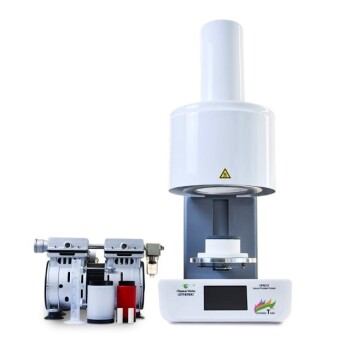
High-temperature sintering is the definitive processing step that transforms a loose blend of metal powder and ceramic reinforcement into a high-performance metal matrix composite (MMC) ready for demanding applications. It fuses the metallic matrix around the reinforcing phase through controlled solid-state diffusion, achieving near-full density, a uniform microstructure, and strong inter-particle bonds—all without melting the matrix or degrading the reinforcement. Appropriate heating equipment, particularly vacuum and controlled-atmosphere laboratory furnaces with precise temperature control, is what makes this possible, protecting materials from oxidation and executing the exact thermal profile needed to balance densification with grain structure.
The deep significance of high-temperature sintering lies not just in bonding particles, but in its ability to engineer the microstructure. The right furnace—providing protective atmosphere, uniform heating, and programmable ramp rates—prevents the two main failure modes: oxidation that destroys material integrity, and improper heating that leaves residual porosity or causes excessive grain growth. The equipment is the enabler that converts a pressed preform into a component with superior wear resistance and elevated-temperature strength.
The Science of Sintering in Metal Matrix Composites
Sintering is not simply “baking” a powder compact; it is a sophisticated metallurgical process that dictates the composite's final identity. For MMCs, this process must simultaneously consolidate the metal matrix and preserve the reinforcing fibers or particles.
Bonding Without Melting: Solid-State Diffusion
Sintering occurs below the liquidus temperature of the matrix, relying on solid-state diffusion to create necks between powder particles. This is critical for reactive matrices like aluminum, titanium, or magnesium, where full melting would trigger severe interfacial chemical reactions with reinforcements like silicon carbide (SiC).
Solid-state processing preserves the reinforcement's morphology and prevents brittle intermetallic phases that would compromise composite toughness. High-temperature furnaces provide the activation energy for atomic mobility, driving particles to bond into a continuous, load-bearing skeleton.
Tailoring Microstructure Through Thermal Profiles
The heating rate and hold temperature directly control pore removal and grain size. A carefully managed thermal profile achieves a dense matrix with a uniform dispersion of hard ceramic particles.
These particles act as barriers to dislocation movement, giving sintered MMCs their signature retention of yield strength at high operating temperatures (120–170 °C). Cast composites or alloys lose strength faster under the same conditions. The microstructure, born in the furnace, is the source of that advantage.
Preventing Reinforcements from Degradation
Fiber-reinforced MMCs are particularly sensitive to processing temperature. Exceeding the matrix liquidus can dissolve or chemically attack the fibers.
By keeping the entire process in the solid state, under a precisely controlled temperature, the furnace preserves fiber morphology and structural integrity. This results in the maximum strength-enhancing benefit from the reinforcement phase, a feat impossible without the right thermal equipment.
The Critical Role of Heating Equipment Precision
The furnace is not a passive container; it is an active tool that must provide a protective, uniform, and accurately programmed thermal environment.
Protecting the Material: Atmosphere and Vacuum Control
Oxidation is the enemy of clean bonding. Controlled-atmosphere and vacuum furnaces purge or evacuate oxygen, ensuring metallic powder surfaces are pristine for diffusion.
This is especially vital for reactive elements like titanium or aluminum. Even minor surface oxide films act as barriers, inhibiting neck growth and leaving behind porosity. The equipment's ability to maintain a reducing or inert environment is a fundamental prerequisite for structural integrity.
The Heating Rate: A Delicate Balance for Density and Grain Size
The ramp rate up to the sintering temperature is not arbitrary. For injection-molded 316L stainless steel, for example, an optimal heating rate of 10 °C/min enables uniform neck growth, achieving near-full density and peak tensile strength.
Increasing the rate to 15 °C/min creates residual macro-porosity due to non-uniform densification; those pores become stress concentrators that drastically reduce ductility and strength. High-temperature laboratory furnaces with programmable PID controllers enforce these exact schedules, preventing defect-prone thermal histories.
Uniformity and the Avoidance of Defects
A thermal gradient across a component leads to differential shrinkage and internal stress. Modern high-temperature furnaces—whether muffle tube, box, or vacuum designs—are engineered for superb temperature uniformity.
Uniform heating of porous preforms above their recrystallization temperature reduces yield strength just enough to enable full plastic deformation during compaction or forging. This ensures maximum densification and consistent mechanical properties throughout the part, directly impacting dynamic load performance.
Advanced Equipment Methods for Superior Results
Beyond standard sintering, specialized equipment unlocks new processing regimes that yield superior MMCs.
Rapid Heating for Nanostructured Composites
At low temperatures, surface diffusion dominates, dissipating surface energy and coarsening grains without densifying. Rapid thermal cycling bypasses this regime, preserving surface energy until bulk diffusion mechanisms activate at higher temperatures.
This strategy suppresses grain growth, making it possible to produce fully dense nanostructured ceramics and composites that would otherwise over-coarsen. The operational benefit is also significant: faster cycles improve furnace throughput and energy efficiency.
Pre-Sintering Ramp Control and Liquid Phase Management
Even in systems that form a small liquid phase above the solidus, over 90% densification often occurs in the solid state during the ramp-up. Precise thermal control during the solid-state sintering stage establishes the critical pore structure and particle contacts before any liquid forms.
This initial microstructure directly governs subsequent particle rearrangement and liquid-phase densification kinetics. Only a furnace with accurate, programmable multi-segment ramp control can manage this sequential development.
High-Frequency Induction: Speed with Strength
High-frequency induction heating equipment offers unparalleled heating speed and thermal uniformity, bringing compacts like tungsten-modified Ti-6Al-4V alloys to near-full density (over 98.8%) rapidly.
The drastically shortened holding time at peak temperature minimizes grain growth, leading to enhanced compressive strength and higher surface hardness levels—up to 45 HRC. This method is a powerful alternative when preserving ultra-fine microstructures is paramount.
Understanding the Trade-offs
No processing route is without compromises. Acknowledging these limitations builds a pragmatic view of sintering technology.
- Oversintering and Grain Growth: Prolonged hold times or excessive temperatures can coarsen the matrix grains, reducing strength despite full density. The optimal process window can be narrow.
- Rapid Heating Defects: Pushing heating rates too aggressively can cause uneven thermal expansion, warpage, or incomplete binder removal, leaving residual carbon contamination that embrittles the composite.
- Atmosphere Complexity: High-vacuum or high-purity inert gas systems add capital cost and maintenance. A small leak or contamination contamination cycle can scrap an entire batch.
- Equipment Cost vs. Throughput: Induction heating is fast but suited to simple shapes; laboratory chamber furnaces offer versatility but slower cycle times. The choice must balance production volume, part complexity, and property requirements.
Making the Right Choice for Your Goal
The ideal thermal process and furnace configuration depend entirely on your performance target. Use this guidance to align equipment with your objective:
- If your primary focus is maximum wear resistance and high-temperature strength: Prioritize a vacuum or controlled-atmosphere tube furnace with precise PID ramp control. A conservative heating rate (e.g., 10 °C/min) ensures uniform densification and a homogeneous dispersion of ceramic reinforcement particles.
- If your primary focus is preserving nanoscale grain size or preventing reinforcement degradation: Consider rapid heating methods like high-frequency induction or a furnace capable of fast thermal cycling. This bypasses low-temperature coarsening regimes, but demands careful fixture design to maintain part uniformity.
- If your primary focus is producing reactive matrix composites (Al, Ti, Mg) with fibers: A high-purity inert atmosphere or high-vacuum furnace is non-negotiable. Solid-state sintering below the liquidus temperature must be enforced to avoid catastrophic fiber-matrix reactions.
- If your primary focus is cost-effective series production: A programmable controlled-atmosphere batch furnace with excellent temperature uniformity offers the best balance of throughput, quality, and operational simplicity. Optimize the heating rate through experimental design to minimize cycle time without introducing porosity.
Ultimately, the furnace is not a commodity—it's the instrument that writes the composite's performance story. Choose the thermal precision and environmental control that match the exact demands of your matrix and reinforcement, and you will unlock the full potential of powder metallurgy.
Summary Table:
| Process / Method | Key Benefit & Microstructure Impact | Furnace & Equipment Requirement |
|---|---|---|
| Solid-State Diffusion | Prevents matrix melting and harmful interfacial chemical reactions | Precise thermal control strictly below liquidus |
| Atmosphere / Vacuum Control | Eliminates oxidation and oxide films to lower porosity | High-purity inert gas or high-vacuum system |
| PID Ramp Control (e.g., 10 °C/min) | Achieves uniform densification and prevents macro-porosity | Programmable multi-segment PID controllers |
| Rapid Heating / Induction | Minimizes grain growth and preserves nanostructure | Fast thermal cycling or high-frequency induction furnaces |
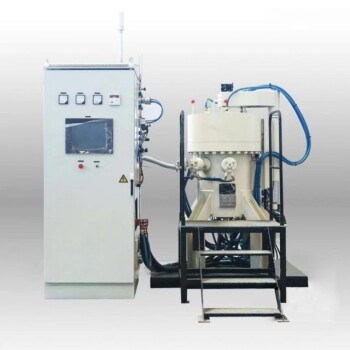
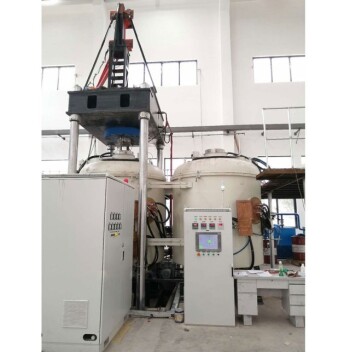
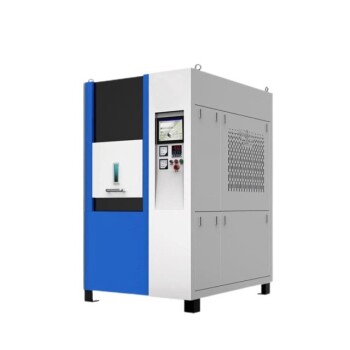
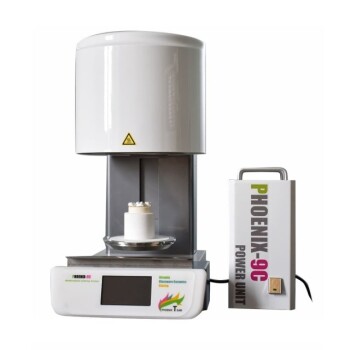
Ready to optimize your powder metallurgy processes and achieve peak performance in metal matrix composites? KINTEK specializes in advanced laboratory equipment and consumables, offering a comprehensive range of customizable high-temperature furnaces—including muffle, tube, rotary, vacuum, CVD, atmosphere, dental, and induction melting systems. Whether you need precise atmosphere control, uniform heating, or tailored thermal profiles to prevent oxidation and control grain growth, our team is here to support your exact research and production needs. Contact us today to explore our customizable lab furnace solutions!
Related Products
- 2200 ℃ Tungsten Vacuum Heat Treat and Sintering Furnace
- High Temperature Muffle Oven Furnace for Laboratory Debinding and Pre Sintering
- 2200 ℃ Graphite Vacuum Heat Treat Furnace
- Vacuum Heat Treat Sintering Furnace Molybdenum Wire Vacuum Sintering Furnace
- 1400℃ High Temperature Laboratory Tube Furnace with Alumina Tube
People Also Ask
- How does a tungsten-heated vacuum sintering furnace prepare (TbxY1-x)2O3 ceramics? Achieve 99%+ Density & Purity
- What wear-resistance enhancements are achieved by powder coating? The Role of Vacuum Sintering Furnaces
- How do compaction pressure and vacuum sintering optimize porous ceramics? Maximize Density & Toughness
- What role does a high-temperature vacuum sintering furnace play in the densification of WC-10(Ni, Ni/Co) alloys?
- How does high-temp vacuum sintering influence Y-TZP mechanical properties? Achieve Max Toughness