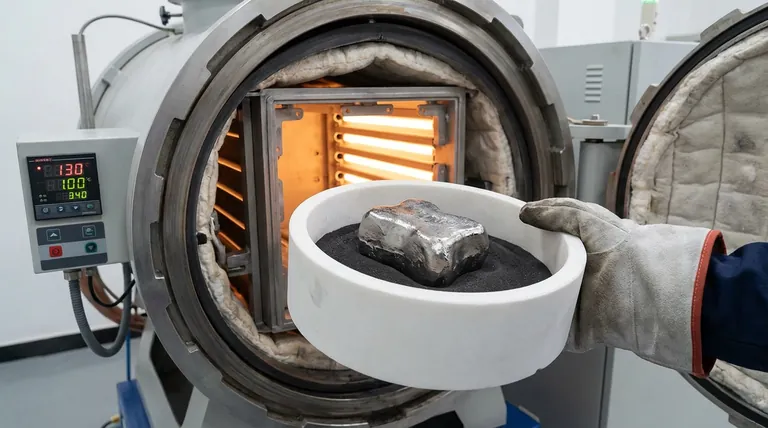
The combination of a corundum crucible and graphite powder acts as a protective system to ensure the integrity of high-entropy alloys during high-temperature annealing. The corundum crucible provides a chemically inert, high-heat resistant container, while the graphite powder creates a localized reducing atmosphere. This dual-layer protection prevents reactive elements within the alloy from bonding with oxygen, thereby preserving the material's chemical composition and surface quality.
The core purpose of this setup is to create a micro-environment that scavenges oxygen before it can reach the alloy. This is critical for preventing oxidation in sensitive materials, ensuring that the final sample retains its intended internal structure and surface purity.
The Role of the Corundum Crucible
High-Temperature Stability
Corundum serves as a robust carrier capable of withstanding the extreme temperatures required for annealing high-entropy alloys.
Chemical Inertness
Crucially, corundum is chemically stable and high-purity. It acts as a neutral vessel that does not react with the alloy itself, ensuring no foreign contaminants are introduced during the heating process.
The Function of Graphite Powder
Creating a Reducing Atmosphere
When the crucible is sealed, the graphite powder enclosed with the alloy reacts with trapped oxygen. This reaction consumes the oxygen, effectively creating a localized reducing or inert environment within the crucible.
Preventing Alloy Oxidation
High-entropy alloys often contain reactive elements—such as Titanium (Ti), Zirconium (Zr), and Hafnium (Hf)—that readily oxidize in air. The graphite powder acts as a sacrificial barrier, preventing these elements from reacting with oxygen.
Ensuring Sample Integrity
Preserving Chemical Composition
By preventing oxidation, the setup ensures the internal chemical stability of alloys like TiZrMoSn0.8Hf0.2. This guarantees that the elemental balance remains consistent with the intended design.
Maintaining Surface Quality
The protective atmosphere prevents surface scaling or degradation. This ensures the sample emerges from the annealing process with a high-quality surface suitable for further characterization or use.
Understanding the Trade-offs
Dependence on Sealing
The efficacy of the graphite powder relies heavily on the crucible being properly sealed. If the seal is compromised, fresh oxygen will continuously enter, consuming the graphite and eventually oxidizing the alloy.
Specificity of Application
This method is specifically designed to counteract oxidation in reactive alloys. It is less critical for noble metals or alloys that are naturally resistant to high-temperature oxidation.
Making the Right Choice for Your Goal
To apply this technique effectively, consider the specific requirements of your material processing:
- If your primary focus is preserving reactive elements (like Ti, Zr, Hf): Ensure the graphite powder fully covers the immediate environment to scavenge all residual oxygen.
- If your primary focus is eliminating contamination: rely on the high-purity corundum crucible to prevent any reaction between the container and the molten or heated alloy.
By controlling the immediate atmosphere, you transform a standard heat treatment into a precision process that guarantees material purity.
Summary Table:
| Component | Primary Function | Key Benefit |
|---|---|---|
| Corundum Crucible | High-temperature inert container | Prevents contamination & withstands extreme heat |
| Graphite Powder | Creates localized reducing atmosphere | Scavenges oxygen to prevent alloy oxidation |
| Reactive Elements (Ti, Zr, Hf) | Target for protection | Preserves internal chemical composition & stability |
| Sealing Mechanism | Atmospheric control | Maintains the protective micro-environment |
Elevate Your Material Purity with KINTEK
Precise heat treatment of high-entropy alloys requires the right environment and high-performance equipment. KINTEK provides industry-leading Muffle, Tube, Rotary, Vacuum, and CVD systems, all customizable to meet your specific research or production needs. Backed by expert R&D and manufacturing, our high-temperature lab furnaces ensure the stability and integrity of your most sensitive materials.
Ready to enhance your lab's efficiency and sample quality? Contact us today to find your custom heating solution!
Visual Guide

References
- Yanfei Xu, Guangsheng Zeng. Effect of annealing treatment on microstructure, wear resistance and corrosion properties of TiZrMoSn0.8Hf0.2 high-entropy alloy for biomedical applications. DOI: 10.1088/2053-1591/ae0fdd
This article is also based on technical information from Kintek Furnace Knowledge Base .
Related Products
- High Temperature Muffle Oven Furnace for Laboratory Debinding and Pre Sintering
- Multi Zone Laboratory Quartz Tube Furnace Tubular Furnace
- Vertical Laboratory Quartz Tube Furnace Tubular Furnace
- 1400℃ Muffle Oven Furnace for Laboratory
- Vacuum Dental Porcelain Sintering Furnace for Dental Laboratories
People Also Ask
- What thermal phenomena occur during polymer binder burnout in ceramic green bodies? Lab Furnace Guide
- Why is controlled heat treatment in a muffle furnace necessary for calcined clay? Achieve Optimal Pozzolanic Activity
- What role does a high-temperature muffle furnace play in STFO synthesis? Achieve Pure Perovskite Results
- How does a high-temperature muffle furnace facilitate the formation of LaNbxAl1−xO3+δ perovskite structures? Key Roles
- What role does a high-temperature muffle furnace play in the formation of biochar catalysts? Master Catalyst Synthesis