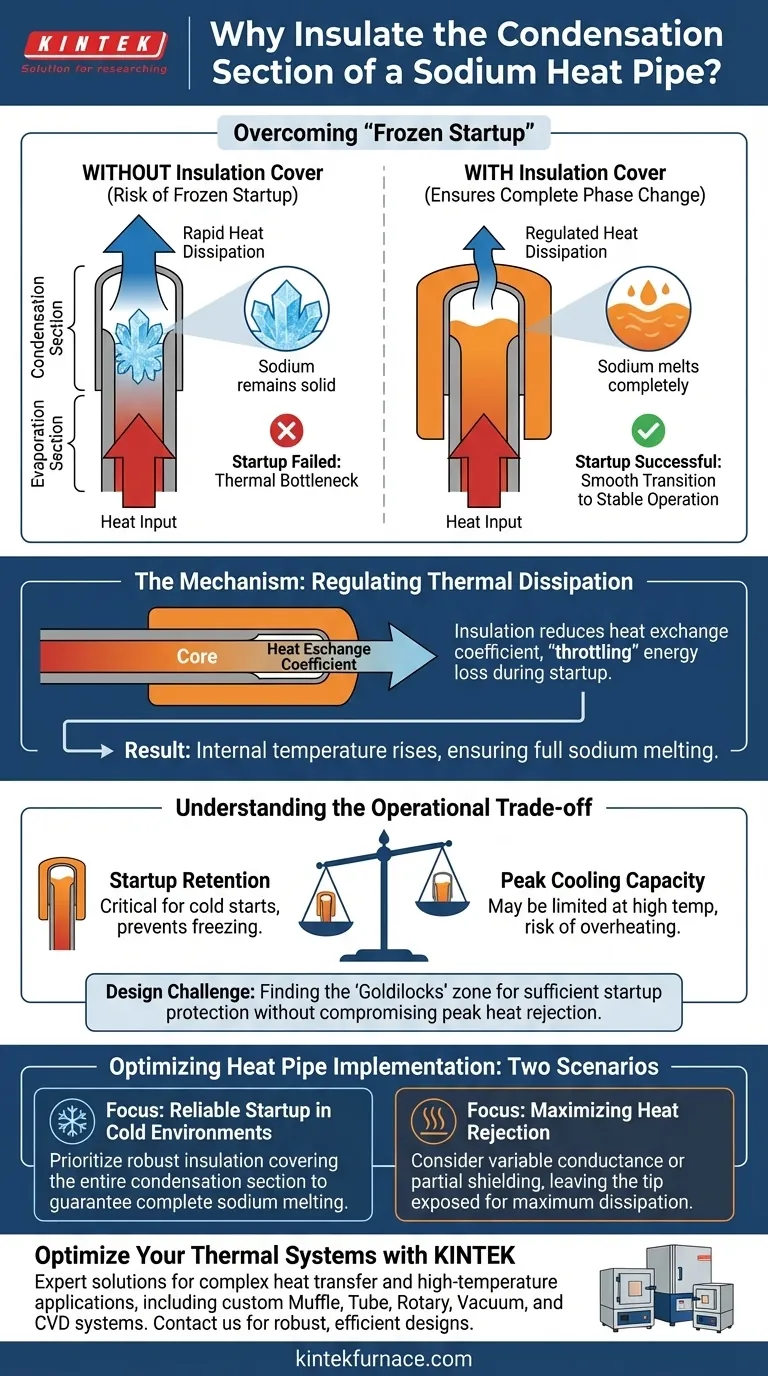
The primary function of a specialized insulation cover or heat shield on a sodium heat pipe’s condensation section is to regulate the rate of heat dissipation during the startup process. By significantly reducing the heat exchange coefficient between the pipe and the surrounding environment, the shield prevents excessive heat loss. This ensures the internal temperature remains high enough to fully melt the sodium working medium, allowing the system to overcome the "frozen startup" limit and reach full thermal activation.
Core Takeaway: High-aspect-ratio sodium heat pipes often fail to start because heat escapes the condensation end faster than it can melt the working fluid. An insulation cover acts as a thermal damper, retaining sufficient energy to ensure a smooth transition from a frozen state to stable operation.
Overcoming the Frozen Startup Challenge
The Risk of Excessive Heat Dissipation
For sodium heat pipes, particularly those with a high aspect ratio (long and thin), the condensation section represents a large surface area for potential heat loss.
If this section is directly exposed to the environment during startup, heat flows out too rapidly. This creates a thermal bottleneck where the energy input at the evaporation end is insufficient to maintain the temperature required at the condensation end.
Ensuring Complete Phase Change
The working medium (sodium) must be in a liquid or vapor state to circulate and transfer heat effectively.
Without shielding, the rapid heat loss can keep the condensation section temperature too low. This prevents the sodium from melting completely or causes it to re-solidify before it can return to the evaporation section, leading to startup failure or stalling.
The Mechanism of Thermal Regulation
Modifying the Heat Exchange Coefficient
The insulation cover works by altering the thermal boundary of the heat pipe.
Technically, it reduces the heat exchange coefficient between the condensation section and the external environment. This effectively "throttles" the rate at which energy leaves the system.
Facilitating Smooth Activation
The ultimate goal of this regulation is to secure a smooth transition curve.
By retaining heat during the critical initial moments, the shield allows the internal pressure and temperature to build gradually. This enables the heat pipe to transition safely through the frozen startup phase until it reaches a self-sustaining operating temperature.
Understanding the Operational Trade-offs
Impact on Steady-State Cooling
While insulation is vital for startup, it inherently limits the heat pipe's ability to shed heat once it is fully active.
If the insulation is too heavy, it may restrict the condensation section's capacity to reject heat during peak operation, potentially leading to overheating of the source.
Balancing Startup vs. Performance
The design challenge lies in finding the "Goldilocks" zone.
The shielding must be substantial enough to prevent freezing during startup, but permeable or limited enough to allow necessary heat transfer once the system reaches its nominal high-temperature operating range.
Optimizing Heat Pipe Implementation
To apply this to your specific thermal management project, consider your system's constraints:
- If your primary focus is reliable startup in cold environments: Prioritize a robust insulation cover that encompasses the entire length of the condensation section to guarantee the sodium melts completely.
- If your primary focus is maximizing heat rejection capacity: Investigate variable conductance solutions or partial shielding that protects the tip of the condenser while leaving the rest exposed for maximum dissipation.
By carefully managing the thermal boundary at the condensation section, you transform a potentially unstable component into a robust, self-starting thermal management system.
Summary Table:
| Feature | Impact on Sodium Heat Pipe Performance |
|---|---|
| Primary Function | Regulates heat dissipation rate during the critical startup phase |
| Thermal Mechanism | Reduces the heat exchange coefficient at the condensation section |
| Startup Benefit | Overcomes "frozen startup" limits by ensuring sodium fully melts |
| Internal Effect | Maintains high enough internal temperature/pressure for circulation |
| Design Trade-off | Must balance startup thermal retention with peak heat rejection needs |
Optimize Your Thermal Systems with KINTEK
Struggling with complex heat transfer challenges or frozen startup failures? At KINTEK, we understand the precision required for high-temperature applications. Backed by expert R&D and manufacturing, we offer advanced Muffle, Tube, Rotary, Vacuum, and CVD systems, along with other lab high-temp furnaces—all fully customizable to your unique thermal management needs.
Let our experts help you design a robust, efficient system today.
Contact KINTEK for Custom Solutions
Visual Guide
References
- Shuaijie Sha, Junjie Wang. Experimental and numerical simulation study of sodium heat pipe with large aspect ratio. DOI: 10.2298/tsci231030059s
This article is also based on technical information from Kintek Furnace Knowledge Base .
Related Products
- Multi Heating Zones CVD Tube Furnace Machine for Chemical Vapor Deposition Equipment
- Multi Zone Laboratory Quartz Tube Furnace Tubular Furnace
- 1700℃ High Temperature Laboratory Tube Furnace with Alumina Tube
- High Temperature Muffle Oven Furnace for Laboratory Debinding and Pre Sintering
- Split Multi Heating Zone Rotary Tube Furnace Rotating Tube Furnace
People Also Ask
- What is the function of a multi-zone tube furnace in CVD synthesis? Master 2D In2Se3 Nanosheet Precision
- What environmental protection applications utilize multi zone tube furnaces? Unlock Precision in Waste Treatment and Green Tech
- Why are multi zone tube furnaces particularly useful for nanomaterial research? Unlock Precise Thermal Control for Advanced Synthesis
- What temperature-related capabilities make multi zone tube furnaces valuable for research? Unlock Precision Thermal Control
- What role do multi zone tube furnaces play in new energy research? Unlock Precise Thermal Control for Innovation