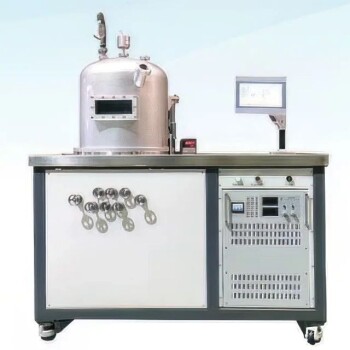
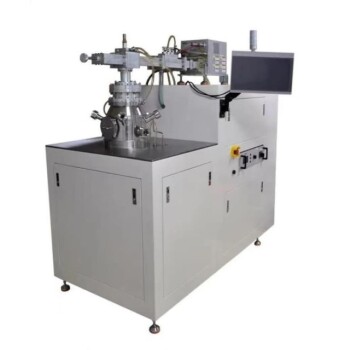
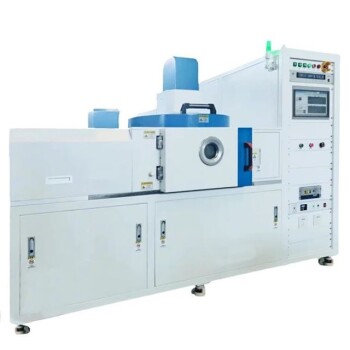
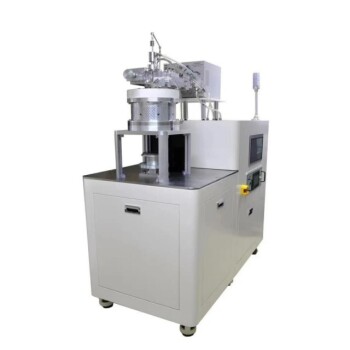
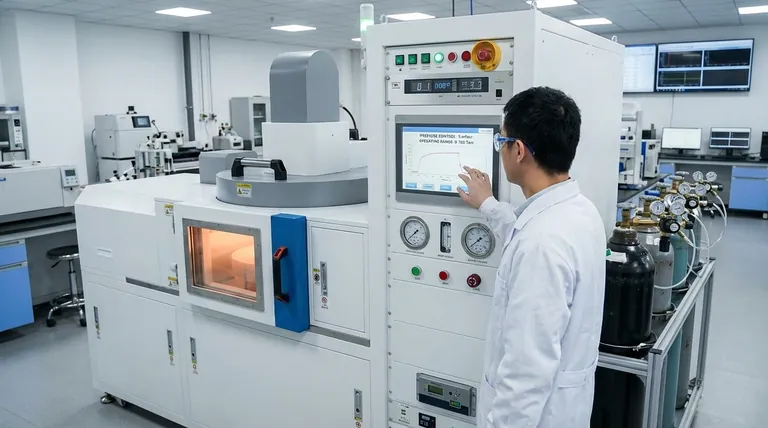
In short, these Chemical Vapor Deposition (CVD) systems feature a controllable operating pressure range from near-vacuum up to 760 Torr (standard atmospheric pressure). Before a process begins, a mechanical pump evacuates the chamber to a base pressure of less than 5 millitorr (mTorr). Some systems can also operate at a slight positive pressure, up to 2 psig.
Understanding the distinction between the base pressure and the operating pressure is critical. The base pressure defines the cleanliness and starting point of your experiment, while the operating pressure is the controlled environment where the actual film growth occurs.
Deconstructing CVD Pressure Specifications
To determine if a CVD system meets your needs, you must understand its two fundamental pressure ratings. These figures dictate the types of processes you can run and the potential purity of the materials you can grow.
The Operating Pressure Range (0-760 Torr)
The operating range is the pressure maintained during the deposition process itself, while precursor gases are flowing into the chamber.
These systems use a throttle valve to precisely control this pressure anywhere between near-vacuum and atmospheric pressure (760 Torr). This wide range allows for a variety of CVD processes, from low-pressure CVD (LPCVD) to atmospheric-pressure CVD (APCVD).
The Base Pressure (< 5 mTorr)
The base pressure, or "base vacuum," is the lowest pressure the system's pump can achieve before you introduce any process gases. It represents the starting level of vacuum.
A mechanical pump evacuates the chamber to create this initial vacuum. A base pressure of less than 5 mTorr signifies that the chamber has been purged of the vast majority of atmospheric gases, providing a relatively clean environment to begin your deposition.
Above-Atmospheric Capability (Up to 2 psig)
The specification of a pressure range up to 2 psig (pounds per square inch gauge) indicates the furnace can safely operate at a pressure slightly above the surrounding atmosphere.
This is equivalent to approximately 860 Torr. This capability is useful for specific processes that benefit from a slight positive pressure to influence gas flow dynamics or suppress unwanted reactions.
Understanding the Trade-offs: The Role of the Mechanical Pump
The system's reliance on a mechanical pump for its vacuum defines its capabilities and, more importantly, its limitations. This is a crucial factor in experimental design.
Not Designed for High Vacuum
A base pressure of 5 mTorr is considered a medium vacuum. It is not a high-vacuum (HV) or ultra-high-vacuum (UHV) system.
HV and UHV systems require more advanced pumps (like turbomolecular or cryogenic pumps) to reach much lower base pressures, often below 10⁻⁶ Torr.
Implications for Film Purity
The base pressure directly correlates to the concentration of residual molecules (like oxygen and water vapor) inside the chamber before deposition begins.
For most standard CVD applications, a 5 mTorr base pressure is perfectly adequate. However, for growing materials that are extremely sensitive to oxidation or other contamination, the residual molecules present at this pressure could be a limiting factor on film quality.
Matching the System to Your Deposition Goal
Use these pressure specifications to determine if the equipment is a fit for your specific material science objective.
- If your primary focus is versatile CVD research at low-to-atmospheric pressure: This system is ideal, offering a wide and controllable operating window for many common materials.
- If your primary focus is growing materials highly sensitive to contamination: You must verify that a medium-vacuum base pressure of <5 mTorr is sufficient to achieve your required film purity.
- If your primary focus requires operating slightly above atmospheric pressure: The system's documented capability of up to 2 psig confirms it is suitable for your process.
Understanding these key pressure specifications—base vacuum and operating range—is the foundation for successful and repeatable material growth.
Summary Table:
| Pressure Type | Range | Purpose |
|---|---|---|
| Base Pressure | < 5 mTorr | Ensures clean chamber start for reduced contamination |
| Operating Pressure | 0-760 Torr | Controls film growth during deposition processes |
| Positive Pressure | Up to 2 psig (~860 Torr) | Influences gas flow and suppresses unwanted reactions |
Ready to elevate your material science research? KINTEK specializes in advanced high-temperature furnace solutions, including CVD/PECVD systems with deep customization to meet your unique experimental needs. Whether you're working with Muffle, Tube, Rotary, Vacuum, or Atmosphere Furnaces, our expertise in R&D and in-house manufacturing ensures precise pressure control and superior film quality. Contact us today to discuss how we can optimize your lab's capabilities and drive innovation!
Visual Guide

Related Products
- HFCVD Machine System Equipment for Drawing Die Nano Diamond Coating
- Cylindrical Resonator MPCVD Machine System for Lab Diamond Growth
- Custom Made Versatile CVD Tube Furnace Chemical Vapor Deposition CVD Equipment Machine
- 915MHz MPCVD Diamond Machine Microwave Plasma Chemical Vapor Deposition System Reactor
- RF PECVD System Radio Frequency Plasma Enhanced Chemical Vapor Deposition
People Also Ask
- What is Hot-filament Chemical Vapor Deposition (HFCVD)? Achieve High-Quality Thin Films with Precision Control
- What are the equipment for chemical vapor deposition? A Guide to the 5 Essential Components
- What is the significance of the vacuum pressure control system in the CVD coating process for powders?
- What is the function of high-purity Argon (Ar) gas during CVD? Optimize Your Thin Film Uniformity and Purity
- What are the advantages of using Chemical Vapor Deposition (CVD) for coating turbine blades? Enhance Life & Performance