
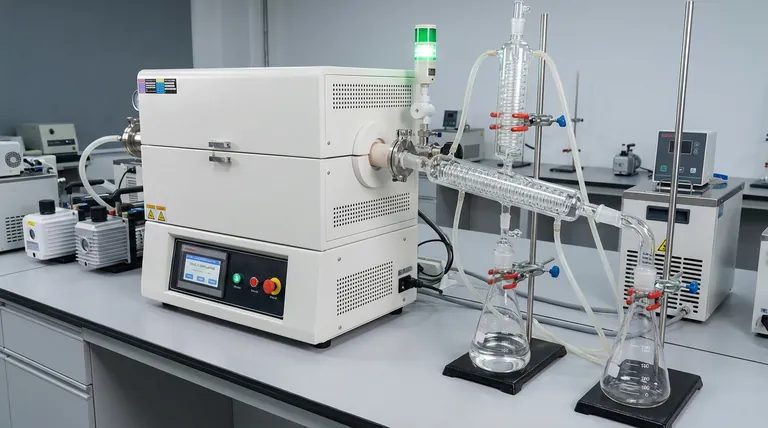
The primary function of the laboratory-scale condensation collection device is to capture and isolate the distillate produced during each individual stage of the separation process. Because a single evaporation-condensation event is insufficient to fully separate magnesium from alloying elements like zinc or cadmium, this device accumulates the intermediate condensate. This collected material then serves as the critical feedstock for subsequent distillation cycles, enabling a stepwise approach to purification.
Effective separation in magnesium alloys is rarely a single-step event due to the complex interaction of components. The collection device acts as the essential bridge between processing stages, holding intermediate products to facilitate the five to six iterative cycles required for high-purity results.
The Necessity of Multi-Stage Distillation
Overcoming Single-Pass Limitations
In the context of magnesium alloy separation, a standalone evaporation and condensation cycle often fails to achieve the desired separation efficiency.
The chemical properties of magnesium, zinc, and cadmium are such that a single pass leaves the elements intermixed. Relying on one cycle alone results in an impure product that does not meet high-grade specifications.
The Role of Iteration
To solve this, the process relies on repetition rather than intensity in a single step.
The primary reference indicates that achieving high-purity zinc or cadmium metal products requires repeating the process through five to six distillation cycles. Each cycle incrementally improves the separation factor.
How the Collection Device Drives the Process
Serving as an Intermediate Reservoir
The condensation collection device is not merely a final storage unit; it is an active component of the workflow.
Its specific role is to capture the output of the current stage before it is reintroduced to the system. This prevents the purified vapor from recombining with the unrefined residue in the evaporation chamber.
Transforming Output into Feedstock
Once the device collects the intermediate condensate, that material changes its role.
It is no longer just a "product"; it becomes the feedstock for the next distillation stage. This functionality allows the operator to systematically refine the material, moving it from a raw alloy state to a high-purity metal over several planned stages.
Understanding the Trade-offs
Process Intensity vs. Purity
While the condensation collection device enables high purity, it dictates a labor-intensive workflow.
Operators must account for the time and energy required to manage five to six distinct cycles. There is a direct trade-off between the purity of the final zinc or cadmium and the number of operational hours invested in managing these collection steps.
Complexity of Handling
Using a collection device for multi-stage distillation introduces handling complexity.
Because the output of one stage must be manually or mechanically transferred to become the input of the next, there is a risk of yield loss or contamination if the device is not managed precisely between cycles.
Making the Right Choice for Your Goal
To maximize the utility of your condensation collection device, align your operational cycles with your specific purity requirements.
- If your primary focus is High-Purity Isolation: Plan for the full five to six cycles, ensuring the collection device is thoroughly cleared between stages to prevent cross-contamination.
- If your primary focus is Rough Separation: Utilize the device for only one to two cycles to bulk-separate the magnesium, accepting that the zinc or cadmium yield will remain an intermediate alloy.
Success in this process depends not just on the equipment, but on the disciplined repetition of the collection and re-distillation cycle.
Summary Table:
| Feature | Function in Multi-Stage Distillation |
|---|---|
| Primary Role | Captures and isolates distillate for subsequent purification stages |
| Cycle Requirement | Facilitates the 5-6 cycles needed for high-purity zinc/cadmium |
| Feedstock Transition | Converts intermediate condensate into raw material for the next stage |
| Efficiency Benefit | Prevents purified vapor from recombining with unrefined residue |
| Purity Control | Allows for stepwise refinement to meet specific grade requirements |
Elevate Your Material Purification with KINTEK
Achieving high-purity results in magnesium alloy separation requires more than just standard equipment—it demands precision at every stage of the distillation cycle. Backed by expert R&D and world-class manufacturing, KINTEK provides high-performance Vacuum, CVD, and Tube furnace systems specifically designed to handle the complexities of multi-stage thermal processing.
Whether you are performing rough separations or require 99.9% purity through iterative cycles, our customizable lab high-temperature solutions ensure uniform heating and reliable condensation collection. Contact KINTEK today to discuss how our specialized furnaces can optimize your laboratory workflow and deliver the high-grade yields your research demands.
References
- В. Н. Володин, Alexey Trebukhov. On the Problem of the Distillation Separation of Secondary Alloys of Magnesium with Zinc and Magnesium with Cadmium. DOI: 10.3390/met14060671
This article is also based on technical information from Kintek Furnace Knowledge Base .
Related Products
People Also Ask
- What are the advantages of using a condensing tube furnace for magnesium extraction? Achieve High Purity and Efficient Metal Recovery
- How does the working temperature range affect the choice of a tube furnace? Match Your Lab's Thermal Needs for Precision and Cost-Efficiency
- What makes tube furnaces indispensable in academic and industrial settings? Unlock Precision Heating for Advanced Materials
- Why is a tube furnace with precise temperature control necessary for atmosphere annealing? Master Ceramic Engineering
- Why is a high-temperature tube furnace required for MoS2 and WS2 thin films? Achieve 2H Crystalline Phase Excellence
