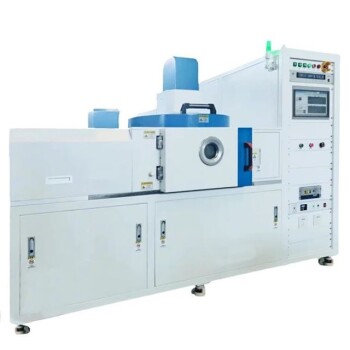
The ultra-high vacuum rapid thermal annealing (RTA) system serves as a precise environmental reactor for mapping the thermal limits of cobalt nitride (CoN) thin films. By applying rapid, controlled heat under extreme low-pressure conditions, the system allows researchers to pinpoint the exact temperature where CoN decomposes into metallic cobalt. This specific setup is essential for characterizing material phase transitions while shielding the sensitive films from atmospheric oxidation.
The core function of a UHV RTA system is to isolate the chemical decomposition of cobalt nitride from external environmental interference. This enables the accurate identification of the "decomposition threshold," the point where nitrogen is expelled and metallic cobalt precipitates.
Mapping Phase Transformations and Stability
Pinpointing the Decomposition Threshold
Cobalt nitride is inherently sensitive to heat, transitioning from a nitride compound to a metallic state at specific temperature markers. The RTA system provides the high-temperature, instantaneous thermal treatment required to trigger these internal atomic reorganizations. Researchers use this data to establish the operational boundaries where the material remains chemically stable.
Observing Metallic Cobalt Precipitation
As the CoN film reaches critical temperatures, the nitride structure begins to break down. The RTA process facilitates the observation of when nitrogen is released, leaving behind metallic cobalt precipitates. This transformation is a key indicator of the film's thermal endurance and its potential lifespan in high-performance electronic applications.
The Necessity of the Ultra-High Vacuum (UHV)
Preventing Material Oxidation
Processing cobalt nitride at high temperatures in the presence of oxygen would result in rapid oxidation, effectively destroying the sample. The ultra-high vacuum environment ensures that the film's reaction is purely internal rather than a reaction with the surrounding air. This isolation is what makes the resulting data regarding "thermal stability" scientifically valid and reproducible.
Material Densification and Impurity Release
Rapid heating in a vacuum can help reorganize the atomic structure of the film, leading to material densification. Under vacuum, the system can help release weakly bonded impurities, such as hydrogen, that may have been introduced during the initial deposition process. This results in a more stable material that more accurately reflects the inherent properties of cobalt nitride.
Understanding the Trade-offs
Throughput vs. Precision
While RTA is significantly faster than traditional furnace annealing, the rapid ramp rates can sometimes induce mechanical stress within the thin film. Furthermore, ultra-high vacuum systems require significant setup time to reach the required base pressures before processing can begin. Researchers must balance the need for rapid thermal data with the logistical complexities of maintaining a pristine vacuum environment.
Phase Identification Complexity
Because RTA happens so quickly, capturing the exact moment of phase transformation requires precise calibration of heating profiles. If the ramp rate is too aggressive, researchers may bypass intermediate phases that are critical for understanding the full stability profile. Careful incremental testing is often necessary to achieve a high-resolution view of the decomposition process.
Applying This Knowledge to Your Project
When utilizing a UHV RTA system for nitride stability studies, you must align your thermal parameters with your specific material objectives.
- If your primary focus is determining maximum operating temperature: Use incremental RTA steps at varying temperatures to identify the exact point of cobalt precipitation and nitrogen loss.
- If your primary focus is film purity and density: Utilize the vacuum environment to purge volatile impurities while monitoring changes in the film's physical properties, such as refractive index or conductivity.
Mastering the UHV RTA environment is the definitive method for ensuring your cobalt nitride films remain reliable and high-performing under thermal stress.
Summary Table:
| Feature | Role in CoN Research | Primary Benefit |
|---|---|---|
| Rapid Thermal Ramp | Triggers instantaneous atomic reorganization | Pinpoints exact decomposition temperatures |
| Ultra-High Vacuum | Eliminates atmospheric oxygen and moisture | Prevents sample oxidation and ensures data purity |
| Controlled Environment | Isolates internal chemical decomposition | Accurate identification of nitrogen release points |
| Impurity Removal | Releases weakly bonded elements (e.g., Hydrogen) | Enhances material densification and film stability |
Elevate Your Material Research with KINTEK Precision
Precise thermal characterization requires equipment that can withstand extreme conditions while maintaining total environmental purity. KINTEK specializes in high-performance laboratory equipment, offering a comprehensive range of high-temperature furnaces, including vacuum, CVD, muffle, tube, and atmosphere-controlled systems, all fully customizable to meet your unique research needs.
Whether you are mapping the stability of cobalt nitride films or developing next-generation semiconductors, our experts are ready to help you find the perfect thermal solution. Contact us today to discuss your project requirements!
References
- Mukul Gupta, Jochen Stahn. X-ray absorption spectroscopy study of cobalt mononitride thin films. DOI: 10.1007/s42452-019-1808-2
This article is also based on technical information from Kintek Furnace Knowledge Base .
Related Products
- Ultra High Vacuum Observation Window Stainless Steel Flange Sapphire Glass Sight Glass for KF
- Split Chamber CVD Tube Furnace with Vacuum Station CVD Machine
- Laboratory Quartz Tube Furnace RTP Heating Tubular Furnace
- Multi Heating Zones CVD Tube Furnace Machine for Chemical Vapor Deposition Equipment
- Custom Made Versatile CVD Tube Furnace Chemical Vapor Deposition CVD Equipment Machine
People Also Ask
- What is the significance of using a high-temperature tube furnace with observation windows? Real-Time Wettability Analysis
- Why is an Ultra-High Vacuum (UHV) System Required for In2Se3? Achieving Atomic-Level Ferroelectric Clarity
- Why is an environmental laboratory chamber equipped with an optical window required for synthesizing Hafnium Carbide?
- What are the structural functions of the dual-chamber quartz glass container? Optimize Magnesium Alloy Vapor Analysis
- What is the purpose of utilizing a glassy carbon crucible and HCl gas treatment? Ensure Pure Molten Salt Systems