
At its core, a box-type atmosphere furnace is a high-temperature heat treatment chamber that allows for precise control over both temperature and the gaseous environment surrounding the material being processed. Unlike a standard oven that operates in ambient air, this furnace creates a sealed, controlled atmosphere to protect materials and facilitate specific chemical changes.
The essential function of a box-type atmosphere furnace is not just to heat materials, but to do so within a carefully managed gas environment. This control prevents unwanted reactions like oxidation and enables advanced material processing that is impossible in open air.
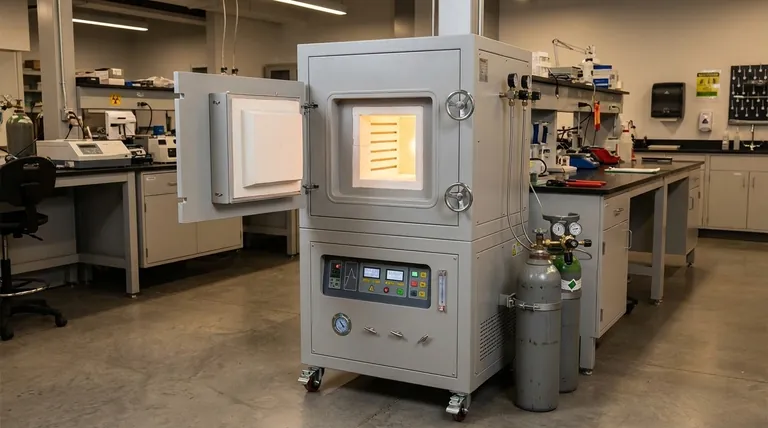
Deconstructing the Box-Type Atmosphere Furnace
To understand its function, it's best to break the furnace down into its four critical systems. Each is designed to provide an exceptional level of control over the heat treatment process.
The Sealed Furnace Chamber
The foundation is a box-shaped structure, often called a muffle furnace, designed to be completely sealed from the outside air. Materials are loaded and unloaded through a single door, making it an intermittent or batch-processing furnace.
The chamber itself is built with advanced insulation materials like ceramic fiber to withstand extreme temperatures, often ranging from 1000°C to 2000°C, while keeping the exterior safe.
The Heating System
Heating is typically achieved with high-performance electric resistance elements. These elements are engineered to provide uniform heat distribution throughout the chamber, eliminating hot or cold spots that could compromise the material.
The Atmosphere Control System
This is the defining feature. A dedicated gas supply system allows the operator to purge the ambient air and introduce a specific gas or mixture of gases. This creates a controlled environment inside the chamber.
Commonly used atmospheres include inert gases (like argon or nitrogen) to prevent any chemical reaction, or reducing gases (like hydrogen) to actively remove oxides from a material's surface.
The Temperature Control System
Modern atmosphere furnaces are equipped with advanced programmable controllers. These systems maintain the set temperature with remarkable stability, often with an accuracy of ±1°C. This precision is critical for achieving repeatable and reliable results in research and production.
The Core Purpose: Why Control the Atmosphere?
The ability to manipulate the gas environment solves critical challenges in material science and manufacturing that a simple furnace cannot address.
Preventing Oxidation and Contamination
Many advanced materials, especially metals, will rapidly oxidize (rust or tarnish) when heated in the presence of oxygen. By replacing the air with an inert gas, the furnace completely prevents this degradation, preserving the material's integrity and surface finish.
Enabling Specific Chemical Reactions
Some processes, such as brazing, sintering, or annealing, require a specific atmosphere to succeed. For example, a reducing atmosphere can be used to prepare a surface for bonding, while other specialized gas environments can be used to intentionally alter a material's chemical composition (e.g., carburizing).
Understanding the Trade-offs
While powerful, the box-type atmosphere furnace is not a universal solution. Understanding its inherent design trade-offs is crucial.
Intermittent vs. Continuous Production
The single-door, batch-loading design makes this furnace ideal for research, development, and small-to-medium scale production runs. However, it is not suited for high-volume, continuous manufacturing where materials flow constantly through a heating process.
Simplicity vs. Capability
While a basic box furnace is simple to operate, adding an atmosphere control system introduces complexity. Managing gas flow rates, ensuring a perfect seal, and implementing safety protocols for flammable gases (like hydrogen) requires additional expertise and maintenance. This is the trade-off for its advanced capabilities.
Making the Right Choice for Your Goal
Deciding whether you need a box-type atmosphere furnace depends entirely on your material and your process objective.
- If your primary focus is preventing oxidation or contamination: This furnace is the correct tool, as it provides the necessary protective inert atmosphere.
- If your primary focus is simple heat treatment in air: A standard, less complex box furnace (or muffle furnace) without atmosphere controls is a more cost-effective and straightforward solution.
- If your primary focus is high-volume, continuous processing: You should investigate conveyor or tunnel furnaces designed for inline manufacturing rather than this batch-style furnace.
Ultimately, this furnace is a specialized instrument for when the environment in which you heat a material is just as important as the temperature itself.
Summary Table:
| Feature | Description |
|---|---|
| Chamber Type | Sealed, box-shaped for batch processing |
| Temperature Range | 1000°C to 2000°C |
| Atmosphere Control | Inert or reducing gases (e.g., argon, hydrogen) |
| Key Applications | Preventing oxidation, sintering, annealing, brazing |
| Temperature Accuracy | ±1°C with programmable controllers |
Ready to elevate your material processing with precise control? At KINTEK, we leverage exceptional R&D and in-house manufacturing to provide advanced high-temperature furnace solutions tailored for your lab. Our product line, including Box-Type Atmosphere Furnaces, Muffle, Tube, Rotary Furnaces, Vacuum & Atmosphere Furnaces, and CVD/PECVD Systems, is complemented by strong deep customization capabilities to meet your unique experimental needs. Contact us today to discuss how our furnaces can enhance your research and production efficiency!
Visual Guide

Related Products
- Mesh Belt Controlled Atmosphere Furnace Inert Nitrogen Atmosphere Furnace
- 1200℃ Controlled Inert Nitrogen Atmosphere Furnace
- 1400℃ Controlled Inert Nitrogen Atmosphere Furnace
- 1700℃ Controlled Inert Nitrogen Atmosphere Furnace
- Controlled Inert Nitrogen Hydrogen Atmosphere Furnace
People Also Ask
- What are the two main purposes of controlled atmosphere conditions in furnaces? Protect or Transform Materials for Peak Performance
- How is a controlled atmosphere furnace used in material research? Achieve Precise Material Synthesis and Heat Treatment
- How does a controlled atmosphere furnace improve product quality and consistency? Master Precise Heat Treatment for Superior Results
- What types of gases can a controlled atmosphere furnace handle? Master Inert and Reactive Gases for Your Lab
- What types of furnaces have controlled atmosphere furnaces largely replaced? Boost Metallurgical Precision & Safety



















