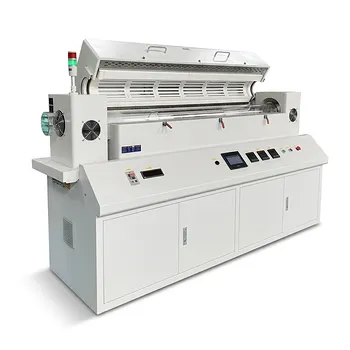
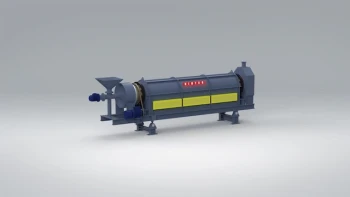
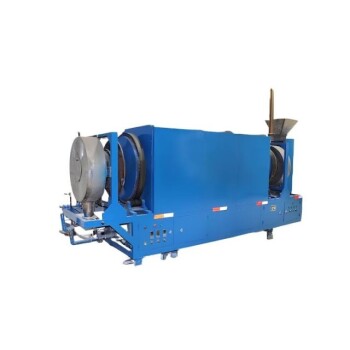
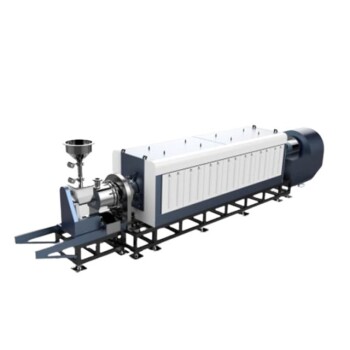
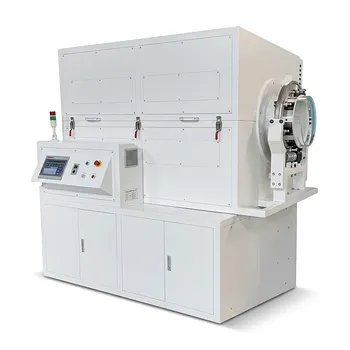
The high-temperature rotary furnace is the thermal linchpin of an automated powder forging line. Its primary function is to continuously preheat pre-sintered metal powder compacts to a precise hot deformation temperature—between 850 °C and 1150 °C—immediately before they enter the forging press. The rotating hearth design ensures uniform thermal exposure throughout the entire volume of each preform, a critical step that enables consistent densification with minimal lateral metal flow.
Achieving full density in powder forging hinges not just on the press force, but on delivering a thermally homogeneous preform that flows predictably. The rotary furnace bridges the gap between sintering and forging by creating that exact, uniform temperature profile, enabling near-net shape accuracy and reliable mechanical properties.
Understanding the Role in the Production Sequence
Before a compacted powder preform can be forged into a high-strength component, it must pass through a carefully choreographed thermal process. The rotary furnace occupies the most critical position in that sequence.
From Green Compact to Near-Net Shape
The journey begins with a lubricant evaporation furnace, which burns off pressing lubricants from the green compact. This prevents contamination and void formation later. The preform then enters the high-temperature rotary furnace for the critical preheating step. After reaching the target temperature, robotic manipulators transfer it directly into heated dies (200–300 °C) for forging.
The Critical Preheating Window (850–1150 °C)
This is not just about softening the metal. Heating to the 850–1150 °C range activates the material’s hot deformation behavior, reducing flow stress and enabling full densification under relatively low forging pressures. Operating below this range would risk cracking or incomplete pore elimination; exceeding it could cause grain coarsening or surface degradation, even under protective atmospheres.
Why Uniform Heating is Non-Negotiable
A preform with temperature gradients will forge unevenly, leading to warpage, residual stresses, or non-uniform density. The rotary furnace’s core design is built specifically to eliminate this risk.
The Rotating Hearth Advantage
The rotating hearth slowly passes each part through a field of carefully controlled radiant or resistive heat. This constant movement eliminates static hot spots and ensures that every point on the part—surface and core—sees the same integrated heat dose. It’s the difference between baking bread in a convection oven versus waving it randomly over a flame.
Enabling Low-Lateral-Flow Forging
When temperature is uniform throughout the preform, the metal flows consistently in the die. This means the part can densify almost entirely through axial compression without needing excessive material redistribution. The result: minimal lateral flow, reduced die wear, and parts that stay much closer to their final net shape right out of the press.
Understanding the Trade-offs
No single heating technology is universally superior. While the rotary furnace excels at uniformity, it comes with its own set of practical considerations when compared to alternatives like induction heating units often found in the same lines.
Rotary Furnace vs. Induction Heating
Induction heating is fast and compact, making it attractive for high-volume production of simple, symmetric parts. However, it can struggle to heat complex shapes evenly and requires careful coil design. The rotary furnace, in contrast, provides inherently uniform bulk heating regardless of part geometry, but it typically has a larger footprint, longer heat-up time, and may require more extensive protective atmosphere blanketing to prevent oxidation.
Cycle Time and Throughput Constraints
The rotating hearth’s thermal inertia can be a double-edged sword. While it guarantees consistency, its ramp-up and cool-down times are slower than induction-based systems. This makes it ideal for dedicated, continuous lines producing a stable part family, but less flexible for rapid changeovers or small-batch specialty work.
Making the Right Choice for Your Goal
The decision to use a rotary furnace—and how to integrate it—should be driven by the specific performance and production demands of your parts.
- If your primary focus is achieving the highest density and dimensional consistency in complex, near-net-shape parts: The rotary furnace’s uniform bulk heating is your baseline requirement. Prioritize pyrometric monitoring and a tightly controlled inert atmosphere.
- If your primary focus is maximizing production speed for simpler, symmetric preforms: Consider exploring a high-capacity induction heating stage, but validate its uniformity for your specific geometry first.
- If your primary focus is a flexible line handling multiple part families: Weigh the rotary furnace’s extended changeover time against its process stability. A hybrid approach—using rotary for high-value, complex parts—may offer the best balance.
The right thermal step doesn’t just heat metal; it de-risks your entire densification process, turning a porous green part into a predictable, reliable forging.
Summary Table:
| Feature / Aspect | Rotary Furnace Role | Impact on Forging Process |
|---|---|---|
| Preheating Target | Continuous heating from 850 °C to 1150 °C | Activates hot deformation & eliminates cracking |
| Thermal Uniformity | Rotating hearth eliminates static hot spots | Ensures consistent metal flow & full density |
| Geometric Versatility | Bulk heating independent of part symmetry | Enables near-net shape for complex preforms |
| Atmosphere Control | Protective inert atmosphere blanketing | Prevents oxidation & preserves surface integrity |
Optimize your production line with KINTEK's advanced thermal processing solutions. KINTEK specializes in high-performance laboratory equipment and high-temperature furnaces—including rotary, muffle, tube, vacuum, CVD, atmosphere, and induction melting furnaces—all fully customizable to meet your exact metallurgical requirements. Achieve superior temperature uniformity, reduce defect rates, and maximize your component density. Contact us today to discuss your customized furnace requirements with our engineering team!
Related Products
- 1400℃ High Temperature Laboratory Tube Furnace with Alumina Tube
- 1700℃ High Temperature Laboratory Tube Furnace with Alumina Tube
- 1800℃ High Temperature Muffle Oven Furnace for Laboratory
- 1700℃ High Temperature Muffle Oven Furnace for Laboratory
- 1200℃ Muffle Oven Furnace for Laboratory
People Also Ask
- How does zone-melting in tube furnaces synthesize bismuth micro-wires? Master Single-Crystal Thermoelectric Growth
- How do high-temperature laboratory tube furnaces ensure environmental stability? Precision Thermal Reduction Tips
- How are high-temperature laboratory tube furnaces applied in long-term vacuum homogenization heat treatments for intermetallic samples?
- How are high-temp tube furnaces used to measure diffusion coefficients per Fick's law? Master Precision Annealing
- How are high-temperature tube furnaces applied in testing ceramic-supported alloy membranes? Insights