
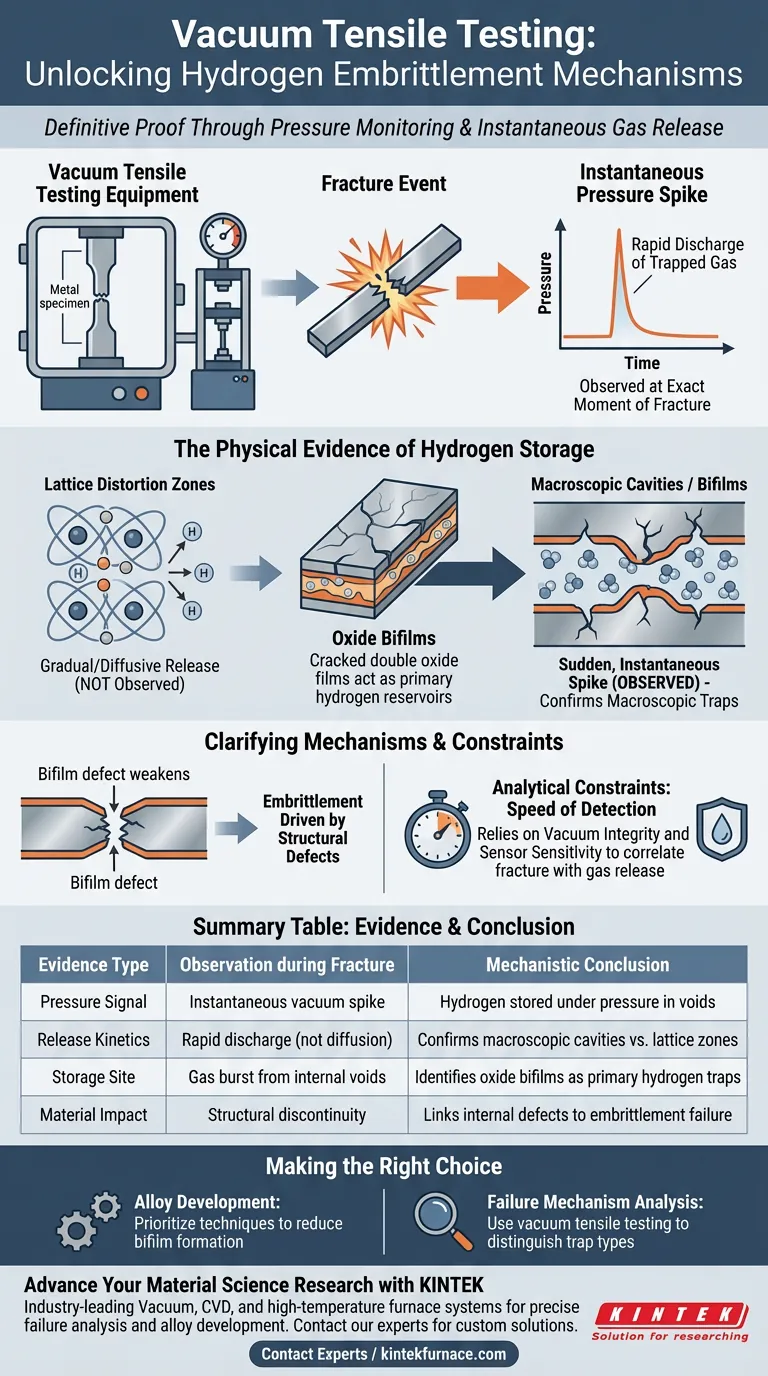
Vacuum tensile testing equipment provides definitive evidence of hydrogen storage mechanisms through pressure monitoring. Specifically, researchers observe a sudden, instantaneous spike in the vacuum chamber pressure at the exact moment the metal specimen fractures. This distinct physical signal serves as experimental proof of how and where hydrogen is retained within the metal's structure.
By capturing the instantaneous release of gas upon fracture, this testing method proves that hydrogen is accumulated in macroscopic cavities, such as bifilms, rather than simply existing within atomic lattice distortions.
The Physical Evidence of Hydrogen Storage
The Phenomenon of Instantaneous Release
The primary evidence provided by vacuum tensile testing is the timing and nature of the pressure change. When the alloy fractures, the equipment records an immediate surge in chamber pressure.
This suggests that the hydrogen was not slowly diffusing out of the material. Instead, it indicates a rapid discharge of a significantly larger volume of gas that was trapped under pressure.
Distinguishing Storage Locations
This evidence allows researchers to differentiate between microscopic and macroscopic hydrogen storage.
If hydrogen were solely located in lattice distortion zones, the release would likely be gradual or diffusive. The sudden pressure spike confirms the presence of macroscopic cavities—physical voids inside the metal that hold pockets of gas.
The Role of Oxide Bifilms
Identifying the Trap
The data specifically points to cracked double oxide films, known as bifilms, as the primary "traps" for hydrogen.
These bifilms create internal discontinuities within the metal. The vacuum test proves these films act as reservoirs, storing hydrogen gas until the material fails.
Clarifying Embrittlement Mechanisms
By identifying bifilms as the core storage site, the equipment clarifies the mechanism of embrittlement.
It moves the understanding away from purely atomic-level interactions to structural defects. The hydrogen trapped in these films weakens the material, facilitating the fracture that releases the gas.
Understanding the Analytical Constraints
Specificity of the Signal
It is important to note that this evidence relies heavily on the speed of detection. The distinct advantage of this method is its ability to correlate the exact moment of structural failure with gas release.
Without the vacuum environment, this release would be undetectable against atmospheric pressure. Therefore, the validity of this evidence depends entirely on the integrity of the vacuum seal and the sensitivity of the pressure sensors.
Making the Right Choice for Your Research
To effectively utilize these findings in material science or failure analysis, consider the following applications:
- If your primary focus is Alloy Development: Prioritize casting and processing techniques that reduce the formation of double oxide films (bifilms) to minimize hydrogen trap sites.
- If your primary focus is Failure Mechanism Analysis: Utilize vacuum tensile testing to distinguish whether hydrogen embrittlement is driven by lattice diffusion or macroscopic gas pockets.
The sudden release of pressure in a vacuum confirms that structural defects, not just atomic lattice issues, are the critical reservoirs for hydrogen in aluminum alloys.
Summary Table:
| Evidence Type | Observation during Fracture | Mechanistic Conclusion |
|---|---|---|
| Pressure Signal | Instantaneous vacuum spike | Hydrogen is stored under pressure in voids |
| Release Kinetics | Rapid discharge (not diffusion) | Confirms macroscopic cavities vs. lattice zones |
| Storage Site | Gas burst from internal voids | Identifies oxide bifilms as primary hydrogen traps |
| Material Impact | Structural discontinuity | Links internal defects to embrittlement failure |
Advance Your Material Science Research with KINTEK
Identifying the root cause of hydrogen embrittlement requires precision and high-performance testing environments. KINTEK provides industry-leading, customizable Vacuum, CVD, and high-temperature furnace systems designed to meet the rigorous demands of material failure analysis and alloy development.
Backed by expert R&D and world-class manufacturing, our equipment empowers researchers to capture critical data—from gas release signals to structural transitions. Whether you need a standard Muffle furnace or a specialized Vacuum system, our solutions are tailored to your unique laboratory needs.
Ready to eliminate structural defects and enhance your alloy performance? Contact our experts today to find your custom solution.
Visual Guide
References
- Time-Dependent Failure Mechanisms of Metals; The Role of Precipitation Cleavage. DOI: 10.20944/preprints202508.2134.v1
This article is also based on technical information from Kintek Furnace Knowledge Base .
Related Products
People Also Ask
- What are the key advantages of using a rotary tube furnace? Achieve Dynamic, Uniform Heating for Powders
- What other fields utilize rotary tube furnaces? Discover Versatile Heating Solutions for Multiple Industries
- What optional features enhance the processing capabilities of rotary tube furnaces? Boost Efficiency with Advanced Customizations
- When are rotary tube furnaces not suitable for a process? Avoid Costly Mistakes in Thermal Processing
- What are the technical advantages of using a rotary tube furnace for hydrochar activation? Achieve Superior Porosity
