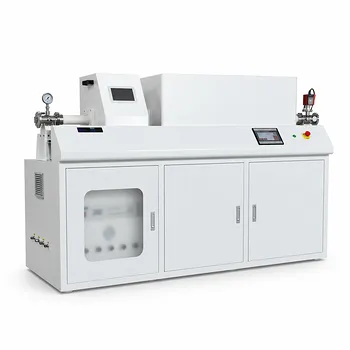
The muffle furnace is the critical instrument for thermal activation.
In the surface treatment of TiO2 nanotubes, the muffle furnace facilitates high-temperature annealing (typically at 450°C) to convert amorphous structures into a functional crystalline phase. This process is essential for transitioning the material from a chemically inert state to an active anatase phase, which possesses the necessary biological, antibacterial, and photoelectrochemical properties for industrial and medical applications.
The muffle furnace serves as a controlled thermal reactor that dictates the final crystalline structure and stability of TiO2 nanotubes. It effectively bridges the gap between a raw, amorphous morphology and a high-performance functional nanomaterial.
The Catalyst for Crystalline Phase Transformation
Transition from Amorphous to Anatase
TiO2 nanotubes produced via anodic oxidation initially exist in an amorphous state, which lacks significant chemical activity. The muffle furnace provides the precise thermal energy required to trigger the rearrangement of lattice atoms into the anatase crystalline phase.
Enhancing Biological and Chemical Activity
The anatase phase is highly valued for its superior photocatalytic efficiency and biological compatibility. By maintaining a stable thermal environment, the furnace ensures the material achieves the high surface energy needed for antibacterial performance and electron transfer.
Achieving Phase Purity
Depending on the specific temperature and duration, the furnace can also manage the transition from anatase to rutile. This allows researchers to produce high-purity single-phase nanomaterials or specific mixed phases tailored for specialized light absorption.
Structural Integrity and Morphological Preservation
Preventing Nanotube Collapse
The delicate architecture of TiO2 nanotubes is susceptible to structural failure under inconsistent heat. A muffle furnace provides strict temperature control and uniform thermal fields to prevent the collapse or sintering of the nanotube walls during treatment.
Elimination of Internal Stresses
The rapid growth of nanotubes during synthesis often introduces significant internal mechanical stress. High-temperature annealing allows these stresses to relax, which significantly improves the photoelectrochemical stability and mechanical durability of the nanotubes.
Removal of Organic Precursors and Contaminants
During the synthesis process, residual solvents and organic precursors can remain on the surface. The furnace acts as a calcination tool, effectively burning off these impurities to ensure a clean, stable surface for subsequent applications.
Understanding the Trade-offs
Temperature Precision vs. Phase Transition
Small fluctuations in temperature can lead to unintended phase transitions. While higher temperatures enhance crystallinity, exceeding specific thresholds (often around 500°C-600°C) may trigger a transition to the rutile phase, which has different photocatalytic properties that may not suit the original goal.
Heating Rates and Structural Fatigue
Applying heat too rapidly can lead to "thermal shock," causing the nanotubes to delaminate from their substrate. Controlled heating and cooling rates (e.g., 20°C/min) are necessary to maintain the adhesion and integrity of the nanostructure.
Energy Consumption and Throughput
Achieving high crystallinity often requires extended isothermal durations, sometimes lasting several hours or even 24 hours. This creates a trade-off between the quality of the crystalline structure and the operational energy costs of the furnace.
How to Apply This to Your Project
High-temperature treatment is the defining step in determining the final performance of your TiO2 nanotubes. Your choice of temperature and atmosphere within the muffle furnace should be dictated by your end-use requirements.
- If your primary focus is Biological Activity: Aim for a temperature of approximately 450°C to maximize the anatase phase while ensuring the nanotubes remain intact and biocompatible.
- If your primary focus is Photocatalytic Stability: Focus on longer annealing cycles and precise cooling rates to eliminate internal stresses and structural defects.
- If your primary focus is Material Purity: Utilize the furnace for extended calcination at higher temperatures to ensure all organic precursors and surface moisture are fully removed.
The muffle furnace is not merely a heater but a precision tool for engineering the atomic landscape of your nanomaterials.
Summary Table:
| Process Step | Muffle Furnace Role | Key Outcome |
|---|---|---|
| Annealing | Precise thermal activation (e.g., 450°C) | Transition from amorphous to anatase phase |
| Phase Control | Strict temperature management | Prevents unwanted transition to rutile phase |
| Structural Care | Uniform thermal field | Prevents nanotube collapse and sintering |
| Calcination | High-temperature purification | Removes organic precursors and contaminants |
| Stress Relief | Controlled heating/cooling rates | Eliminates internal mechanical stresses |
Elevate Your Nanomaterial Research with KINTEK
Precision is the difference between a failed sample and a high-performance functional nanomaterial. KINTEK specializes in advanced laboratory equipment, providing the high-accuracy thermal environments necessary for delicate processes like TiO2 nanotube annealing.
Whether you require a standard muffle furnace, or specialized tube, rotary, vacuum, CVD, or atmosphere furnaces, our equipment is engineered for exceptional temperature uniformity and stability. We also offer dental and induction melting furnaces, all fully customizable to meet your unique experimental parameters.
Ready to optimize your crystalline phase transitions?
Contact KINTEK today to find the perfect high-temperature solution for your lab!
References
- Salih Durdu, Metin Usta. Surface characterization and antibacterial efficiency of well-ordered TiO2 nanotube surfaces fabricated on titanium foams. DOI: 10.1038/s41598-024-51339-6
This article is also based on technical information from Kintek Furnace Knowledge Base .
Related Products
- High Temperature Muffle Oven Furnace for Laboratory Debinding and Pre Sintering
- 1200℃ Muffle Oven Furnace for Laboratory
- 1700℃ High Temperature Muffle Oven Furnace for Laboratory
- 1800℃ High Temperature Muffle Oven Furnace for Laboratory
- 1400℃ Muffle Oven Furnace for Laboratory
People Also Ask
- What thermal phenomena occur during polymer binder burnout in ceramic green bodies? Lab Furnace Guide
- What role does a high-temperature muffle furnace play in STFO synthesis? Achieve Pure Perovskite Results
- Why is controlled heat treatment in a muffle furnace necessary for calcined clay? Achieve Optimal Pozzolanic Activity
- How does a high-temperature muffle furnace facilitate the formation of LaNbxAl1−xO3+δ perovskite structures? Key Roles
- What role does a high-temperature muffle furnace play in the multi-stage synthesis of Li0.5MnFe1.5O4? Key to Pure Spinel