
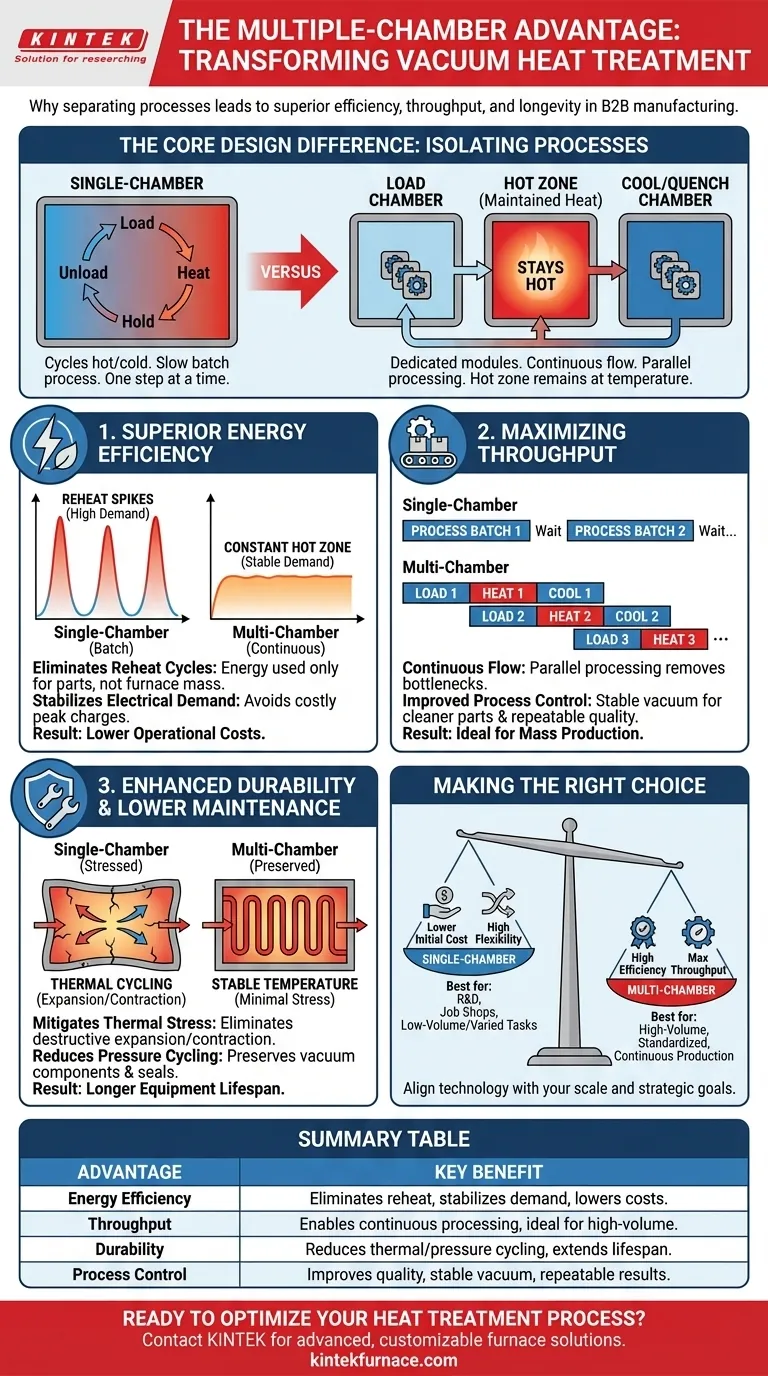
In essence, multiple-chamber vacuum furnaces outperform single-chamber designs by separating the heating and cooling processes into different physical modules. This fundamental design difference leads to major advantages in energy efficiency, production throughput, and equipment longevity by eliminating the need for the hot zone to cool down and reheat between every batch.
The core advantage of a multi-chamber vacuum furnace is its transformation of heat treatment from a slow, energy-intensive batch process into a highly efficient, continuous production flow. By keeping the heating chamber consistently hot, you minimize energy waste, accelerate production cycles, and reduce mechanical stress on the equipment.
The Core Design Difference: Isolating Processes
The functional superiority of a multiple-chamber furnace stems from one simple principle: dedicating separate, isolated chambers for distinct process steps.
The Single-Chamber Limitation
A single-chamber furnace must perform every step—pumping down, heating, holding at temperature, and cooling or quenching—in the same space. This requires the chamber and all its internal components to cycle through extreme temperature and pressure changes with every load.
The Multi-Chamber Advantage
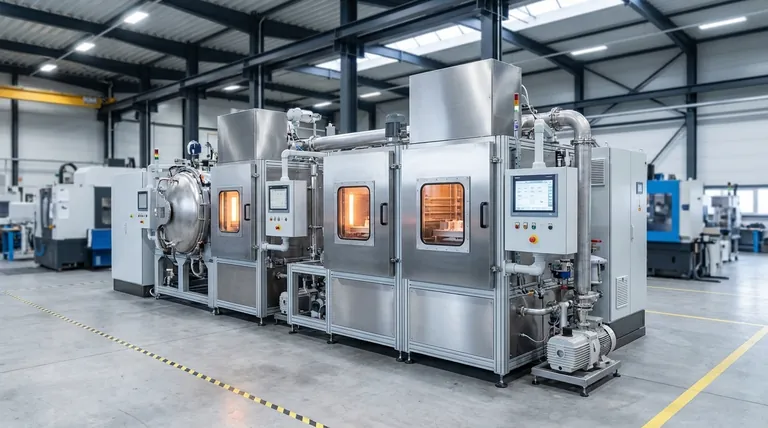
A multiple-chamber system moves the workload between specialized chambers. A typical flow involves a loading chamber, a dedicated hot zone that remains at temperature, and a separate cooling or quenching chamber. This allows multiple loads to be in different stages of the process simultaneously.
Advantage 1: Superior Energy Efficiency
By not cooling the hot zone for every cycle, multi-chamber furnaces achieve significant energy savings and operational cost reductions.
Eliminating Reheat Cycles
The single largest energy expenditure in batch processing is reheating the furnace from a cooled state. In a multi-chamber design, the heat is retained in the hot zone, ready for the next load.
The available energy is consumed almost exclusively by the parts being treated, not by the furnace itself. This dramatically lowers the energy cost per pound of processed material.
Stabilizing Electrical Demand
Single-chamber furnaces create massive spikes in electrical demand as they ramp up to temperature. A multi-chamber furnace, by maintaining a constant hot zone temperature, draws a much more consistent and predictable electrical load, reducing or eliminating costly peak-demand charges from utility providers.
Advantage 2: Maximizing Throughput for Mass Production
The ability to process loads continuously makes multiple-chamber furnaces ideal for modern industrial-scale production.
From Batch to Continuous Flow
While one load is cooling, the next load can already be in the hot zone. This parallel processing overcomes the primary bottleneck of single-chamber designs, which are inherently unsuited for high-volume manufacturing.
This continuous model significantly increases productivity and overall output, making it the standard for applications that require consistent, large-scale results.
Improved Process Control and Quality
Dedicated chambers allow for more precise control over each step. The constant, stable vacuum in the hot zone prevents oxidation from moisture contamination that can occur during pressure cycling. This results in cleaner part surfaces, minimal decarburization, and superior metallurgical repeatability.
Advantage 3: Enhanced Durability and Lower Maintenance
Maintaining a stable environment within the furnace chambers dramatically reduces wear and tear, extending the equipment's lifespan.
Mitigating Thermal Stress
The repeated expansion and contraction caused by thermal cycling is a primary cause of fatigue and failure in furnace components like heating elements, insulation, and the chamber itself. By keeping the hot zone at a stable temperature, this destructive stress is virtually eliminated.
Reducing Pressure Cycling
Likewise, the hot zone is not subjected to constant pressure cycling between deep vacuum and atmospheric pressure. This preserves the integrity of the furnace casing, seals, and vacuum components, leading to a longer operational life and fewer maintenance interventions.
Understanding the Trade-offs
While powerful, a multiple-chamber system is not the universal solution. The primary trade-off is between operational efficiency and initial investment.
A multi-chamber furnace represents a higher capital expenditure and is more complex. Its benefits are most fully realized in high-volume, standardized production environments where efficiency and cost-per-part are the dominant concerns.
A single-chamber furnace offers a lower initial investment and greater flexibility. It is often a more practical choice for research and development, job shops with highly varied parts and processes, or low-volume production where the costs of a continuous system cannot be justified.
Making the Right Choice for Your Operation
Your decision should be guided by your specific production goals, volume, and budget.
- If your primary focus is high-volume, continuous production: A multiple-chamber furnace is the definitive choice for its superior throughput and low cost-per-part.
- If your primary focus is long-term operational cost reduction: The energy savings and reduced maintenance of a multi-chamber system provide a clear return on investment.
- If your primary focus is process flexibility for low-volume or varied tasks: A single-chamber furnace offers a more versatile and cost-effective entry point for vacuum heat treatment.
Ultimately, choosing the right furnace architecture is about aligning the technology with the scale and strategic goals of your operation.
Summary Table:
| Advantage | Key Benefit |
|---|---|
| Energy Efficiency | Eliminates reheat cycles, stabilizes electrical demand, lowers operational costs |
| Throughput | Enables continuous processing, ideal for high-volume mass production |
| Durability | Reduces thermal and pressure cycling, extends equipment lifespan |
| Process Control | Improves quality with stable vacuum, cleaner parts, and repeatable results |
Ready to optimize your heat treatment process? Leveraging exceptional R&D and in-house manufacturing, KINTEK provides diverse laboratories with advanced high-temperature furnace solutions. Our product line, including Muffle, Tube, Rotary Furnaces, Vacuum & Atmosphere Furnaces, and CVD/PECVD Systems, is complemented by our strong deep customization capability to precisely meet unique experimental requirements. Whether you're in high-volume production or need flexible solutions, we can help you achieve superior efficiency and quality. Contact us today to discuss how our furnaces can benefit your operation!
Visual Guide
Related Products
- Split Chamber CVD Tube Furnace with Vacuum Station CVD Machine
- Multi Heating Zones CVD Tube Furnace Machine for Chemical Vapor Deposition Equipment
- Molybdenum Vacuum Heat Treat Furnace
- Multi Zone Laboratory Quartz Tube Furnace Tubular Furnace
- Vacuum Induction Melting Furnace
People Also Ask
- What role does a Tube Furnace play in the CVD growth of carbon nanotubes? Achieve High-Purity CNT Synthesis
- What are the operational and maintenance requirements for a CVD tube furnace? Ensure Precision for Thin Film Deposition
- What are the advantages of using a CVD tube furnace for preparing gate dielectrics? Achieve High-Quality Thin Films for Transistors
- How does a CVD tube furnace achieve high purity in gate media preparation? Master Precision Control for Flawless Films
- What improvements can be made to the bonding force of gate dielectric films using a CVD tube furnace? Enhance Adhesion for Reliable Devices



















