The definitive kinetic difference lies in grain size sensitivity. During final-stage sintering, grain boundary (GB) diffusion shrinks isolated pores with a rate inversely proportional to the grain size to the fourth power ($G^{-4}$). In contrast, lattice diffusion through the crystal bulk has a weaker $G^{-3}$ dependence. This means refining your powder particle size yields a dramatically more powerful densification boost when GB diffusion is the controlling mechanism.
The core insight for process design is this: the exponential temperature dependence of diffusion allows you to choose your mechanism. By leveraging the lower activation energy of grain boundary transport, a precisely controlled furnace can drive densification to near-theoretical limits while outrunning the grain growth that traps porosity. You are not just heating; you are navigating a kinetic map.
The Fundamental Kinetic Divide in Final-Stage Sintering
After pores close off at grain corners around 85-92% density, the final act of sintering begins. The transport mechanism that dominates this stage dictates both the rate of densification and the ultimate microstructure you can achieve.
Deciphering the Scaling Laws: Why Grain Size Matters More for One Path
The mathematical models tell a clear story. The general sintering rate is proportional to the diffusion coefficient $D$ and inversely proportional to $G^m$. The grain size exponent $m$ is the critical differentiator.
For lattice (volume) diffusion, $m=3$. This is reflected in specific final-stage models where the densification rate $d\rho/dt$ scales with $G^{-3}$. Atoms migrate through the grain interior to fill a pore.
For grain boundary diffusion, $m=4$. The rate scales with $G^{-4}$, making it inherently more sensitive to microstructure according to models like Coble's spherical pore analysis.
The physical reason is straightforward. The area fraction of grain boundaries increases sharply as grains get smaller ($f_b \propto 1/G$). This massively amplifies the cross-section for GB transport in fine-grained compacts, while lattice diffusion remains largely unchanged. In a fine-grained ceramic, GB transport becomes the superhighway for atom delivery, directly targeting sintering stress concentrations at the pore surface.
The Temperature Map: Selecting the Dominant Mechanism
Both diffusion coefficients follow Arrhenius laws, meaning temperature is your master switch. However, each path has a distinct activation energy ($Q$).
Grain boundary diffusion has a lower activation energy than lattice diffusion ($Q_{gb} < Q_l$). This creates a temperature window where GB diffusion is active and dominant, but lattice diffusion is still sluggish.
This principle is the foundation of two-step sintering. An initial high-temperature spike closes pores and establishes a fine-grained network. The temperature is then rapidly dropped to a lower soak. At this lower temperature, grain boundary migration—a distinct, often faster process requiring nucleation and growth of new interface area—is effectively pinned by triple junctions. However, GB diffusion continues, allowing mass transport and pore elimination to proceed without the exaggerated grain growth that would destroy the fine grain structure and trap pores.
Translating Kinetic Theory into Furnace Process Design
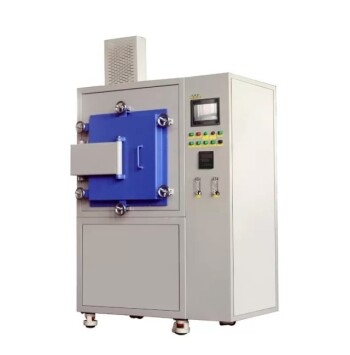
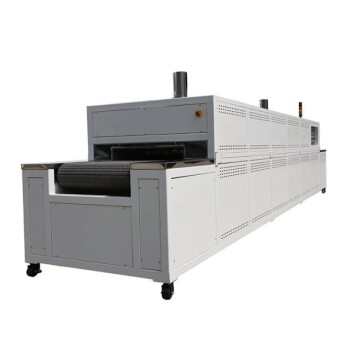
A high-temperature atmosphere furnace is not just a heater; it is a precisely controlled reactor for directing mass transport. The kinetic differences inform every stage of the thermal recipe.
The Two-Step Strategy: Decoupling Densification from Coarsening
Your goal in the final stage is to eliminate porosity without letting the microstructure coarsen. This requires exploiting the differential kinetics.
Favor GB diffusion to close the last pores. Because the densification rate from GB diffusion scales with $G^{-4}$, maintaining a small grain size creates a virtuous cycle. The fine grains fuel rapid GB-mediated densification, which eliminates the pore pinning points before they can be consumed by a rapidly migrating boundary.
Suppress grain boundary migration. This is the critical countermove. By holding at a lower second-step temperature, you reduce the driving force for migration. Grain growth accelerates uncontrollably in the final stage once pores can no longer pin boundaries. A precisely controlled atmosphere furnace allows you to dwell in the kinetic sweet spot where the activation energy favors GB diffusion over migration, achieving full density while effectively suppressing coarsening.
Navigating the Low-Temperature Trap of Surface Diffusion
Not all diffusion leads to densification. Surface diffusion has the lowest activation energy of all thermal transport paths ($Q_s < Q_{gb} < Q_l$).
It dominates at lower temperatures during heat-up, coarsening the neck between particles and smoothing pore surfaces but causing no dimensional change. This non-densifying transport consumes the driving force for sintering and makes final-stage pore elimination harder.
Your process design must account for this. A rapid heating ramp through the low-temperature regime minimizes the time available for wasteful surface diffusion. This conserves the sintering potential, ensuring that when the furnace reaches the target temperature, the high-activation-energy bulk mechanisms—GB and lattice diffusion—can efficiently drive the entire compact toward full densification.
Understanding the Trade-offs
The strategy of harnessing grain boundary diffusion has inherent constraints. It is not a universally free advantage.
Fine starting powders are non-negotiable. The $G^{-4}$ advantage of GB diffusion is parasitic on a small grain size. This demands high-quality, nano- or sub-micron ceramic powders, which are more expensive and can be difficult to disperse and handle without agglomeration. An agglomerate effectively acts as a large, coarse grain, negating the benefit.
The thermal window is narrow. A two-step or lower-temperature soak profile requires exceptional furnace uniformity and control. A small temperature overshoot can trigger runaway grain boundary migration, destroying the fine-grained network and switching the dominant densification mechanism to the slower, $G^{-3}$-dependent lattice diffusion, leaving porosity trapped inside large grains.
Chemical dopants add complexity. While precise dopant additions can shift the kinetic window by altering grain boundary energy and mobility, they introduce a new process variable. Their distribution must be perfectly homogeneous to avoid localized abnormal grain growth, undermining the very microstructural control you sought to achieve.
Making the Right Choice for Your Process Goal
Your process design must align the kinetic mechanism with your overarching objective. Use these heuristics to guide your furnace profile development.
- If your primary focus is achieving maximum density with minimal grain growth: Implement a two-step sintering profile. Exploit the lower activation energy of GB diffusion with a precisely controlled lower-temperature soak to decouple densification from boundary migration.
- If your primary focus is processing coarser, less expensive powders: Rely on lattice diffusion. Recognize that densification will be slower and more thermally demanding, making a long, high-temperature dwell necessary. Your microstructural control will rely more on the initial particle packing uniformity than on kinetic tricks.
- If your primary focus is high throughput and tolerance for some grain growth is acceptable: Maximize the ramp rate to skip surface diffusion and use a single, elevated soak temperature where both lattice and GB diffusion are active. This provides the fastest overall densification rate at the expense of final grain size.
Mastering the sintering furnace means mastering these diffusion pathways, not by reading the equations, but by using them to chart the optimal thermal journey for your material.
Summary Table:
| Feature / Kinetic Metric | Surface Diffusion | Grain Boundary (GB) Diffusion | Lattice (Volume) Diffusion |
|---|---|---|---|
| Grain Size Exponent ($m$) | N/A (Neck smoothing) | $m = 4$ ($G^{-4}$ dependence) | $m = 3$ ($G^{-3}$ dependence) |
| Activation Energy ($Q$) | Lowest ($Q_s$) | Moderate ($Q_{gb} < Q_l$) | Highest ($Q_l$) |
| Densification Effect | Non-densifying (Coarsening) | Rapid densification | Slow/moderate densification |
| Microstructural Impact | Reduces sintering driving force | Shrinks pores, preserves fine grains | Eliminates residual interior pores |
| Furnace Control Strategy | Fast heating ramp to bypass | Two-step sintering (lower soak temp) | Long, high-temperature dwell |
Achieving near-theoretical density while controlling microstructural grain growth requires exact thermal control and atmosphere stability. KINTEK specializes in premium laboratory equipment and consumables, offering a comprehensive range of high-temperature furnaces—including atmosphere, tube, muffle, vacuum, CVD, and rotary furnaces—all fully customizable to meet your specific research and production demands.
Empower your material synthesis with high-precision thermal systems designed to navigate complex kinetic maps. Contact KINTEK today to consult with our laboratory equipment experts and build your custom high-temperature solution!
Related Products
- 1700℃ Controlled Inert Nitrogen Atmosphere Furnace
- 1400℃ Controlled Inert Nitrogen Atmosphere Furnace
- 1200℃ Muffle Oven Furnace for Laboratory
- 1400℃ High Temperature Laboratory Tube Furnace with Alumina Tube
- Laboratory Muffle Oven Furnace with Bottom Lifting
People Also Ask
- Why is thorough binder burnout necessary before sintering advanced ceramics? Ensure Peak Density & Zero Defects
- How does real-time dilatometric analysis in a controlled-atmosphere furnace optimize PZT ceramic sintering?
- How does oxygen partial pressure control affect ceramic sintering? Master Defect Chemistry
- How do controlled-atmosphere furnaces support polymer pyrolysis? Master SiC & Si3N4 Ceramic Conversion
- Why is controlled-atmosphere heating required for functional ceramics and sensors? Master Defect Engineering