
At their core, the key features of modern zirconia sintering furnaces are those that deliver speed, precision, and process integrity. This is achieved through a combination of high-purity heating elements that prevent contamination, advanced PID control systems ensuring temperature accuracy within ±1℃, and user-friendly interfaces for programming complex heating cycles. Features like rapid sintering programs and power interruption recovery are designed to maximize laboratory efficiency and protect against costly failures.
The defining characteristic of a high-quality zirconia furnace is not just its list of features, but its ability to guarantee a repeatable and clean sintering process. This process integrity, driven by precise temperature control and contamination-free heating, is what ultimately determines the strength, longevity, and aesthetics of the final restoration.
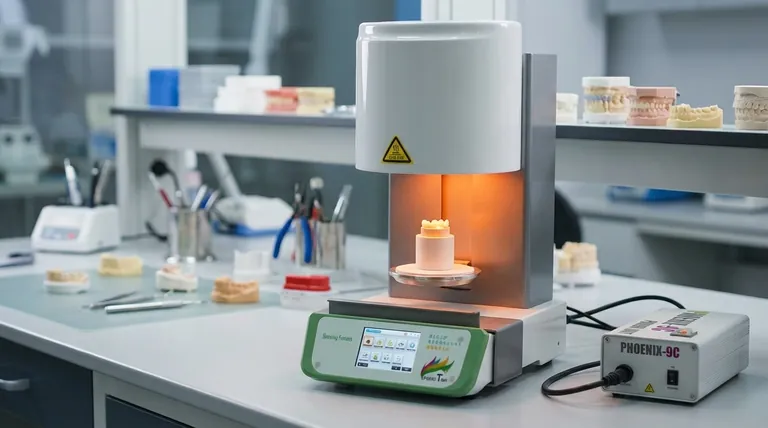
The Anatomy of a Modern Zirconia Furnace
Understanding the purpose of each core component reveals why certain features are non-negotiable for achieving clinical-quality results.
The Heating System: The Heart of the Process
The quality of the heating elements directly impacts the final zirconia. High-purity silicon molybdenum rods are the industry standard for this task.
These specialized elements ensure pollution-free heating, which is critical for maintaining the translucency and shade of the zirconia. They also provide exceptionally even heat distribution throughout the chamber, which is essential for uniform shrinkage and preventing weak spots.
The Control System: The Brains of the Operation
A furnace's intelligence lies in its control system. Modern units use sophisticated PID (Proportional-Integral-Derivative) controllers to manage temperature.
This technology allows for incredibly precise temperature accuracy, often to within ±1℃. This precision is vital for navigating the complex heating and cooling stages without inducing thermal shock, which can cause fractures. These systems are typically managed via a user-friendly color touch screen, allowing technicians to easily program or select pre-set multi-stage cycles.
The Support Systems: Ensuring Reliability
Downtime and failed cycles are expensive. Key support features are designed to create a reliable and resilient workflow.
The power interruption recovery function is a critical feature. If power is lost, the furnace's memory allows it to resume the cycle exactly where it left off once power is restored, saving the restoration and significant time. Furthermore, robust insulation and cooling systems protect the furnace components, ensuring a long operational life.
From Green State to Final Restoration: The Sintering Process
Each furnace feature plays a specific role during the multi-stage sintering cycle.
Stage 1: Pre-Drying and Heating
The cycle begins with a slow ramp-up in temperature. This pre-drying stage gently removes any residual moisture from the "green state" zirconia. Precise control here prevents rapid steam formation that could crack the restoration before the process even truly begins.
Stage 2: Soaking at Peak Temperature
The furnace then heats to a peak temperature between 1350°C and 1600°C and holds it there. This "soaking" phase, lasting from 30 minutes to over two hours, allows the zirconia particles to fuse and the restoration to shrink to its final, dense state. The uniform heat from high-quality elements is crucial for predictable and complete densification.
Stage 3: Controlled Cooling
Perhaps the most critical phase is the slow, controlled cooling. Rushing this step can create internal stresses that lead to warping or cracking. The furnace's PID controller meticulously manages the cool-down rate, ensuring the final restoration is stable and stress-free.
Understanding the Trade-offs: Speed vs. Tradition
The rise of "speed sintering" presents a key decision point for any dental lab or clinic.
The Allure of Speed Sintering
Furnaces capable of completing a cycle in as little as 65 minutes offer undeniable advantages. This enables same-day dentistry, improves workflow flexibility, and reduces labor costs. For many single-unit restorations, the time savings are a massive operational benefit.
The Impact on Material Properties
Independent research indicates that when performed correctly with a validated furnace and material, speed sintering can produce zirconia with equal or even superior strength compared to slower, traditional methods. The key is adhering to the manufacturer's specific protocols for both the furnace and the zirconia pucks being used.
When to Consider Traditional Cycles
Despite the benefits of speed, longer, traditional sintering cycles remain the gold standard for complex, multi-unit bridges or cases requiring maximum marginal fidelity. The slower, more gentle heating and cooling process provides an added layer of security against any potential for warping or internal stress in large, complex frameworks.
Making the Right Choice for Your Goal
Selecting the right furnace depends entirely on balancing the demands of your workflow with the need for uncompromising clinical quality.
- If your primary focus is high-volume production or same-day dentistry: Prioritize a furnace with proven, manufacturer-validated speed sintering programs and a reliable power-recovery function.
- If your primary focus is complex, multi-unit restorations: Emphasize furnaces renowned for their temperature uniformity and precise, programmable slow-cooling stages.
- If your primary focus is research and material development: Consider specialized furnaces, such as vacuum or rotary models, that offer greater control over the sintering atmosphere and heating parameters.
Ultimately, the best furnace is one whose features directly support a repeatable process that guarantees the strength, fit, and aesthetics of your final product.
Summary Table:
| Feature | Key Benefit | Impact on Sintering Process |
|---|---|---|
| High-Purity Silicon Molybdenum Rods | Pollution-free heating | Maintains translucency and shade of zirconia |
| PID Control Systems | Precise temperature accuracy (±1°C) | Prevents thermal shock and ensures uniform shrinkage |
| Speed Sintering Programs | Rapid cycle times (e.g., 65 minutes) | Enables same-day dentistry and high-volume production |
| Power Interruption Recovery | Resumes cycle after power loss | Saves restorations and reduces downtime |
| User-Friendly Interfaces | Easy programming of multi-stage cycles | Simplifies operation for technicians |
Ready to elevate your dental lab's sintering process? Leveraging exceptional R&D and in-house manufacturing, KINTEK provides diverse laboratories with advanced high-temperature furnace solutions. Our product line, including Muffle, Tube, Rotary Furnaces, Vacuum & Atmosphere Furnaces, and CVD/PECVD Systems, is complemented by our strong deep customization capability to precisely meet unique experimental requirements. Whether you need speed sintering for same-day results or precise control for complex restorations, we can help you achieve superior outcomes. Contact us today to discuss how our furnaces can enhance your workflow and deliver reliable, high-quality zirconia restorations!
Visual Guide

Related Products
- Chairside Dental Porcelain Zirconia Sintering Furnace with Transformer for Ceramic Restorations
- Dental Porcelain Zirconia Sintering Ceramic Vacuum Press Furnace
- Vacuum Dental Porcelain Sintering Furnace for Dental Laboratories
- Vacuum Heat Treat Sintering Furnace with Pressure for Vacuum Sintering
- Vacuum Heat Treat Sintering Furnace Molybdenum Wire Vacuum Sintering Furnace
People Also Ask
- What factors determine the quality of sintered zirconia restorations? Master Material, Equipment, and Technique
- How do conventional vs rapid sintering in dental furnaces affect zirconia? Optimize Efficiency Without Sacrificing Strength
- What industries use zirconia sintering furnaces? Beyond Dental and Jewelry Applications
- What type of heating elements are preferred for zirconia sintering and why? Choose SiC or MoSi2 for Optimal Results
- What are the key components of a zirconia sintering furnace? Unlock Precision for Superior Dental Restorations



















