The driving forces are twofold: elastic strain energy relaxation and electrostatic space‑charge interactions. Additive segregation at ceramic grain boundaries during high‑temperature furnace treatments is overwhelmingly governed by these two nanoscale mechanisms. Elastic strain energy originates from the ionic size mismatch between host ions and substituting solutes; electrostatic interaction arises when charged grain boundaries and aliovalent dopants form potential differences that pull solutes into an extended space‑charge layer.
Ceramic grain boundary segregation is a battle between elastic misfit and electrostatic forces. Elastic strain relaxation concentrates solutes within a sub‑nanometer boundary core, while electrostatic space‑charge layers can extend tens of nanometers away. Together, these energies—reaching up to ~140 kJ/mol and ~100 kJ/mol—dictate how solutes redistribute at high temperature, and their interplay is the key to predictable microstructural control in laboratory furnaces.
The Two Dominant Driving Forces for Segregation
The primary reference identifies two fundamental mechanisms that drive additive atoms toward grain boundaries in ionic ceramics. Below, we break down their physical origins and operational scales.
Elastic Strain Energy Relaxation: Misfit‑Driven Segregation
Ionic size misfit between a solute ion and the host lattice ion it replaces creates significant strain in the crystal.
When a solute atom migrates to the structurally disordered grain boundary core, that strain is partially relaxed because the atomic arrangement is already irregular.
The driving force scales with the square of the size misfit, making it especially potent for dopants with substantially different ionic radii.
This relaxation localises solutes within a narrow region—typically less than 1 nm wide—directly at the boundary plane.
The energy contribution can be as high as ~140 kJ/mol, often dominating the total segregation enthalpy.
Electrostatic Space‑Charge Interactions
In ionic crystals, grain boundaries develop a net electrical charge when the formation energies of cation and anion defects are unequal.
Introducing aliovalent solutes (dopants with a different charge state than the host) amplifies this effect, creating a potential gradient.
A space‑charge layer then forms to balance the boundary charge, attracting or repelling charged defects and solute ions over a wider zone—extending from 1 nm to several tens of nanometres from the boundary.
This electrostatic driving force can contribute up to ~100 kJ/mol.
Its strength is exquisitely sensitive to temperature, oxygen partial pressure, and dopant valence, making it a powerful knob for researchers using atmosphere‑controlled laboratory furnaces.
Beyond the Primary Forces: The Full Segregation Enthalpy
While elastic strain and electrostatics dominate, the total segregation enthalpy actually comprises four distinct contributions:
- Interfacial energy difference (up to ~20 kJ/mol)
- Binary interaction enthalpy (up to ~60 kJ/mol)
- Elastic strain energy (up to ~140 kJ/mol)
- Electrostatic interaction energy (up to ~100 kJ/mol)
The latter two regularly outweigh the others, but the binary and interfacial terms matter when designing multi‑dopant systems or evaluating boundary structural transitions.
How High‑Temperature Furnace Conditions Modulate Segregation
The furnace is not just a heat source; the temperature and atmosphere inside directly govern the equilibrium and kinetics of these driving forces.
The Role of Temperature
The thermodynamic relationship for segregation, $X_B^b / X_A^b = (X_B / X_A) \exp(-\Delta E / kT)$, shows that as temperature rises, thermal agitation reduces the equilibrium concentration of solutes at the boundary.
Higher furnace temperatures therefore diminish solute drag—the resistive force that segregated atoms exert on moving grain boundaries—allowing boundaries to migrate faster and approach intrinsic mobility.
This is why precise thermal profiling can switch between solute‑pinned nanostructures and rapid grain growth.
Atmospheric Control and Defect Equilibria
The electrostatic driving force depends critically on oxygen partial pressure and the resulting point‑defect populations.
By adjusting the atmosphere in a high‑temperature tube or vacuum furnace, researchers can shift the grain boundary potential through the isoelectric point, where the net boundary charge becomes zero and segregation behaviour can reverse.
This tunability allows active control over defect equilibria, solute migration, and grain boundary mobility to achieve targeted microstructural outcomes.
Understanding the Trade‑offs
Harnessing additive segregation is a balancing act laden with material and process trade‑offs.
Solute drag versus brittleness. While strong elastic strain segregation can retard grain growth and yield fine‑grained ceramics, it may also embrittle boundaries if solutes accumulate in continuous films.
A deliberate high‑temperature homogenisation step can dissolve such excess segregants back into the matrix, followed by controlled cooling to restore toughness.
Kinetic competition. Elevated temperatures lower the equilibrium segregation concentration, which can erase a beneficial drag force.
Conversely, too low a temperature may not overcome diffusion barriers, leaving the microstructure unaffected.
Finding the optimal soak temperature and dwell time demands iterative furnace runs and, often, post‑treatment characterisation.
Atmosphere sensitivity. Tuning oxygen partial pressure to flip the space‑charge sign is powerful, but it simultaneously affects defect structures, densification rates, and even the volatile loss of dopants.
An atmosphere that minimises unwanted segregation may inadvertently slow sintering kinetics, requiring a careful co‑optimisation of temperature and gas flow.
Making the Right Choice for Your Material System
With the driving forces clarified, your furnace parameters become design levers. Tailor your approach to your primary goal.
- If your primary focus is grain size control: Select dopants with a large ionic radius misfit to maximise elastic strain energy segregation, and exploit moderate temperatures to maintain a consistent solute drag that pins boundaries without causing brittleness.
- If your primary focus is maximising densification: Use atmosphere‑controlled furnaces to tune the electrostatic space‑charge potential; targeting conditions near the isoelectric point can minimise segregation‑inhibited grain growth and help you reach near‑theoretical density.
- If your primary focus is avoiding grain‑boundary embrittlement: Incorporate a high‑temperature homogenisation anneal early in the cycle to dissolve excess segregants, then apply a controlled cooling profile that freezes a non‑embrittling boundary chemistry.
By mastering these driving forces, you transform the laboratory furnace from a simple heating enclosure into a precision instrument for designing the very microstructure you need.
Summary Table:
| Driving Force | Physical Origin | Energy Contribution | Spatial Range | Key Furnace Control Lever |
|---|---|---|---|---|
| Elastic Strain Energy Relaxation | Ionic size mismatch between solute and host lattice | Up to ~140 kJ/mol | Boundary Core (< 1 nm) | Dopant selection & thermal soak time |
| Electrostatic Space-Charge Interactions | Asymmetric defect formation & aliovalent dopant charges | Up to ~100 kJ/mol | Extended zone (1–30+ nm) | Temperature & Atmosphere ($p\text{O}_2$) control |
| Binary & Interfacial Energies | Chemical interactions & boundary energy reduction | Up to ~20–60 kJ/mol | Interfacial plane | Multi-dopant composition balancing |
Master Precision Microstructural Engineering with KINTEK
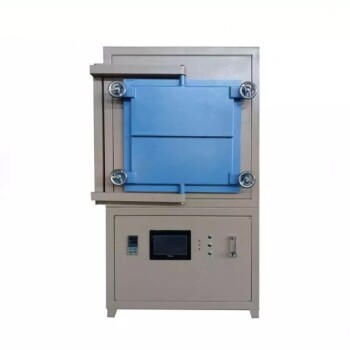
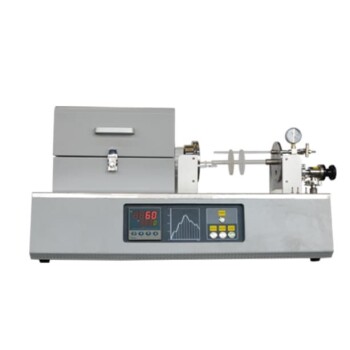
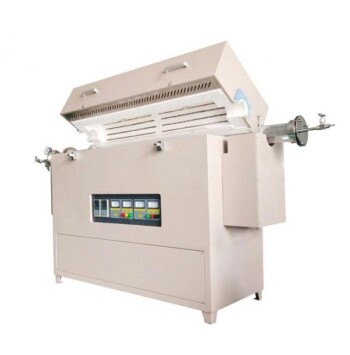
Controlling grain boundary segregation and solute drag requires precise management of thermal profiles and atmospheric oxygen partial pressures. KINTEK specializes in premium laboratory equipment and customizable high-temperature furnaces—including muffle, tube, vacuum, atmosphere, CVD, rotary, and induction melting furnaces—built to give materials scientists complete control over defect kinetics and microstructural evolution.
Whether your goal is preventing embrittlement, pinning grain growth, or achieving theoretical density, KINTEK delivers the reliability and accuracy your research demands. Contact KINTEK today to consult with our experts and design the ideal custom furnace solution for your laboratory!
Related Products
- 1400℃ High Temperature Laboratory Tube Furnace with Alumina Tube
- 1700℃ High Temperature Laboratory Tube Furnace with Alumina Tube
- 1800℃ High Temperature Muffle Oven Furnace for Laboratory
- 1700℃ High Temperature Muffle Oven Furnace for Laboratory
- 1200℃ Muffle Oven Furnace for Laboratory
People Also Ask
- How does zone-melting in tube furnaces synthesize bismuth micro-wires? Master Single-Crystal Thermoelectric Growth
- How do high-temperature laboratory tube furnaces ensure environmental stability? Precision Thermal Reduction Tips
- How are high-temp tube furnaces used to measure diffusion coefficients per Fick's law? Master Precision Annealing
- How are high-temperature laboratory tube furnaces applied in long-term vacuum homogenization heat treatments for intermetallic samples?
- How are high-temperature tube furnaces applied in testing ceramic-supported alloy membranes? Insights