
For smelting precious metals, the primary benefits of an induction furnace are unparalleled control over the process, which ensures maximum material purity and minimizes costly losses. Unlike flame-based methods, induction heating provides a clean, contained, and highly efficient environment that is perfectly suited for high-value materials like gold, silver, and platinum group metals.
The core issue in precious metal smelting is not simply melting the material, but preserving its inherent value. Induction furnaces excel because their fundamental technology is designed to protect assets from oxidation, contamination, and waste, delivering a final product of the highest possible purity and yield.
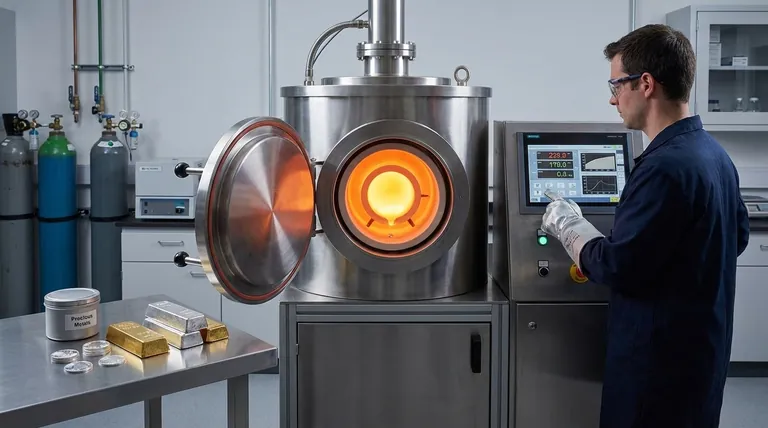
The Core Principle: How Induction Protects Your Assets
To understand the benefits, you must first understand the process. An induction furnace does not use an external flame or heating element to melt the metal.
Contact-Free Heating
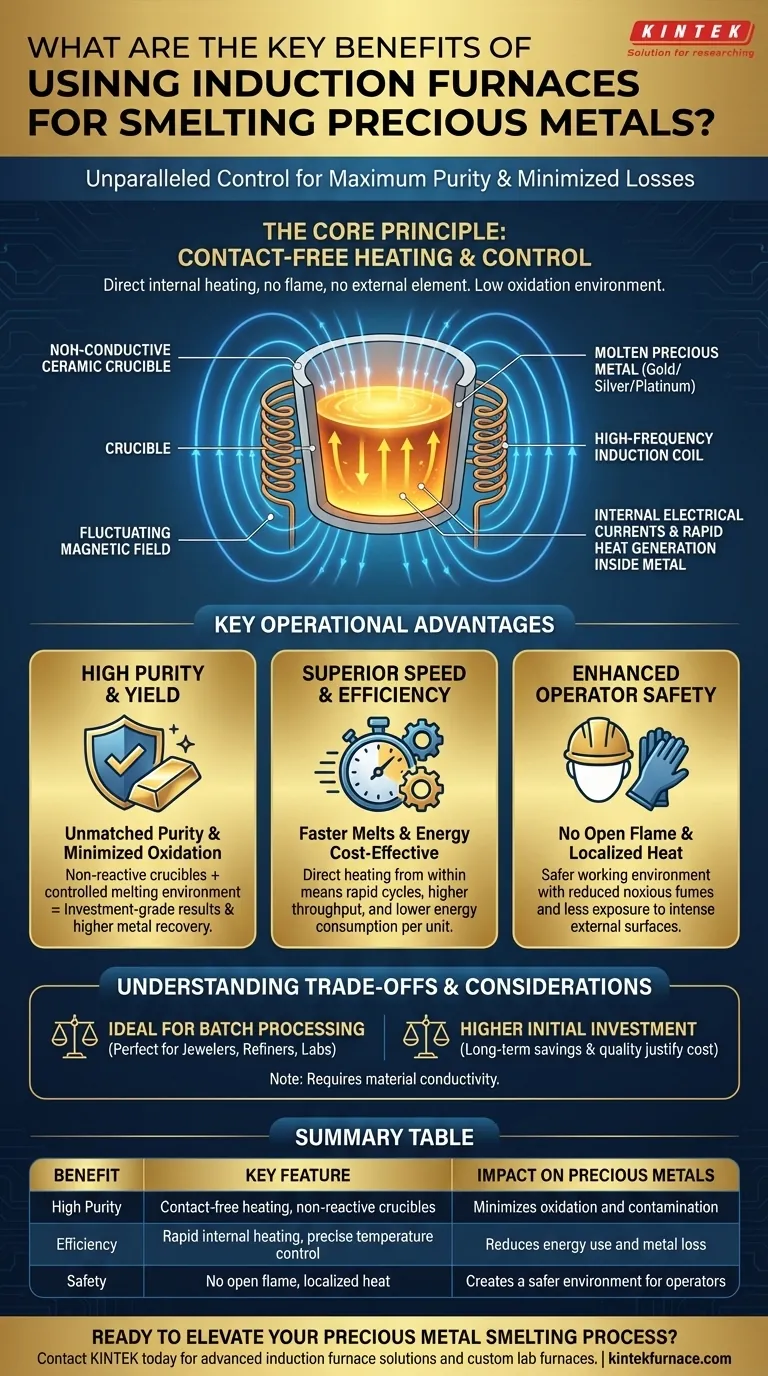
An induction furnace uses a powerful, high-frequency induction coil to create a fluctuating magnetic field. When a conductive material like gold or silver is placed within this field (inside a crucible), the field induces powerful electrical currents directly within the metal itself.
This internal electrical resistance generates precise and rapid heat. The heat originates inside the metal, not from an outside source, leading to an incredibly fast and efficient melt.
A Controlled Melting Environment
Because there is no combustion, the melting process has inherently low oxygen levels. This is critical for precious metals, as it dramatically reduces oxidation—a chemical reaction that can turn a portion of your valuable metal into worthless dross or slag.
This controlled environment means more of your metal ends up in the final bar or casting, maximizing your yield.
The Importance of the Crucible
The metal is held in a non-conductive container called a crucible. For precious metals, these are typically made from specialized, non-reactive materials like graphite or ceramics.
This ensures that no impurities from the container can leach into the melt, which is essential for achieving the high levels of purity required for investment-grade bullion or fine jewelry.
Key Operational Advantages
The unique heating principle of induction furnaces translates into direct operational benefits when working with precious metals.
Unmatched Temperature Precision
Induction systems offer extremely precise temperature control. You can set and hold a specific temperature, preventing the overheating that can vaporize certain metals in an alloy or degrade the material.
This consistency is vital for creating reliable alloys and achieving repeatable results with every melt.
Superior Speed and Efficiency
Since the heat is generated directly within the metal, melts are completed much faster than in traditional furnaces, which must first heat the entire chamber.
This speed translates to higher throughput and lower energy consumption per ounce or kilogram of metal melted, making the process more cost-effective in the long run.
Enhanced Operator Safety
Induction furnaces are significantly safer than fuel-fired furnaces or torch melting. There is no open flame, noxious fumes from combustion, or intensely hot external surfaces.
The heat is localized to the metal inside the crucible, creating a safer and more comfortable working environment for the operator.
Understanding the Trade-offs and Considerations
While highly advantageous, induction technology has specific characteristics that you must consider.
Ideal for Batch Processing
Most induction furnaces are designed for batch processing—melting a specific quantity of material at one time. This is a perfect fit for jewelers, refiners, or labs that handle varying alloys and melt sizes.
However, they may be less suitable than continuous furnaces for massive, single-metal industrial operations that run 24/7.
Initial Investment Cost
The upfront cost of an induction furnace is typically higher than that of a simple gas-fired furnace or torch setup. This is a sophisticated piece of equipment.
This initial investment is often justified by the long-term savings from reduced metal loss, lower energy bills, and higher product quality.
Material Conductivity is Required
The principle of induction heating relies on the material being electrically conductive. This makes it perfect for all metals but unsuitable for melting non-conductive materials like glass or enamel in the same way.
Making the Right Choice for Your Goal
Selecting the right induction furnace depends entirely on your specific application and scale.
- If your primary focus is small-scale artisan work or jewelry repair: A smaller, lower-kilowatt benchtop furnace provides the precision and control needed for bespoke batches without significant waste.
- If your primary focus is medium-scale refining or bullion production: A mid-to-high capacity furnace (e.g., 5kg to 50kg) offers the efficiency and speed required for larger melts while maintaining strict purity control.
- If your primary focus is working with diverse alloys or high-temp platinum group metals: Ensure the furnace and crucible combination is explicitly rated for the temperatures required, as precision is paramount to prevent material loss and ensure alloy integrity.
Ultimately, adopting an induction furnace is about taking direct control over the quality and value of your precious metals.
Summary Table:
| Benefit | Key Feature | Impact on Precious Metals |
|---|---|---|
| High Purity | Contact-free heating, non-reactive crucibles | Minimizes oxidation and contamination for investment-grade results |
| Efficiency | Rapid internal heating, precise temperature control | Reduces energy use and metal loss, increasing cost-effectiveness |
| Safety | No open flame, localized heat | Creates a safer environment for operators handling high-value materials |
Ready to elevate your precious metal smelting process? Contact KINTEK today to explore our advanced induction furnace solutions. Leveraging exceptional R&D and in-house manufacturing, we provide diverse laboratories with high-temperature furnace options like Muffle, Tube, Rotary, Vacuum & Atmosphere Furnaces, and CVD/PECVD Systems. Our strong deep customization capability ensures we can precisely meet your unique experimental needs, helping you achieve superior purity, efficiency, and safety. Get in touch now to discuss how we can support your goals!
Visual Guide
Related Products
- Vacuum Induction Melting Furnace
- 600T Vacuum Induction Hot Press Vacuum Heat Treat and Sintering Furnace
- Vacuum Heat Treat Sintering Furnace with Pressure for Vacuum Sintering
- Small Vacuum Heat Treat and Tungsten Wire Sintering Furnace
- High Temperature Muffle Oven Furnace for Laboratory Debinding and Pre Sintering
People Also Ask
- What are the core functions of the High Vacuum Induction Melting (VIM) furnace? Optimize DD5 Superalloy Purification
- What are the technical advantages of using a Vacuum Induction Melting furnace in the development of advanced packaging steel?
- What are the advantages of using a VIM furnace to control residual oxygen pressure? Achieve Superior Metal Uniformity
- Why is a Vacuum Induction Melting furnace (VIM) used for Cu-Zn-Al-Sn alloys? Achieve Precision Composition Control
- What role does a Vacuum Induction Melting furnace play in the production of high-aluminum nickel-based superalloys?



















