
At its core, a muffle furnace is used for three primary purposes across research and industry: performing high-temperature material analysis, executing precise heat treatments on metals and other substances, and synthesizing new materials. Its applications range from quality control in aerospace and pharmaceuticals to fundamental materials science research.
The defining feature of a muffle furnace is not just its high heat, but its isolated internal chamber (the "muffle"). This design separates the material being heated from the heating elements, ensuring a contaminant-free and highly controlled thermal environment, which is the key to all its applications.
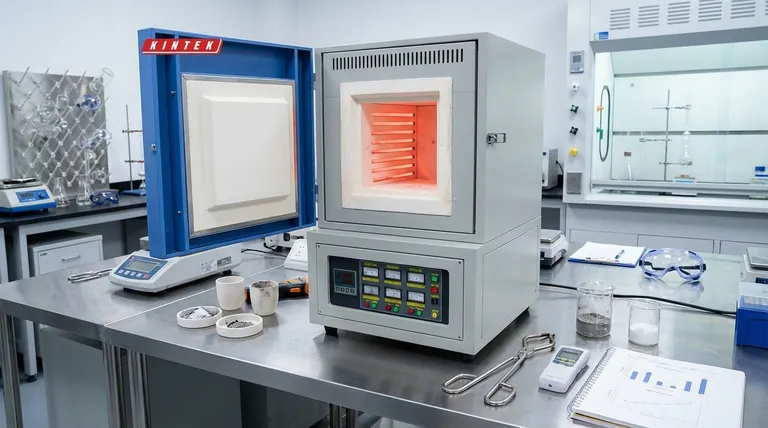
The Core Principle: Controlled Thermal Transformation
A muffle furnace is essentially a high-temperature oven with an insulated chamber. This design ensures that the sample is heated uniformly through convection and radiation, without any chemical interference or contamination from the heating source.
This principle of clean, controlled heating is what makes it an indispensable tool for transforming a material's physical or chemical properties in a predictable way.
Key Applications in Material Analysis and Testing
The most common use for a muffle furnace is to determine what a material is made of. This is achieved by using high temperatures to induce specific changes, which are then measured.
Ashing and Loss on Ignition (LOI)
Ashing is the process of burning away all organic content in a sample to determine the weight of the non-combustible inorganic residue (the ash).
This is critical for quality control in industries like food science, pharmaceuticals, petroleum, and coal analysis to measure filler or impurity content. Loss on Ignition (LOI) is a similar test used in geology and environmental science to measure the weight loss of a sample after heating.
Determining Fundamental Material Properties
Researchers use muffle furnaces to test a material's response to extreme heat. This includes determining melting points, sintering temperatures, or testing the flame retardancy of components used in the aerospace and building industries.
Quality Control for Manufactured Goods
Industries from textiles to plastics use muffle furnaces to verify material composition and strength. For example, a test might involve analyzing fiber content or assessing how a polymer's strength changes after thermal stress.
Applications in Material Processing and Synthesis
Beyond analysis, muffle furnaces are workhorses for creating and refining materials. The controlled environment allows for precise structural changes at a molecular level.
Heat Treatment of Metals
In metallurgy, muffle furnaces are essential for processes that alter the properties of metals.
- Annealing: Softens metal to make it more workable.
- Hardening: Increases the strength and wear resistance.
- Sintering: Fuses powdered materials together below their melting point.
- Brazing: Joins two pieces of metal using a filler material.
Firing Ceramics and Fusing Glass
The uniform, high heat of a muffle furnace is perfect for firing ceramics, dental crowns, and pottery. It ensures even curing and vitrification. In glassmaking, it is used for processes like melting, fusing, and annealing to remove internal stresses.
Catalyst Activation and Material Synthesis
In chemical research, these furnaces are used to activate catalysts or to synthesize novel materials and alloys. The ability to maintain a precise, stable temperature over long periods is crucial for growing crystals or studying phase transitions in new compounds.
Understanding the Trade-offs
While incredibly versatile, a muffle furnace is not the solution for every high-temperature task. Understanding its limitations is key to using it effectively.
Atmosphere Control is Not Standard
A standard muffle furnace operates in an air atmosphere. If your process requires an inert or reactive gas (like nitrogen or argon) to prevent oxidation, you will need a specialized model with gas ports and a sealed chamber, which adds significant cost and complexity.
Temperature Uniformity Can Vary
While designed for uniform heating, temperature zones can exist within the chamber. For highly sensitive processes, sample placement is critical, and a furnace with multiple heating zones or a circulation fan may be necessary to ensure absolute uniformity.
Designed for Batch, Not Continuous, Processing
Muffle furnaces are batch processors. They are ideal for treating individual samples or small groups of items. They are generally not suited for high-volume, continuous industrial production lines, where a tunnel kiln or conveyor furnace would be more efficient.
Making the Right Choice for Your Goal
To select the right approach, align the furnace's capabilities with your primary objective.
- If your primary focus is quality control and analysis (ashing): You need a furnace with excellent temperature accuracy, repeatability, and potentially programmable cycles for standardized tests.
- If your primary focus is metallurgy or ceramics: You need a furnace that can reach your required maximum temperature and hold it with high stability. Durability of the heating elements and insulation is paramount.
- If your primary focus is research and development: You need versatility. A smaller, programmable furnace that can adapt to various sample sizes and heating profiles is often the most valuable choice.
Ultimately, a muffle furnace is a powerful tool for anyone needing to precisely control the transformation of matter with heat.
Summary Table:
| Application Area | Key Uses | Industries/Benefits |
|---|---|---|
| Material Analysis | Ashing, LOI, melting point tests | Quality control in food, pharma, geology; precise composition analysis |
| Material Processing | Annealing, sintering, brazing, ceramics firing | Metallurgy, aerospace, dental; enhances material strength and properties |
| Synthesis & Research | Catalyst activation, material synthesis | Chemical R&D, materials science; enables clean, controlled experiments |
Ready to elevate your laboratory's capabilities with tailored high-temperature solutions? At KINTEK, we leverage exceptional R&D and in-house manufacturing to provide advanced furnaces like Muffle, Tube, Rotary, Vacuum & Atmosphere, and CVD/PECVD Systems. Our deep customization ensures they meet your unique experimental needs for precise heat treatment, material analysis, and synthesis. Contact us today to discuss how our solutions can drive your research and industrial processes forward!
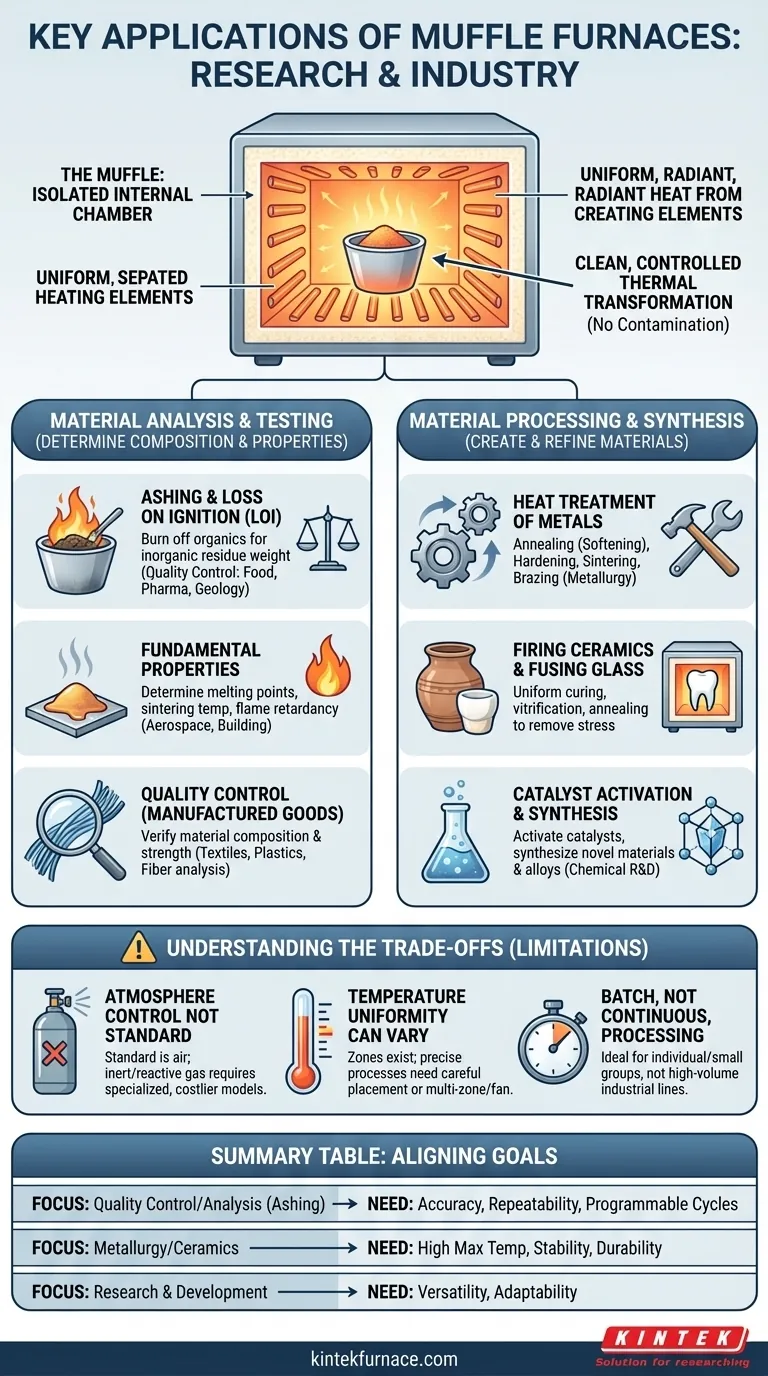
Visual Guide
Related Products
- 1400℃ Muffle Oven Furnace for Laboratory
- 1700℃ High Temperature Muffle Oven Furnace for Laboratory
- 1800℃ High Temperature Muffle Oven Furnace for Laboratory
- 1200℃ Muffle Oven Furnace for Laboratory
- High Temperature Muffle Oven Furnace for Laboratory Debinding and Pre Sintering
People Also Ask
- How does a high-temperature laboratory muffle furnace affect material properties? Transform Anodic Oxide Films Fast
- What is the primary function of a high-temperature laboratory muffle furnace in chemical synthesis? Achieve Precision.
- How is a laboratory high-temperature muffle furnace utilized in g-C3N4 synthesis? Optimize Your Thermal Polycondensation
- How is a laboratory high-temperature muffle furnace used in agloporite preparation? Optimize Material Synthesis
- How does a laboratory high-temperature muffle furnace contribute to the final formation of Bismuth Oxide nanosheets?



















